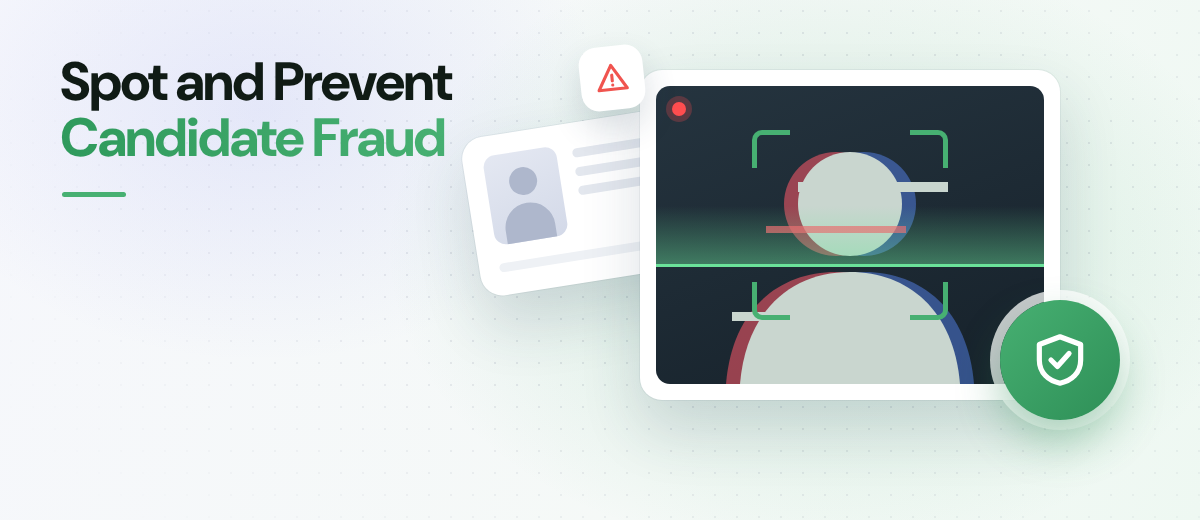
Fake Candidates Showing Up For Interviews: Spot and Prevent Candidate Fraud
On-demand interviewing and AI-powered hiring have expanded access to a global talent pool and enabled screening at scale. But they’ve also exposed the recruiting pipeline to an unprecedented wave of candidate fraud. Hiring teams are no longer dealing exclusively with exaggerated resumes or fabricated employment histories. They now face automated application floods, AI assistance during interviews, synthetic identities, proxy interviewers, and organized operations that use fraudulent identities to secure jobs.
For recruiters, the challenge presented is no longer just determining whether someone has the right qualifications; it is also establishing whether the person applying, interviewing, and eventually joining the organization is who they claim to be.
At volume, you can’t eyeball each candidate. Hiring teams need a combination of professional credential verification, identity checks, interview monitoring, structured assessments, and human oversight to identify suspicious activity without creating unnecessary barriers for legitimate applicants.
The 2027 Candidate Fraud Threat Landscape
Three developments have made candidate fraud more difficult to detect: the growing accessibility of generative AI, convincing deepfakes and synthetic identities, and automated application tools that allow candidates or organized operations to submit applications at scale.
The numbers back this up:
- 75% of hiring leaders and HR professionals in Jobma’s own survey for the 2027 Interview Fraud Prevention Report reported suspected or confirmed hiring fraud in the past 12 months. Only 12.5% said their current hiring tools were fully equipped to prevent it.
- 86% of organizations experienced at least one type of hiring fraud in the past year, according to Checkr’s 2026 survey. The same survey found 68% of managers think job seekers are now better at faking identities with AI than employers are at catching them.
- 6% of 3,000 job candidates admitted to interview fraud, either posing as someone else or having someone pose as them, in a Gartner survey. This is a self-reported figure, so it may not capture the full extent of the problem.
- 28% of candidates admitted to using AI to create fake work samples, according to Greenhouse’s 2025 Workforce & Hiring Report. This highlights the growing difficulty of distinguishing genuine professional experience from AI-generated submissions.
Inside Jobma’s Interview Fraud Prevention Report
The five-part report combines industry insights and survey findings to explore the key challenges shaping today’s hiring landscape, including quality of hire, candidate experience, and hiring integrity.
Each part is focused on one topic. Start with the part most relevant to your hiring team, or read them in order.
Read Part 1: The Growing Challenge of Hiring Fraud
Read Part 2: Detecting Fraud Before the Interview
Read Part 3: Securing Interviews, Assessments & Credentials
Read Part 4: AI, Candidate Experience & Real-World Impact
Read Part 5: Jobma Survey Results: What Hiring Leaders Are Seeing
The consequences extend beyond making the wrong hire. Fraudulent candidates can gain access to confidential information, internal systems, customer data, and company infrastructure. Organizations may also face financial losses, legal exposure, security incidents, and the cost of restarting the recruitment process.
For remote tech roles, the stakes are higher still. Recently, the US Department of Justice announced charges against 14 people in a scheme that placed North Korean IT workers in remote jobs at more than 70 US companies, using stolen and fabricated identities.
The case demonstrates that candidate fraud is not always an isolated attempt to misrepresent qualifications. It can involve coordinated operations designed to gain employment, generate income, and potentially access sensitive company systems.
Different Types of Candidate Fraud
Candidate misrepresentation has shifted from human embellishment to machine-assisted deception. Modern talent acquisition teams face several distinct tactics across the hiring funnel:
The AI-Polished Applicant/ Skillfishing: This is a real person with an inflated profile. This involves a candidate who uses AI-generated content or fabricated credentials to present qualifications they may not actually possess. A resume may closely mirror the job description, while portfolios, coding samples, or writing assignments may be generated using AI tools. During interviews, candidates may rely on rehearsed responses or real-time AI assistance to answer questions they cannot independently address.
Credential Fraud: Fake or expired degrees, certifications, and licenses. This matters most in regulated fields like healthcare and finance, where a false credential creates liability for patients, clients, and regulators, not just a bad hire.
The Proxy Interviewee: Someone other than the applicant takes the interview on their behalf. The stand-in may be a more qualified friend or part of an organized network. It isn’t only a remote-hiring problem. In high-volume, on-site hiring, the person who shows up for the first shift may not be the one who completed the video interview.
The Deepfake or AI Avatar: Real-time face-swapping and voice-cloning technologies have introduced another layer of complexity to interviews. These tools can potentially allow someone to manipulate their appearance or voice during a video call, making it harder for recruiters to establish who is actually participating.
Organized Employment Fraud: Some operations go well beyond the interview. Individuals or networks use fabricated identities and proxy arrangements to get hired, sometimes at several organizations at once. The DOJ case above, which relied on stolen identities and US-based facilitators, is one example. That’s why verification shouldn’t stop at the offer. Teams hiring for roles with access to sensitive systems or data also need sensible post-hire access controls.
Frontline Signals: How Recruiters Can Spot Fake Candidates
When you’re screening hundreds or thousands of applicants, recruiters can’t run deep manual checks on every one, and they shouldn’t have to. Automated checks (covered in the next section) should handle the first pass. The signals below are most useful for shortlisted candidates, or when an automated flag needs a human look. None of them proves fraud on its own. Treat each one as a reason to look closer, not a reason to reject.
1. Digital Footprint & LinkedIn Audits
- Account age and history: Open the profile’s “About this profile” panel to see when the account was created. A profile that’s only a few months old, with little activity, deserves a closer look, especially if the resume claims 8+ years of experience.
- Verification: Check whether the candidate has verified their identity or work email on LinkedIn.
- Network and engagement: No profile photo, a blurry or stock image, very few connections, or no posts and comments at all are yellow flags.
Keep context in mind. A new grad, or someone who’s simply stayed off LinkedIn, can have a thin profile too. For hourly and frontline roles, many genuine candidates won’t have a profile at all, so skip this check there. What you’re looking for is a mismatch between the story on the resume and the footprint online.
2. Signals in On-Demand and Live Interviews
- Use video for screening. A phone screen hides almost every signal on this list. One-way video interviews let you see every candidate on camera without scheduling a single call.
- Response patterns: Some pause is normal. A steady pause before every answer, followed by a fluent response, or eyes that track across the screen as if reading, can point to AI-generated answers or someone feeding lines off camera.
- Background and audio: A virtual background the candidate won’t turn off, combined with overlapping voices or call-center noise, can suggest a proxy interview setup.
- Consistency across stages: Compare the face, voice, and depth of knowledge between the one-way screen, the live interview, and the first day on the job. Proxy fraud often shows up as a mismatch between stages.
3. Unscripted Follow-Up Questions
Ask questions a script can’t anticipate. Start with their own work: “Walk me through what went wrong on that project and what you’d do differently.” Real experience comes with messy specifics. Generated experience tends to stay polished and vague.
Location details work too. “I see your resume lists Midtown Manhattan. How are you liking the neighborhood? What’s your go-to dinner spot around there?” Someone with a fabricated location will often freeze or stay vague. Someone who just moved may hesitate as well, so use this as one signal among several.
Building a Layered Fraud Defense That Works at Scale
A single checkpoint, like a resume review or an unmonitored coding test, leaves gaps. Manual review of every candidate doesn’t scale. What works is a set of layered checks that run automatically on every candidate and send only the exceptions to a person.
- Application Layer (Automated Screening): Deploy detection systems that analyze submission velocity, duplicate IP addresses, browser fingerprinting, and linguistic AI patterns to flag bot-submitted applications before recruiters review them.
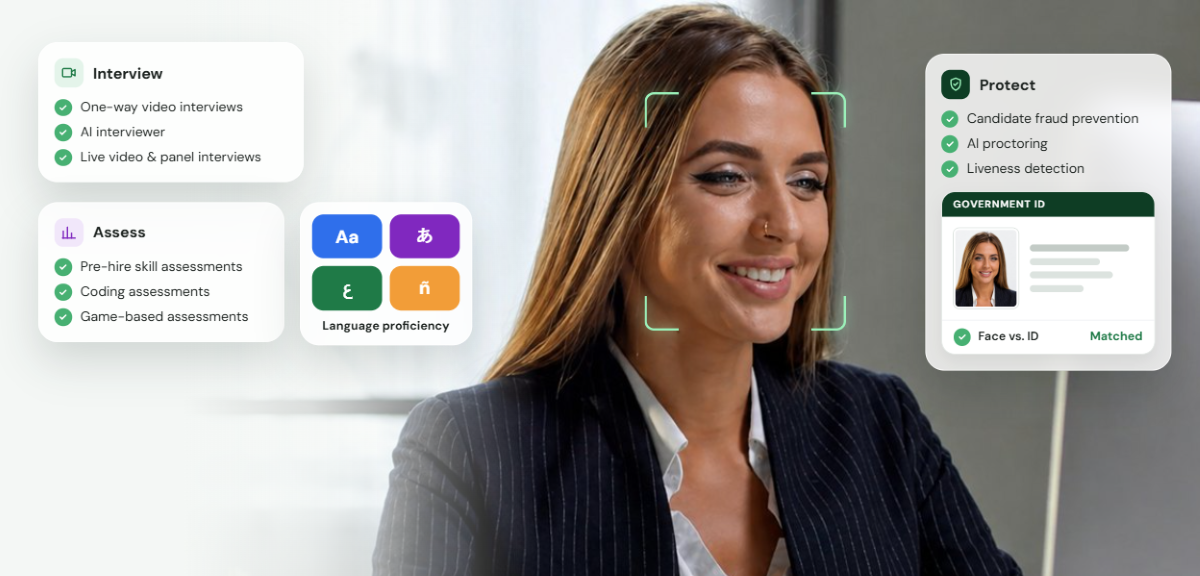
- Pre-Interview Identity Verification: Require government-issued ID validation, facial matching, and liveness detection before technical rounds to confirm the applicant matches their documentation.
- Interview & Assessment Integrity: Proctor one-way, live, and AI interviews for signs of outside help. Use tools that can lock down browsers, detect secondary devices, and analyze response patterns. Each flag should be timestamped so a reviewer can check the moment it happened. Just as important, set clear rules on AI use for interviews, skills tests, and take-home assignments, and share them before the assessment starts.
- Employment & Credential Auditing: Don’t wait for the offer. Validate employment history, education, certifications, and occupational licenses directly with employers and issuing bodies as early as practical.
- Post-Hire Monitoring & Access Control: Confirm that the person who starts is the person you interviewed, whether that’s an ID check at the first on-site shift or in-person equipment pickup where practical. For roles with access to confidential information or production systems, use role-based access permissions and watch for unusual account activity, unexplained absences, or a mismatch between stated location and work activity.
How Jobma Helps Prevent Interview Fraud
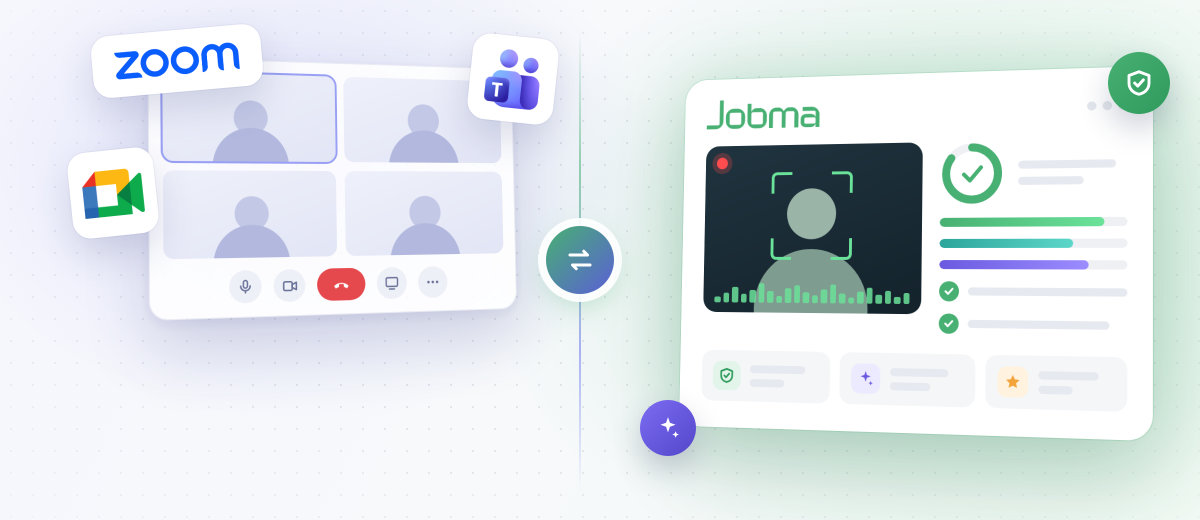
To solve candidate fraud without damaging candidate experience, hiring teams need an end-to-end security architecture. Jobma provides the comprehensive platform solution designed specifically to protect interview integrity, eliminate synthetic candidates, and automate verification across the entire talent pipeline.
Jobma secures the recruitment journey across four core pillars:
1. Built-In ID Verification
Jobma helps verify candidate identity before an interview begins through government-issued ID validation and real-time facial document matching. These checks help establish whether the person attending the interview matches the identity submitted during the application process.
2. AI-powered Interview Proctoring
Take-home tests are easy to outsource. Jobma’s AI proctoring capabilities monitor interview activity and flag potentially suspicious behavior for recruiter review. These include:
- Proxy & Liveness Detection: Detects off-camera feeds, unusual eye movement, or multiple faces in the video frame.
- AI Assistance & Latency Signals: Analyzes response timing and linguistic patterns to flag real-time script reading or LLM co-pilot usage.
- Copy-paste Detection: Identifies copy-and-paste activity during an interview.
- Browser Integrity Monitoring: Tracks unauthorized tab switching, copy-pasting, and secondary screen usage during evaluations.
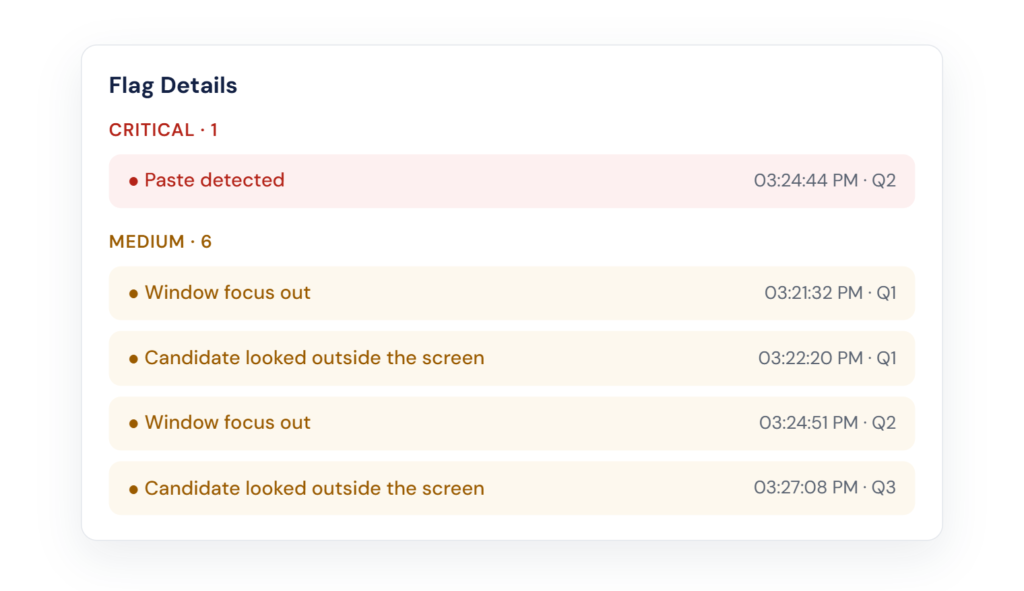
Each flag is timestamped and included in the candidate’s interview record, allowing recruiters to review the relevant activity alongside the candidate’s responses.
3. Structured Evaluations and Human Review
Fraud prevention should not come at the expense of fair candidate evaluation. Jobma provides structured interview kits, evaluation rubrics, AI-generated summaries, and scoring that help recruiters assess candidates against predefined criteria.
Integrity flags can be reviewed alongside interview responses, giving hiring teams additional context when evaluating a candidate. These signals support human decision-making rather than automatically determining whether someone advances or is rejected.
4. Integrated Hiring Workflow
Jobma integrates with existing ATS platforms and supports both integrated and standalone hiring workflows. This allows organizations to incorporate identity verification, interview proctoring, and structured evaluations into their existing recruitment processes without creating unnecessary friction for candidates.
Balance Fraud Prevention with Candidate Experience
Most of your applicants are honest, and they’re already wary. A Gartner survey cited by Personnel Today found only 26% of job candidates trust AI to evaluate them fairly. Pile on intrusive checks without explanation, and you’ll lose good people before you ever meet them.
A few principles keep the balance right:
- Be upfront. Tell candidates what you collect, why you need it, and how long you keep it.
- Match the checks to the risk. An engineer with production access warrants more verification than a seasonal retail role.
- Keep a human in the loop. A lag can be bad Wi-Fi. A thin LinkedIn can be a new grad. Eye movement can reflect neurodivergence or note-checking anxiety, not fraud. Automated flags should send a candidate to human review, never to an automatic rejection.
- Apply the same checks to everyone in the same role. Consistency is fairer, and it’s easier to defend.
Compliance matters here too. Identity verification and liveness checks involve biometric data, and rules vary by location. The EU’s GDPR restricts personal data processing and automated decisions. Illinois’ BIPA requires written consent before collecting biometric identifiers. California’s CCPA/CPRA gives candidates specific privacy rights. Loop in legal before you roll out biometric checks, especially if you hire across states or countries.
Understand Your Privacy and Compliance Obligations
Identity verification and interview monitoring may involve collecting and processing personal or biometric data. Understand the legal requirements:
- GDPR: Biometric data processed to identify an individual receives special-category protection. Organizations must establish an appropriate legal basis and comply with relevant data protection obligations.
- Illinois’ Biometric Information Privacy Act (BIPA): Organizations must provide written notice explaining the collection, purpose, and retention period of biometric information and obtain a written release before collecting covered biometric identifiers or information.
- California’s CCPA/CPRA: Establishes privacy rights for covered individuals, including applicable job applicants and employees, subject to statutory requirements and exceptions.
- EU AI Act: Certain AI systems used for recruitment and candidate selection are classified as high-risk, depending on their intended purpose and functionality.
Before rolling out identity verification or AI-powered monitoring, work with legal and privacy professionals on consent procedures, data retention policies, access controls, and human-review processes. The goal is to strengthen hiring integrity while respecting candidate privacy and keeping the process transparent.
Protect Your Hiring Process Without Compromising Candidate Trust
Candidate fraud isn’t limited to remote roles or to one stage of the funnel. It shows up wherever hiring moves fast and at volume. By pairing recruiter judgment with layered checks that run on every candidate, organizations can make fraud far harder to pull off and hire genuine talent with confidence, at any scale.
One caveat we’d give any buyer: integrity flags and AI scores are decision-support tools, not verdicts. They point your team to what deserves a second look. A person should always make the call.
Take the next step toward smarter, more secure hiring. Talk to an expert.
Frequently Asked Questions
Very common. In Checkr’s 2026 survey of 3,000 US managers, 86% said their organization faced at least one type of hiring fraud in the past year, and 40% had interviewed someone later found to be using a fake identity.
There is no single reliable way to identify a fraudulent candidate. Recruiters should look for inconsistencies across resumes, professional credentials, interview responses, and identity documents. Follow-up questions about submitted work and appropriate identity verification can help establish whether a candidate’s claims are genuine.
Automate the first pass. Build identity verification and proctoring into the interview so they run on every candidate, score responses against structured criteria, and send only flagged candidates to human review. That keeps checks consistent without adding recruiter workload.
Standalone video interviews provide the opportunity to assess candidates on the screen, but they cannot independently prevent impersonation or deepfake-based fraud. Proxy interviewees and sophisticated identity manipulation can still compromise interviews. Organizations should combine video interviews with identity verification, interview monitoring, structured assessments, and human review.
Employers can reduce the risk of proxy interviews by verifying candidate identities before interviews, using selfie-to-ID matching and liveness checks where appropriate, and comparing candidate information across recruitment stages. Structured follow-up questions and live assessments can also help establish whether the person participating has the experience and skills claimed in their application.
Identity verification helps establish whether the person participating in an interview matches the identity provided during the application process. Government-issued ID validation, selfie matching, and liveness detection can provide additional safeguards against impersonation and fabricated identities. These checks should be combined with other interview integrity measures rather than treated as a complete fraud prevention solution.