What are Pre-Hire Skill Assessments, and What are the Best Assessment Platforms for Recruiters?
Resumes alone have never been a perfect measure of someone’s abilities. Two applicants can present near-identical resumes listing the same tools, degrees, and years of experience, yet perform radically differently when they’re hired.
That disconnect is the primary problem skills assessments solve. By replacing guesswork with objective candidate data, skills assessments help talent acquisition teams predict on-the-job performance, shorten hiring cycles, and eliminate unconscious bias.
In this comprehensive guide, we explore what pre-hire skills assessments are, break down the most popular employment tests, evaluate the top 10 pre-hire skills assessment platforms in 2027, and provide a framework for selecting the right vendor for your tech stack.
- Jobma
- Criteria
- iMocha
- TestGorilla
- Mercer Mettl
- Testlify
- Hirevue
- Codility
- Harver
- SHL
What is a Skill Assessment?
A skills assessment (also called a pre-employment test or skills test) is a standardized way to measure a candidate’s knowledge, abilities, or technical competencies against what a specific job requires. Conducted primarily online during the pre-employment screening phase, these assessments use objective scoring metrics to validate whether an applicant possesses the exact qualifications required for a specific role.
Types of Skill Assessments
The U.S. Equal Employment Opportunity Commission (EEOC) outlines specific guidelines regarding employment tests and selection procedures to ensure hiring practices remain non-discriminatory and job-related. Most talent assessment platforms align their test engines across these fundamental categories:
Cognitive Ability Tests: These assessments measure general mental capability, problem-solving, abstract reasoning, numerical logic, and verbal comprehension. They evaluate how quickly a candidate can absorb new information, adapt to changing environments, and solve complex workplace challenges.
Skills & Job Knowledge Tests: Designed to evaluate mastery over specific tools, frameworks, or domain-specific concepts, these tests assess technical capabilities like programming languages, accounting principles, digital marketing tools, or software proficiency.
Personality & Behavioral Assessments: These look at work style and tendencies, such as dependability, cooperativeness, or how someone handles pressure. These should be treated as context for interviews rather than selection filters.
Situational Judgment Tests (SJTs): SJTs present realistic workplace scenarios and ask candidates to choose the most and least effective actions. They measure conflict resolution, prioritization, decision-making, and leadership in a day-to-day context.
Job Simulations & Work Samples: Candidates perform tasks directly mirroring actual job duties, such as writing a sales email, debugging a code snippet, creating a spreadsheet model, or handling a customer service scenario. Work samples are among the strongest predictors of future job performance.
Physical Ability & Medical Examinations: Used primarily for physical roles (e.g., public safety, logistics, field engineering), these tests evaluate strength, endurance, physical agility, and stamina. Under EEOC guidelines, medical exams are administered only after a conditional job offer has been extended.
Language & Proficiency Tests: These evaluate written and spoken communication, reading comprehension, grammar, and pronunciation. They often utilize CEFR-aligned scoring models to ensure candidates can communicate effectively in global or customer-facing environments.
Best Skill Assessment Platforms at a Glance
| Platform | Best For | Standout Capability | Deployment Focus |
| Jobma | Pre-employment Skill Assessments for Any Role Plus Video Screening | Coding challenges, language proficiency tests, gamified challenges, and role-specific screening | Mid-Market Scalable & Enterprise |
| Criteria | Psychometrics & Cognitive Aptitude | Science-backed CCAT & game tests | Growing & Mid-Market Organizations |
| iMocha | Deep Tech & Business English | 10,000+ skills library & AI-LogicBox | IT Services, BPO & Enterprise |
| TestGorilla | Fast Self-Serve SMB Testing | 5-in-1 customizable test batteries | Startups & Mid-Market Teams |
| Mercer Mettl | Scale & Proctored Campus Hiring | High-concurrency proctoring & SpeechX | Large Enterprise & Higher Ed |
| Testlify | Candidate-Centric Screening | Low drop-off UI + multi-role tests | Fast-Growing Teams & Startups |
| Hirevue | Enterprise Video & Simulations | Game-based tests & Virtual Job Tryouts | High-Volume Enterprise |
| Codility | Pure Technical Hiring | Real-world IDE & AI-assisted screening | Engineering & Software Teams |
| Harver | Volume Frontline Hiring | SJTs & automated application flows | Hourly, Retail & Call Centers |
| SHL | Deep Psychometric Benchmarking | OPQ32 & enterprise talent analytics | Enterprise & Global Mobility |
1. Jobma
Best for: Talent acquisition teams looking to evaluate candidate skills and communication abilities in a unified workflow.
Pricing: Custom plans based on hiring volume, integrations, and AI features
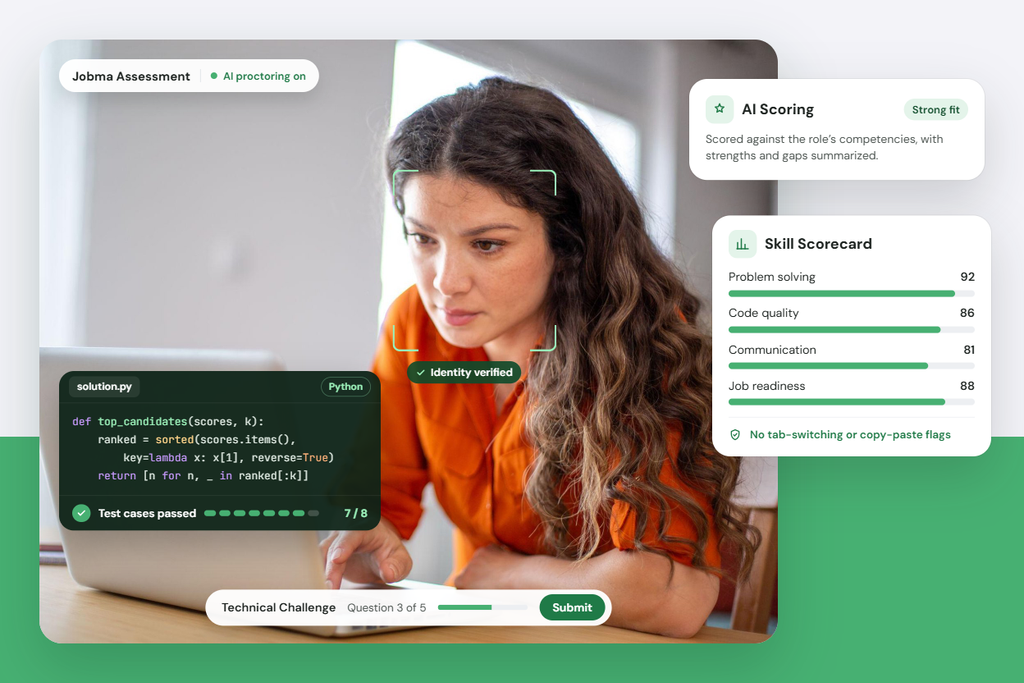
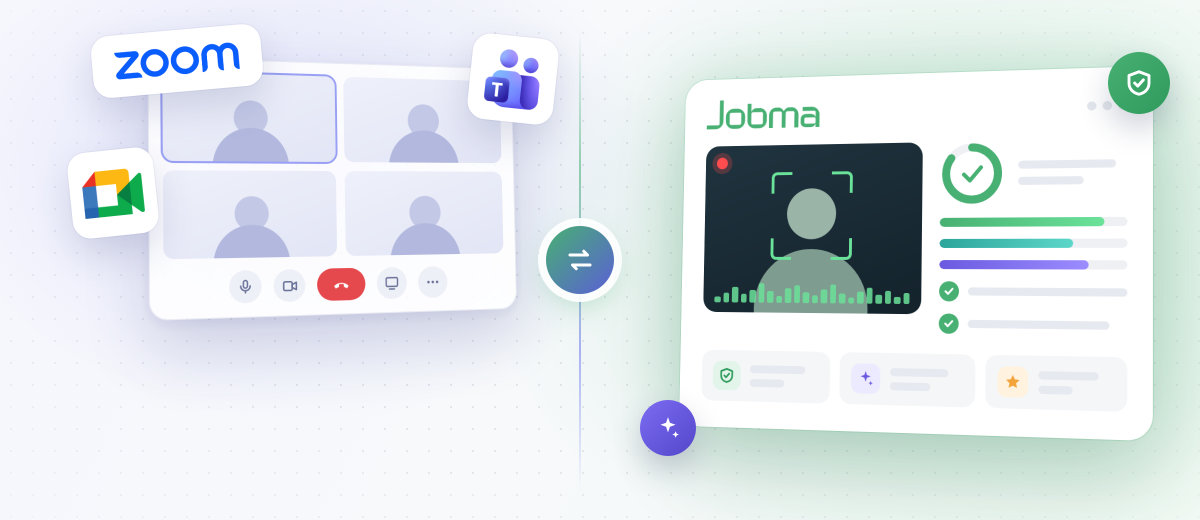
Jobma is an intelligent, human-first hiring platform that unifies pre-employment skill assessments with video screening. Rather than requiring candidates to complete an assessment in one platform and jump to a separate application for pre-screening, Jobma allows talent acquisition teams to build a single candidate flow.
This combined workflow is particularly beneficial for assessing technical and soft skills at scale. Jobma’s AI transcribes and summarizes responses and scores them against job-specific competencies, but those scores are meant to support the hiring team’s judgment, not replace it.
Key Capabilities of Jobma
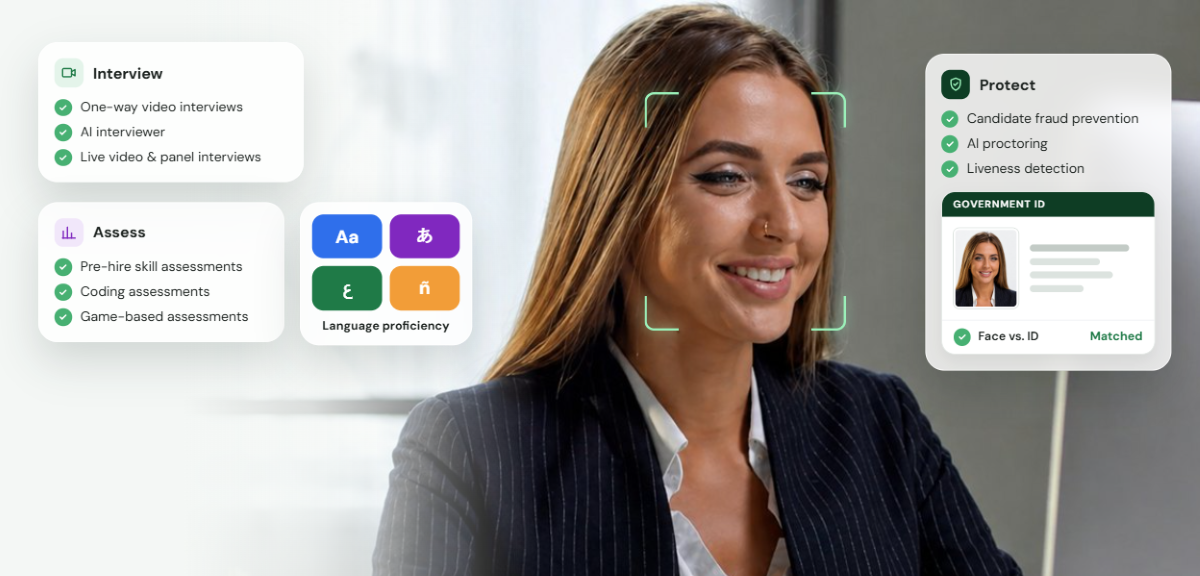
- Broad talent assessment scope, including technical and coding challenges in 20+ programming languages, language proficiency tests, interactive games, and role-based tasks.
- Pre-built interview kits, plus custom assessments with configurable question formats, difficulty, time limits, and evaluation criteria.
- AI-assisted scoring that summarizes responses, highlights strengths and gaps, and supports candidate comparison.
- Built-in ID verification and real-time AI proctoring that flags tab-switching, copy-pasting, and AI assistance.
- Candidates can take tests on mobile, tablet, or desktop, and pause and resume within the allowed window.
- ATS and HR system integrations, including iCIMS, Bullhorn, BambooHR, Workday, and Greenhouse, with a full list on the integrations page.
- SOC 2, ISO 27001, GDPR, and CCPA compliance.
Highly rated on G2 (4.7/5) and Gartner (4.5/5)
Pros
- Candidates can self-schedule for the assessment based on their availability.
- Asynchronous video combined with skill screening significantly cuts initial time-to-interview.
- Interview kits and question types are highly customizable, including newer gamified formats.
- ID verification and non-intrusive AI proctoring features ensure interview integrity.
Cons
- Transparent pricing is not published on the website; quotes require a sales consultation.
- The feature set can get overwhelming for smaller talent teams.
2. Criteria
Best for: Organizations prioritizing validated aptitude, personality, and emotional intelligence tests
Pricing: Three quote-based plans: Criteria Assess, Criteria Interview, and Criteria Hire
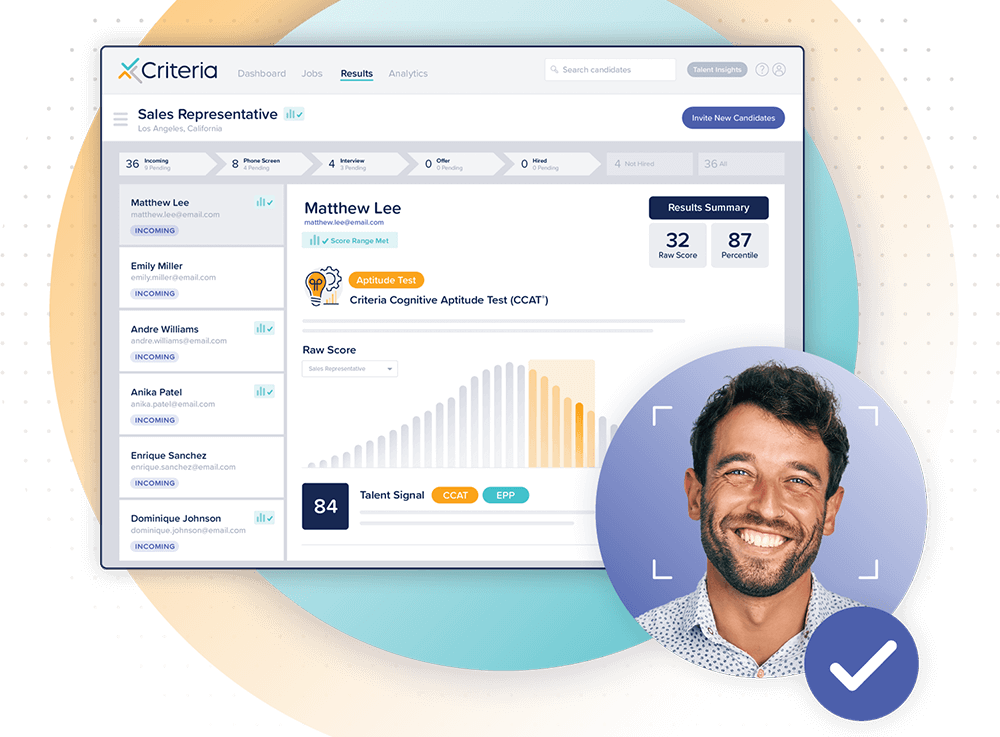
Criteria focuses heavily on psychometric science and employment psychology. Its core platform offers validated cognitive aptitude tests, personality profiles, emotional intelligence screeners, and role-specific skills assessments designed to predict long-term employee retention and performance.
It offers traditional timed tests alongside short game-based and mobile-first assessments, which is beneficial for assessing hourly workers who apply from their phones.
Key Capabilities of Criteria
- Criteria Cognitive Aptitude Test (CCAT), 50 questions in 15 minutes, plus game-based options such as GAME, Cognify, and the language-independent UCognify.
- Criteria Think Reason Solve (CTRS), an adaptive aptitude test that’s screen-reader compatible.
- Personality tests including the Employee Personality Profile (EPP), Illustrait, and role-focused profiles for sales and customer service.
- Emotify, an ability-based emotional intelligence assessment built from three short interactive tasks.
- TestMaker for custom skills tests.
- Integrated video interviewing options with objective scoring guidelines.
- Standard ATS integrations, SSO, and MFA.
Reviews on G2 (4.4/5) Gartner (4.3/5)
Pros
- High psychometric validation across cognitive and aptitude assessments.
- Clear, easy-to-read candidate scorecards and benchmark reports.
Cons
- ATS integrations can require extra setup, particularly for regional or niche software stacks.
- TestMaker custom builder offers limited branching logic and granular per-question timing rules.
3. iMocha
Best for: Enterprises needing an extensive technical library for workplace planning
Pricing: On request

iMocha positions itself as a skills intelligence platform that serves internal mobility and hiring. It features a massive assessment library covering technical, functional, cognitive, and soft skills mapped across hundreds of specialized job roles.
It stands out for communication testing. AI-EnglishPro is a CEFR-aligned English assessment that covers speaking, writing, reading, and listening, which is useful for BPO, IT services, and other customer-facing teams.
Key Capabilities of iMocha
- Pre-built assessment library covering technical, functional, cognitive, and soft skills.
- AI-EnglishPro, scored for grammar, fluency, tone, clarity, and structure.
- AI-LogicBox for assessing algorithmic logic without requiring rigid compiler setup.
- Proctoring suite with webcam and screen monitoring, tab-switch detection, impersonation flags, and timestamped violation logs.
- Async video, live coding, and whiteboard interviews.
Reviews on G2 (4.4/5) and Gartner (3.9/5)
Pros
- Large, customizable library covering both technical and soft skills.
- AI proctoring detects window and image violations to discourage cheating.
- Detailed reports and analytics on candidate strengths and gaps.
Cons
- Platform navigation and dashboard setup present a learning curve for non-technical users.
- High-volume testing reports can occasionally take time to compile during peak server usage.
- A Gartner reviewer noted delays in receiving assessment results.
4. TestGorilla
Best for: SMBs and scaling businesses seeking self-serve pre-employment screening
Pricing: Free plan, Core from $215/mo billed annually; Plus from $520/mo billed annually.
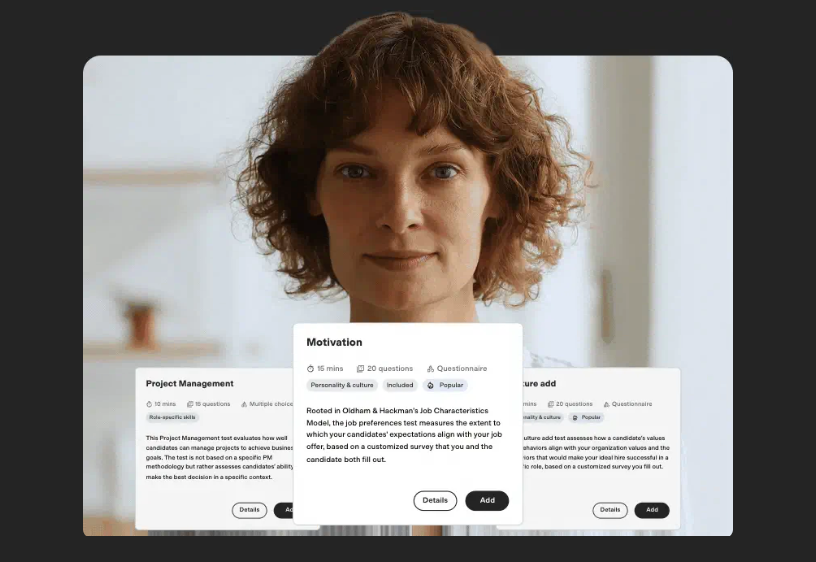
TestGorilla is a popular skills assessment software known for its low entry barrier and transparent model. It allows recruiters to stack up to five individual test modules – covering cognitive ability, programming, software tools, and personality – into a single platform.
Key Capabilities of TestGorilla
- Validated test modules across coding, cognitive, soft skills, and software tools.
- Custom question builder supporting multiple-choice, open essay, file upload, and video response formats.
- Anti-cheating measures such as randomized questions, webcam snapshots (with permission), IP tracking, full-screen detection, and disabled copy-paste.
- Library localized in 12+ languages.
- AI video interviews and ATS integrations on higher-tier plans.
Reviews on G2 (4.5/5) and Gartner (3.9/5)
Pros
- Allows multi-test stacking (e.g., pairing a coding challenge with a personality assessment).
- Candidate ranking and comparison make shortlisting faster and more consistent.
- Free plan lets small teams try it before paying
Cons
- Some general skill tests can feel overly broad for highly senior or specialized roles.
- Their reporting, customization, and integrations are common improvement requests.
5. Mercer Mettl
Best for: High-concurrency remote assessment
Pricing: On request
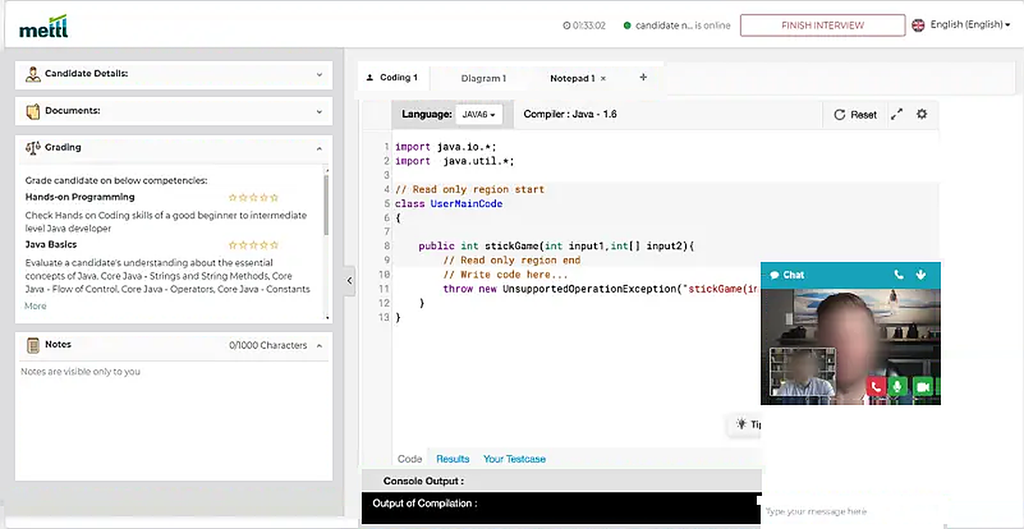
Mercer Mettl offers psychometric, cognitive, technical, coding, and communication assessments, along with an examination and proctoring platform used by both employers and universities. It is capable of massive candidate concurrency and is widely used for university drives and high-volume hiring.
Key Capabilities of Mettl
- Personality, behavioral, cognitive, technical, coding, and communication tests.
- AI-assisted coding assessments with real-world simulators in 20+ programming languages.
- SpeechX, an AI-powered tool for assessing spoken English fluency and pronunciation.
- Secure examination browser with candidate multi-factor authentication.
- Hackathon hosting, virtual assessment, and development centers.
Reviews on G2 (4.4/5) and Gartner (4.7/5)
Pros
- High scalability for university relations and high-volume recruitment programs.
- Robust security architecture with live human and AI proctoring modes.
- Highly customizable test blueprints for enterprise environments.
Cons
- The administration portal interface may feel complex for day-to-day recruiters.
- Custom reports and analytics are less flexible than some users expect.
6. Testlify
Best for: Growing teams that want skills tests and AI interviews
Pricing: Starter plan $89/mo billed at $1,068/year, Custom plan is available on request
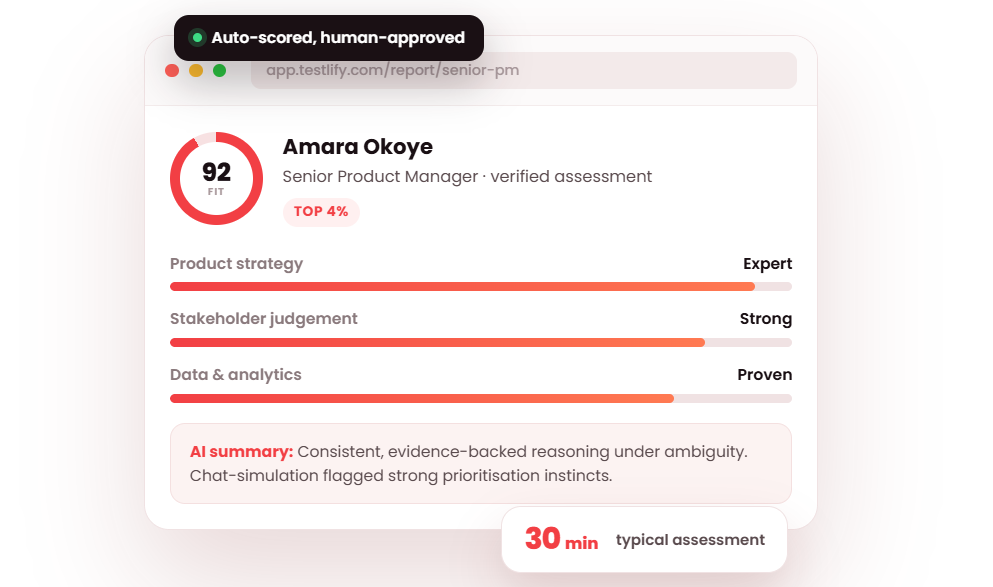
Testlify is a newer, AI-native platform designed around candidate experience. It prioritizes short, engaging assessments and a clean UI. You get role-specific tests, psychometric and situational judgment tests, software simulations, AI interviews, and live coding without stitching together multiple tools.
Key Capabilities of Testlify
- Pre-configured tests, including cognitive, psychometric, language, and situational judgment.
- Software simulations for Excel, Google Sheets, Word, and G Suite
- Built-in live coding environments and anti-cheating features.
- Supports integrations, including Workday, SAP SuccessFactors, Lever, Greenhouse, and BambooHR.
- SOC 2 Type 2, ISO 27001, GDPR, and CCPA compliance
Reviews on G2 (4.7/5) and Gartner (4.9/5, 3 reviewers)
Pros
- Fast setup with minimal configuration friction.
- AI-assisted grading with customizable evaluation factors.
- Competitive pricing for small and mid-sized teams.
Cons
- Reporting metrics lack the deep psychometric benchmarking offered by legacy platforms.
- Advanced customization options for complex logic branch questions are limited.
- Users also report wanting more integrations and detailed reporting.
7. Hirevue
Best for: Enterprises that use gamified job simulations and video interviews together.
Pricing: Available on request, post-demo
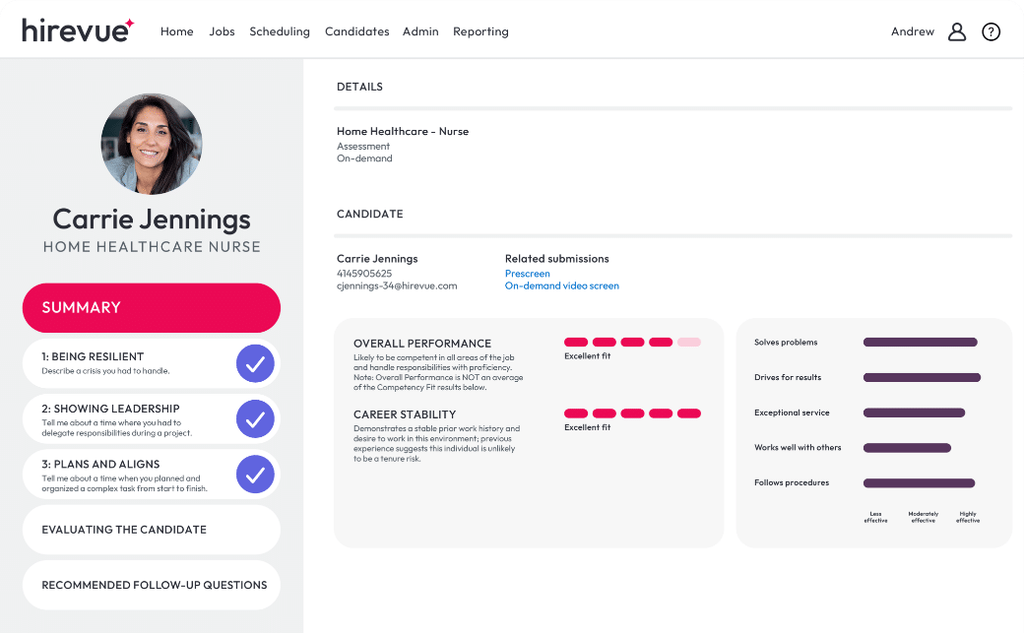
Hirevue combines game-based assessments, Virtual Job Tryout simulations, AI-scored interviews, and coding challenges. Built primarily for enterprise volume (e.g., retail, graduate programs, customer service), Hirevue handles high-volume candidate intake through automated workflows.
Key Capabilities of Hirevue
- Game-based assessments measuring problem-solving, attention, memory, and learning agility.
- Virtual Job Tryout simulations that let candidates experience realistic tasks for the role.
- Auto-scored coding assessments and language proficiency tests.
- Assessment Builder for ready-made, lightly adapted, or fully tailored assessments.
- On-demand and live video interviewing on the same platform.
Reviews on G2 (4.1/5) and Gartner (4.4/5)
Pros
- Virtual Job Tryouts simulations mirror day-to-day job scenarios.
- Highly efficient for screening tens of thousands of applicants systematically.
- Smooth end-to-end scheduling and video interview integrations.
- Strong compliance and algorithmic auditing governance.
Cons
- Reviewers report technical issues, including bugs and audio glitches
- Integration issues come up more often than for most platforms here
- Pricing is a barrier for SMBs.
8. Codility
Best for: Engineering recruiters screening and interviewing developers
Pricing: From $800/month or $4,800/year; Enterprise on request
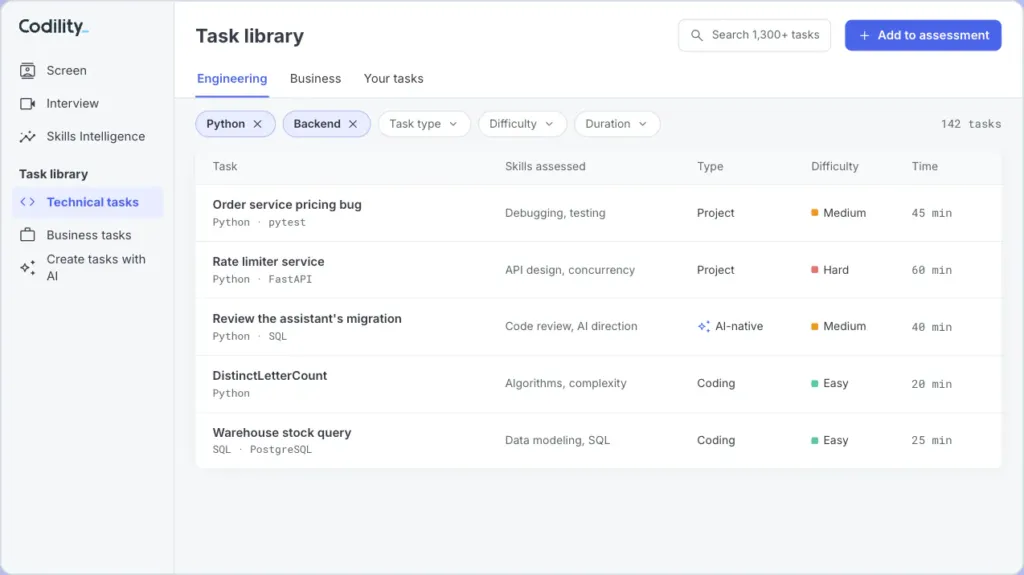
Codility focuses exclusively on technical talent acquisition. Its core offerings – CodeCheck (take-home technical assessments) and CodeLive (interactive live pair-programming) – allow hiring teams to evaluate real-world developer capabilities using realistic codebases.
Key Capabilities of Codility
- Validated tasks on Enterprise plans, plus a task builder for custom content.
- Real-world IDE environment featuring modern AI assistant options (allowing evaluation of how developers write code alongside AI tools).
- Video proctoring, ID verification, interview recording, and a desktop app that flags unauthorized apps on the Enterprise plan.
- Integrations with 20+ ATS and HR systems, including Greenhouse, Lever, Ashby, Workday, and SAP.
- Skills Intelligence for mapping an existing engineering team’s capabilities.
Reviews on G2 (4.6/5), not available on Gartner
Pros
- Real-world coding tasks instead of trivia-style questions
- AI detection flags suspicious behavior so interviewers can focus on problem-solving
- Detailed reports, code playback, and well-rated customer support
Cons
- The coding environment isn’t a full IDE, with limited debugging and unclear test-case output.
- Hidden test cases and inconsistent difficulty frustrate some candidates
- Setup and navigation for advanced features can be confusing
9. Harver
Best for: High-volume hiring
Pricing: On request
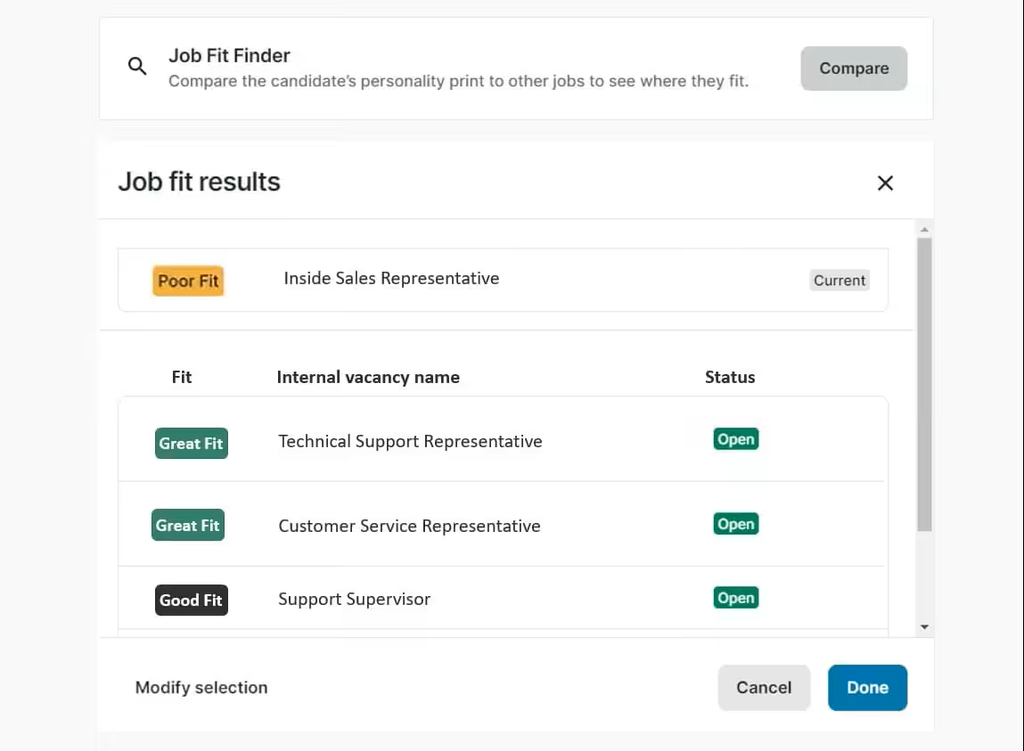
Harver is built to automate volume recruitment pipelines. Utilizing situational judgment tests, typing checks, and realistic job previews, Harver filters large applicant pools quickly while giving candidates a clear window into daily job responsibilities.
Its video-based situational judgment tests double as realistic job previews. Candidates see what the job actually involves, which helps them self-select out early if it’s not a fit and can reduce early turnover.
Key Capabilities of Harver:
- Assessments covering cognitive ability, personality, situational judgment, learning agility, multitasking, typing, and language proficiency.
- Video-based SJTs and realistic job previews built by I/O psychologists.
- Automated screening, candidate matching, and interview self-scheduling.
- Candidates can apply to multiple roles and locations in one flow.
- Harver Insights dashboards for time-to-hire, drop-off, and bias monitoring.
Reviews on G2 (4.6/5) and Gartner (4/5, 3 reviews)
Pros
- High scores for ease of use, setup, and administration.
- Automation saves recruiters substantial time on screening and reference checks.
- Realistic job previews help lower early employee turnover.
Cons
- Less suited for specialized, executive, or highly technical corporate roles.
- Custom assessment build-outs require strategic implementation support.
10. SHL
Best for: Organizations requiring validated psychometric testing
Pricing: On request; some assessments available through SHL’s online store
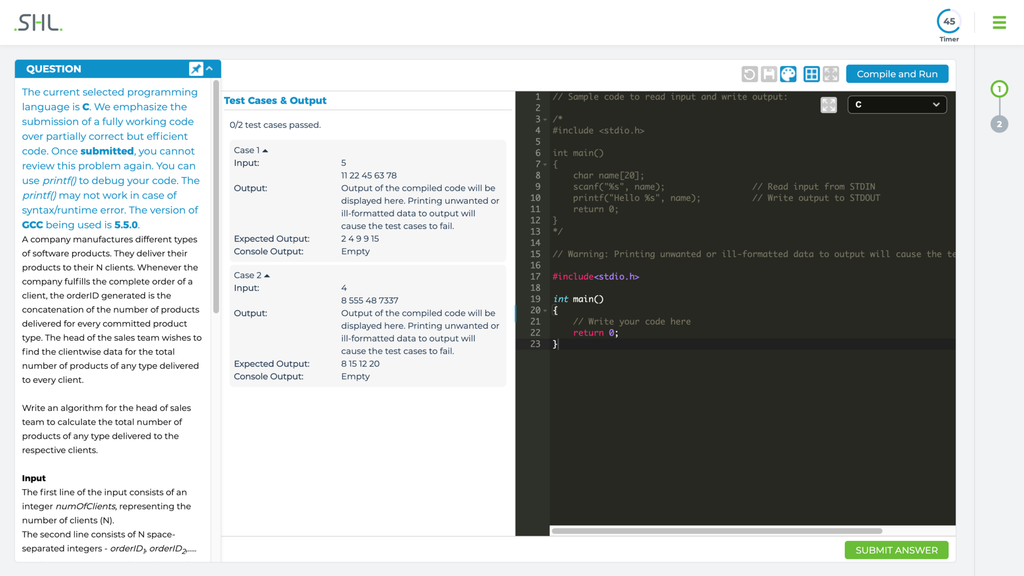
SHL has a long-standing name in talent assessment. Powered by extensive organizational psychology research, SHL delivers assessments spanning graduate screening, individual contributor skill testing, and executive leadership benchmarking.
Their Occupational Personality Questionnaire (OPQ) and Verify cognitive tests are widely used benchmarks.
Key Capabilities of SHL:
- Personality tools, including OPQ and the Motivation Questionnaire (MQ).
- SHL Verify cognitive tests, including Verify G+.
- Situational judgment tests and job-focused assessments.
- Skills and simulations for call center, business skills, coding, technical skills, and language.
- Video interviews and virtual assessment and development centers.
Reviews on G2 (4.3/5) and Gartner (4.3/5)
Pros
- Can be configured to the exact role and employee type you’re testing
- Handles high-volume campus and bulk hiring well
- Detailed reports show each candidate’s strengths and development areas
Cons
- Some Gartner reviewers say the UI and workflows don’t feel smooth and reporting is limited.
- Platform user interface feels legacy compared to modern AI-native entrants.
- Setting up custom candidate workflows requires platform training.
How to Choose a Pre-Employment Assessment Tool
Start with the hiring problem you’re trying to solve, not the size of a vendor’s test library. A platform with 10,000 tests won’t help if none of them match the work your new hire will actually do. Here’s a practical checklist you can use for vendor selection:
1. Name Your Bottlenecks First
Is the problem too many applicants, unverified resume claims, or inconsistent interviewer decisions? Volume problems point to automated screening, resume claims point to job-specific skills tests, and inconsistency points to structured interviews and scorecards.
2. Match Test Types to Your Roles
List the roles you hire for most and the skills each one depends on. Engineering-heavy teams need real coding environments. Customer-facing teams need language and situational judgment tests. Graduate programs often lean on cognitive and personality tests.
3. Ask for Validation and Adverse Impact Data
The EEOC is clear that employers remain responsible for a test’s validity, even when a vendor provides it. Ask each vendor how its tests were validated, who built them (for example, I/O psychologists or subject-matter experts), and whether it can share adverse impact analysis. Also confirm how candidates can request accommodations.
4. Review How AI is Used
Many platforms now use AI to score video answers, essays, or gameplay. Ask what the AI scores, how the model monitors for bias, and whether recruiters can review and override results. AI scores should support human judgment, not replace it.
5. Test the Candidate Experience Yourself
Take the assessment as a candidate would, on both a laptop and a mobile phone. Review how long it takes, whether instructions are clear, and whether it feels relevant to the job. Long, generic test batteries tend to increase drop-off, especially for hourly roles.
6. Look at Integrity Features & How They Prevent Candidate Fraud
With AI tools widely available to candidates, continuous interview proctoring matters more than ever. Look for tab-switch and copy-paste detection, liveness detection and candidate ID checks for high-stakes roles, and randomized question pools. Then balance that against candidate comfort, since heavy monitoring may feel intrusive depending on how it’s implemented on some platforms.
7. Confirm Integrations and Security
Make sure assessment results flow back into your ATS without manual work. Your IT team will also want to see security certifications, such as SOC 2 or ISO 27001, and data privacy compliance like GDPR and CCPA.
8. Calculate the Total Cost and ROI
Compare pricing models carefully. Some vendors charge per candidate or invite, others use flat annual plans, and enterprise tools often add implementation and support fees. Estimate your annual candidate volume before you compare quotes. Jobma keeps an ROI Calculator to calculate your hiring savings as well, ahead of implementation.
Upgrade Your Pre-Employment Skill Assessment Process with Jobma
Most hiring teams run skills tests in one tool and interviews in another. Candidates get two sets of invitations, recruiters juggle two dashboards, and the full picture of a candidate only comes together in someone’s spreadsheet.
Jobma brings both into one flow. You can pair a technical assessment, a language check, or a scenario-based task with a one-way or live video interview, so you see what a candidate knows and how they communicate it before the first live conversation.
Here’s what that looks like in practice:
- Build once, reuse often: Start from pre-built kits or create custom assessments with your own questions, difficulty, and scoring rules.
- Keep reviews consistent: Every candidate is scored against the same job-specific competencies, and AI summaries help reviewers move faster. Final decisions stay with your team.
- Protect integrity: AI proctoring flags tab-switching, copy-pasting, and AI assistance, so you can trust what you’re reviewing.
- Work inside your stack: Results sync with your ATS, and the platform is built with SOC 2, ISO 27001, GDPR, and CCPA compliance in mind.
Want to see how much Jobma could save your team? Try the recruitment ROI calculator or request a demo to get a personalized walkthrough.
Frequently Asked Questions
A skills assessment objectively measures a job applicant’s role-specific abilities, cognitive skills, or behavioral attributes before an offer is made. It helps hiring managers filter candidates based on verified competency rather than resume claims alone.
The terms are often used interchangeably. Strictly speaking, “pre-employment test” is the broader category, covering cognitive, personality, identity, and background verification tests, while a skills assessment focuses on job-specific abilities.
Yes. Pre-employment assessments are legal under EEOC guidelines provided they are job-related, consistent with business necessity, non-discriminatory, and administered fairly with appropriate accommodation options for candidates with disabilities.
They can try, especially with AI interview assistant tools. Most platforms combat this with randomized questions, time limits, tab-switching and copy-paste detection, webcam snapshots, and ID verification. Pairing a test with a short video answer, where candidates explain their reasoning, also makes it harder to fake.
No. AI scoring can speed up reviews and add consistency, but it should always be human-in-the-loop by design. Look for compliant vendors that explain what their AI evaluates and let your team review and make the final call.