How do Enterprise Recruiting Teams Evaluate Interview Platforms?
Hiring teams are managing more complexity at every stage of recruitment. Application volumes have risen sharply, while recruiters are expected to evaluate candidates more carefully and move them through the process efficiently. Ashby found that applications per hire tripled between 2021 and 2024 and remained above 300 throughout 2025. This increased workload has landed largely on recruiting teams.
At the same time, hiring is becoming more skills-focused and more rigorous, with nearly 70% of employers now using skills-based hiring. Technology is becoming part of the response. Sixty-seven percent of companies plan to increase their investment in AI and recruitment automation in 2026. AI interviews are also moving into the mainstream: 63% of job seekers surveyed by Greenhouse have now experienced an AI interview, up 13 percentage points in six months.
But adding technology alone does not solve the problem. Candidates increasingly expect hiring processes to be transparent and well structured, particularly when AI is involved. The real opportunity is to use technology where it can genuinely reduce workload while improving how candidates are evaluated.
Choosing The Right Interviewing Platform
Smart interviewing platforms can help teams manage high application volumes, standardize evaluations, automate repetitive tasks, surface useful candidate insights, and maintain human oversight throughout the decision-making process. That’s a significant responsibility for a single platform.
The challenge is that almost every vendor claims to solve the same problems. Browse a handful of product websites, and you’ll see familiar promises – AI-powered interviewing, workflow automation, ATS integrations, analytics, candidate engagement, and faster hiring.
But organizations rarely make buying decisions based on feature lists alone.

Let’s take a look at what matters while evaluating interviewing platforms for your enterprise hiring needs:
1. Hiring Efficiency and Return on Investment
Recruiters now handle 93% more applications and 40% more open roles than they did in 2021, even as recruiting teams have become smaller. That makes efficiency more than a productivity metric. The right interview platform should take work out of the process, from scheduling and candidate coordination to interview reviews and feedback collection.
Asynchronous interviews, automated scheduling, AI-generated summaries, and centralized feedback can help teams move candidates forward without adding more administrative work. When those workflows scale, recruiters can spend more time evaluating candidates and less time managing the process.
Those efficiencies are highly valuable at scale. Faster hiring cycles reduce the cost of unfilled roles, streamlined workflows improve recruiter productivity, and automation allows hiring teams to manage these higher hiring volumes. The result is measurable improvements in time-to-hire, cost-per-hire, and overall recruiting ROI.
2. Hiring Quality and Decision Confidence
Hiring decisions improve when every candidate is evaluated through a structured and consistent process. With recruitment becoming more skill-focused, modern interview platforms help identify top candidates by combining multiple interview formats, skill-based assessments, standardized scorecards, and collaborative evaluations within a single workflow. Instead of relying on fragmented feedback across multiple systems, this provides a complete view of each candidate’s skills and role-fit.
AI further strengthens human decision-making by surfacing insights. Interview summaries, searchable transcripts, contextual recommendations, and intelligent interview assistants keep reviews more efficient. You can compare candidates side-by-side and identify areas of improvement without replaying entire recordings. This leads to more informed hiring decisions, greater alignment across interviewers, and a more consistent evaluation process across teams and locations.

Compatibility with Existing HR Tech Tools
On average, talent teams use a minimum of 5 tools in their hiring process. That makes compatibility an important consideration when choosing an interviewing platform. Can it connect with your ATS, HRIS, identity management, and productivity tools without creating another silo? Can candidate and interview data move between systems without recruiters having to enter the same information twice?
Look beyond the number of integrations a vendor offers. Consider how well the platform fits into your existing workflows, how much manual work it removes, and whether your IT team will need to maintain custom workarounds. The right connectivity should make the interview process feel like a natural part of your existing hiring stack, while giving recruiting and HR teams the flexibility to scale as their needs change.
4. Smart Insights
AI has a useful role to play in interviewing, but candidates are increasingly sensitive to how that role is defined. They expect employers to be transparent about AI use in pre-recorded interviews and to keep human involvement visible throughout the evaluation process. Clear communication and human oversight can make AI-enabled interviews feel more trustworthy and less impersonal.
This makes transparency and human oversight part of the technology evaluation. Look for AI that can summarize interviews, surface relevant candidate insights, generate transcripts, suggest follow-up questions, or flag potential integrity concerns while keeping recruiters responsible for the final decision.
Configurable AI features and clear explanations of how AI is used can also help organizations build processes that are easier to communicate to candidates and easier for hiring teams to govern.
5. Scalability, Governance, and Security
Recruitment becomes increasingly complex as organizations expand across business units, regions, and global teams. Platforms with role-based permissions, configurable workflows, centralized administration, and detailed audit trails allow organizations to scale hiring without losing visibility or control. This balance enables organizations to scale recruiting operations without sacrificing visibility, consistency, or administrative control.
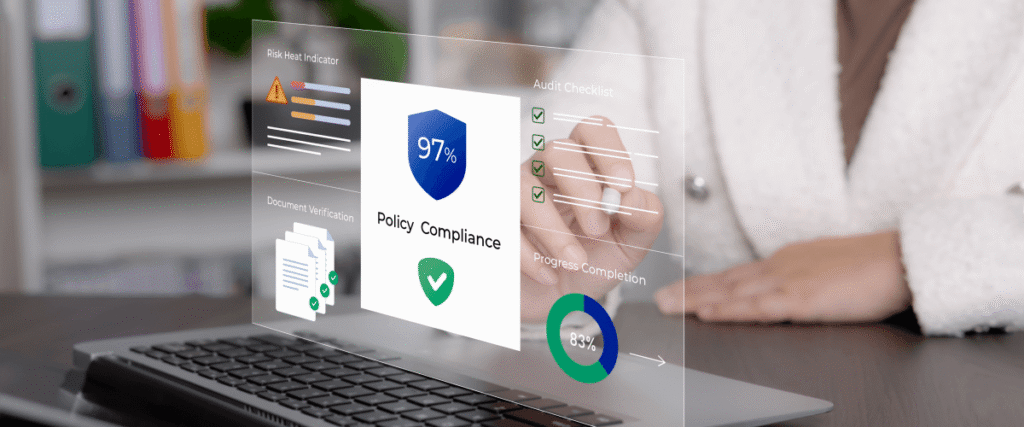
Security and compliance are equally important for long-term success. It can be backed by enterprise-grade security controls like SOC 2 Type II and ISO 27001, compliance with GDPR and CCPA, responsible AI governance, and robust identity management. This is crucial to protect sensitive candidate information, meet internal procurement requirements, and reduce risk across distributed hiring operations. The result is a platform that supports both business growth and organizational resilience.
6. User Experience and Adoption
Only 26% of job seekers report having a great candidate experience. That puts pressure on employers to make every stage clear and easy to complete, particularly when interviews are conducted at scale. Meanwhile, 72% of candidates expect the recruitment process to take three weeks or less. [Source]
For recruiters, that means straightforward workflows and less technical troubleshooting. Hiring managers need quick access to recordings, evaluations, and candidate insights. Administrators need simple ways to manage users and permissions. Candidates should be able to access and complete interviews across common devices and network conditions without unnecessary friction.
Adoption is ultimately a measure of how well the platform works for all of these groups. When the experience is intuitive on both sides of the hiring process, teams are more likely to use the platform consistently, and candidates are less likely to drop out along the way.
Three Enterprise Interview Platforms Worth Considering
Once you’ve identified the capabilities that matter most, the next step is narrowing your shortlist.
There are dozens of interview platforms on the market today, and many of them cover the fundamentals. The challenge isn’t just finding software that can conduct video interviews but one that supports complex hiring workflows, integrates with existing systems, scales across business units, and continues delivering value as hiring needs evolve.
1. Jobma
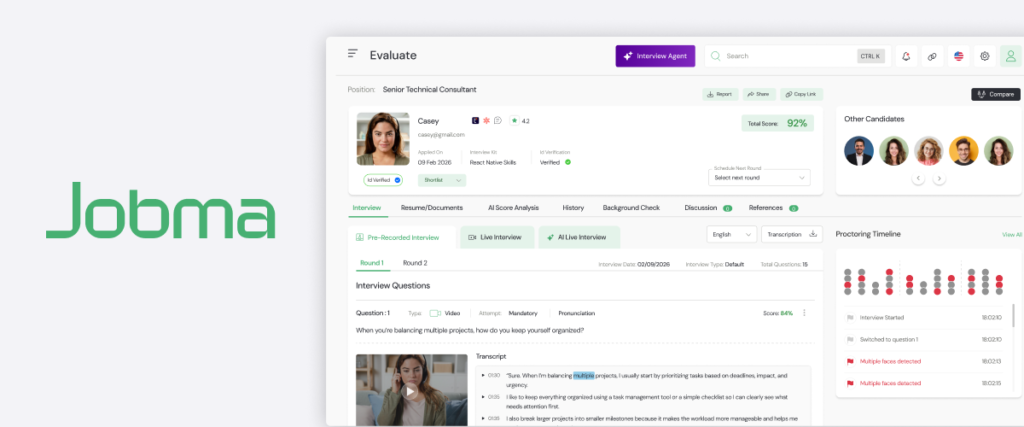
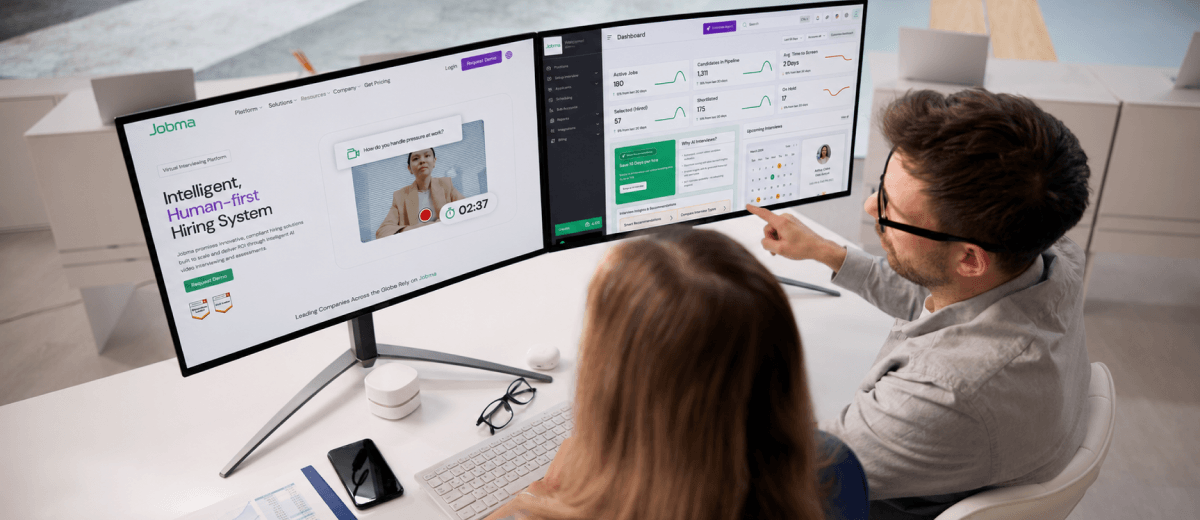
Jobma is designed for enterprises that want to standardize and scale hiring without introducing additional complexity. Rather than relying on multiple point solutions for interviews, assessments, and candidate evaluations, organizations can manage the entire hiring process within a single platform. This simplifies recruiter workflows, improves collaboration across hiring teams, and provides greater visibility into every stage of the recruitment lifecycle.
Its flexibility is one of its biggest differentiators. Different departments and hiring programs can adopt workflows that suit their needs while maintaining centralized governance and a consistent hiring experience. The platform adapts to varying recruitment needs by providing technical assessments, skill assessments, AI interviews, and smart analytics in a single place.
- Interview and Assessment Tools: Multiformat interviews including pre-recorded, live, and AI interviews. Offers skill and role-based assessments, technical coding challenges, objective tests, and cognitive assessments.
- AI Features: AI-generated resume and interview insights, percentage scores, and context-based summaries.
- Evaluation Tools: Identity verification, AI proctoring, liveness detection, AI content and plagiarism detection, customizable evaluation parameters, centralized interview notes and comments for collaborative decisions, and reference checks.
- Integrations: Integrates with 70+ leading ATS, HRIS, background check, and CRM tools, including Greenhouse, Workday, iCIMS, JazzHR, Bullhorn, Oracle, and more than 9,000 apps through Zapier.
- Security: Protects user privacy through CCPA, EEOC, and GDPR compliance, and ensures hiring data security through ISO 27001, SOC 2 Type II certifications, end-to-end encryption, and role-based platform access.
- Implementation and Support: Easy to implement with less than 2 months of implementation time for enterprise accounts. For smooth implementation, the platform offers a dedicated account representative, 24/7 human support for candidates and recruiters, 1-month free trial.
G2 Rating: 4.7/5 stars
2. Hirevue
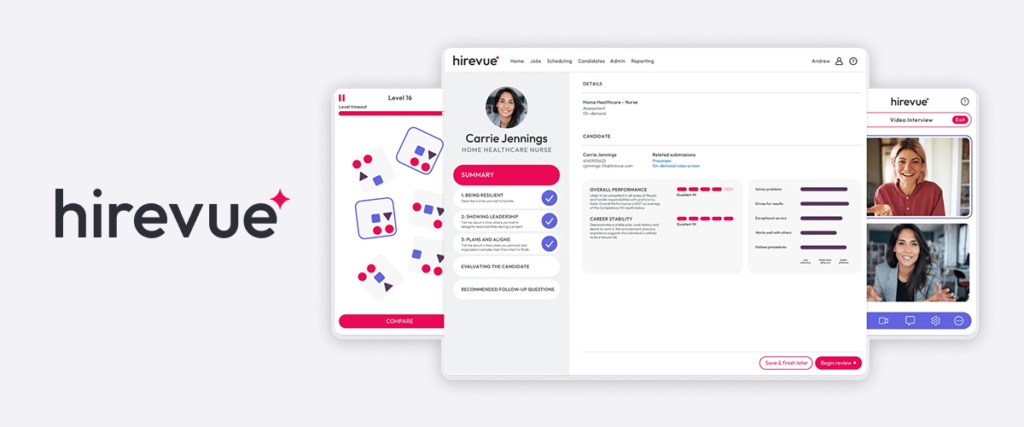
Hirevue helps create consistent hiring experiences across enterprise recruiting teams while introducing greater structure and automation. Organizations with complex hiring operations can leverage its extensive configuration options, advanced workflow capabilities, and automated AI screening functionalities that support standardized decision-making for high-volume recruiting.
Platform implementation needs hands-on involvement of HR and IT teams to set up and configure HR processes. Organizations should expect a longer path to full adoption compared with more flexible platforms, like Jobma. For teams seeking deep configurability and long-term scalability over ease of implementation, Hirevue remains a strong choice.
- Interview and Assessment Tools: Includes video and AI interviews, automated scheduling, language proficiency tests, and technical coding challenges.
- AI Features: Interview insights and assistive intelligence, automated candidate screening through performance score, with little to no human involvement.
- Evaluation Tools: Role-based assessment builders, leadership, technical, and cognitive skill validation.
- Integrations: 20 native ATS integrations including Workday, Oracle, and SmartRecruiters.
- Security: Protects data and privacy through CCPA, EEOC, and GDPR compliance, and ISO 27001, SOC 2 Type II certifications.
- Implementation and Support: Lengthy, complex implementation process that can take up to 3 months. User support offered through automated AI chatbots and self-serve platform guides.
G2 Rating: 4.1/5 stars
3. Spark Hire
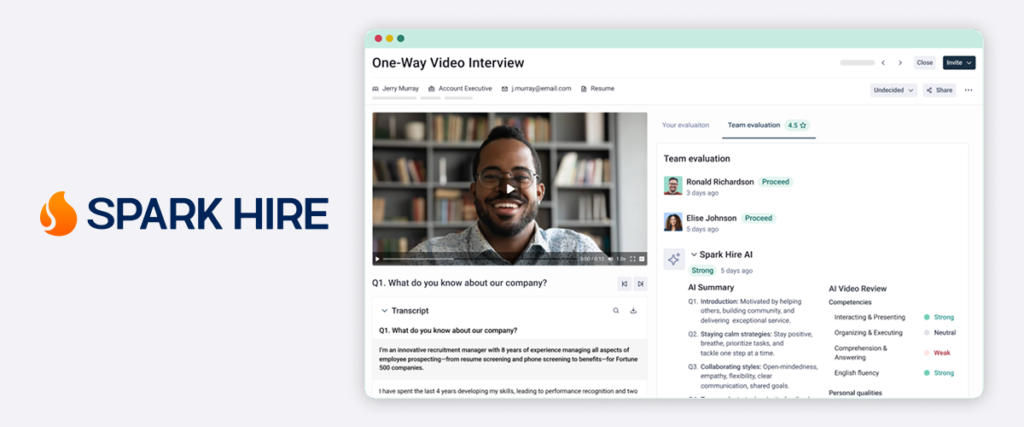
Spark Hire is a video interviewing platform designed to simplify interview scheduling and asynchronous video interviews. It is particularly suited to small and mid-sized businesses looking to replace manual interview coordination with more efficient digital workflows.
The platform focuses on making one-way video interviews accessible without requiring highly advanced hiring infrastructure. It also supports live interviews and basic collaboration and evaluation tools, giving recruiting teams a straightforward way to manage video interviews and gather feedback.
- Interview and Assessment Tools: Supports one-way and live video interviews, with customizable questions, response time limits, retakes, interview sharing, and recorded live interviews.
- Scheduling: Allows recruiters to set their availability and let candidates select a suitable time slot for live interviews.
- Evaluation Tools: Enables hiring teams to rate candidates, add comments, and bookmark key moments in interviews. Custom question sets can also be used to assess role-specific skills.
- Team Collaboration: Allows recruiters and hiring managers to share interviews, review candidate responses, and provide feedback within the platform.
- Integrations: Integrates with its in-house ATS and other platforms to support interview coordination within existing recruiting workflows.
G2 Rating: 4.7/5 stars
Endnotes
Enterprise hiring needs go well beyond interviewing and onboarding candidates. They look for a platform that accelerates hiring workflows and increases operational efficiency without creating additional complexity.
This is where Jobma stands out. The platform adapts to custom hiring workflows, integrates with existing HR technology, and supports recruiters with AI and data-driven insights, all within a human-first hiring system designed for enterprise.