9 High-volume Hiring Strategies Every Enterprise Needs in 2026
High-volume hiring in retail, logistics, healthcare, BFSI, and gig-driven sectors is now a continuous operational requirement. Hiring teams are not just expected to fill roles fast, but to do it without compromising quality, compliance, or candidate experience. The real challenge is not volume. It is maintaining recruiter productivity without compromising candidate experience.
Below are 11 proven strategies to build scalable, resilient, and high-performing hiring cycles.
1. Centralize the High-Volume Hiring Workflow
Organizations may fail at scale when hiring is fragmented across regions, departments, or hiring managers. Each team using its own process, evaluation criteria, and tools creates inconsistency, slows down decision-making, and introduces unconscious bias.
By centralizing the hiring framework, you create a unified system for how hiring is executed across the organization.
A strong framework typically includes:
- Standardized job descriptions with clear success criteria
- Pre-defined evaluation scorecards for each role
- Consistent interview workflows across locations
- Unified reporting metrics such as time-to-fill, cost-per-hire, and candidate drop-off rates
For example, a retail chain hiring across 200 locations can standardize screening questions. As regional offices screen candidates, the assessment criteria remain the same, ensuring consistency in the quality of candidates.
2. Shift from Resume Filtering to Skills-Based Screening
Manual resume-based screening is often slow, subjective, and can’t properly tell what the candidate has to offer. In high-volume environments, recruiters simply do not have the bandwidth to review thousands of resumes manually. So, enterprises are moving toward skills-first hiring models. Instead of asking “Where has this candidate worked?”, shift your focus to “What can this candidate actually do?”
This is implemented through:


Pre-employment Assessments for Role-specific Skills
Pre-employment assessments are structured tests designed to evaluate whether a candidate has the exact skills required for a role before they move forward in the hiring process. Unlike resumes, which reflect experience, assessments measure actual capability in a controlled and standardized way.
These assessments can vary depending on the role:
- Technical Roles: coding tests, debugging exercises
- Customer-facing Roles: communication and comprehension tests
- Sales Roles: persuasion, objection handling scenarios
- Operations Roles: numerical reasoning, attention to detail
For example, if you’re hiring 500 customer support agents, instead of just relying on resumes, you can require candidates to complete a 15-minute written assessment. Only candidates who meet the threshold score move forward.
AI-powered Scenario-based Evaluations
AI-powered scenario-based evaluations help analyze how candidates respond to real-world situations they are likely to face on the job. Instead of asking theoretical questions, candidates are given a problem and asked how they would handle it. An AI agent can ask scenario questions to the candidate according to the role, ask follow-up questions, and record the responses for the recruiter to review. The recruiter can check smart assessment summaries, insights, strengths, and weaknesses to ascertain the top candidates.
2. Pre-recorded Video Interviews
Pre-recorded video interviews allow candidates to record responses to a standardized set of questions at their convenience. Recruiters and hiring managers can then review these responses later, without needing to coordinate schedules. This format is specifically designed for scale. Every candidate answers the same questions under the same conditions, which makes evaluation more structured and comparable across large applicant pools.
Beyond efficiency, this method improves decision quality. Recruiters can:
- Rewatch responses for clarity
- Share recordings with multiple stakeholders
- Evaluate candidates using standardized scorecards
- Reduce reliance on memory or subjective impressions
For scale, integrate video interviews directly after initial screening or assessments, use automated reminders to ensure high completion rates, and enable bulk review workflows so recruiters can evaluate multiple candidates efficiently.
3. Use Automation to Eliminate Manual Bottlenecks
Manual tasks like phone screening, interview scheduling, follow-ups, and status updates consume the majority of recruiter time. As does drafting and reviewing offer paperwork, since each contract introduces a bottleneck at the final step, and tooling to support with generating employment contracts keep terms accurate when you are issuing dozens at once. Automation through smart hiring platforms and AI tools helps remove these inefficiencies.
Key areas where automation delivers immediate ROI:
- Resume Parsing and Candidate Shortlisting: Define the key skills and experience required for a role, upload the candidate resumes, and get clear summaries and score recommendations for each candidate. Research shows that enterprises that use AI-powered screening automation to rank candidates based on job fit improve talent matching by 67%.
- Automated Interview Scheduling Based on Availability: Set up your availability slots and timezone, and allow candidates to pick a slot for the live interview.
- Application Update Communication: As you select, shortlist, or reject a candidate, they receive a personalized email updating them about their application status. According to Select Software, 79% of rejected candidates would reapply with a company if they got post-interview feedback.
- Interview Reminders and Follow-ups: Send candidates automated reminders to complete assessments before the assessment link expires.
Automation through AI allows recruiters to spend 75% more time on strategic activities rather than manual operations.
4. Implement Structured Video Interviewing at Scale
According to Safesthires Traditional phone screens and coordinating live interviews for hundreds or thousands of candidates create scheduling chaos and delay hiring cycles. Structured pre-recorded video interviewing solves this problem by allowing candidates to complete interviews asynchronously.
In one-way video interviews, candidates are required to record their answers to a set of pre-defined questions. These questions allow you to gather information about the candidate’s skills, expertise, and technical strengths.
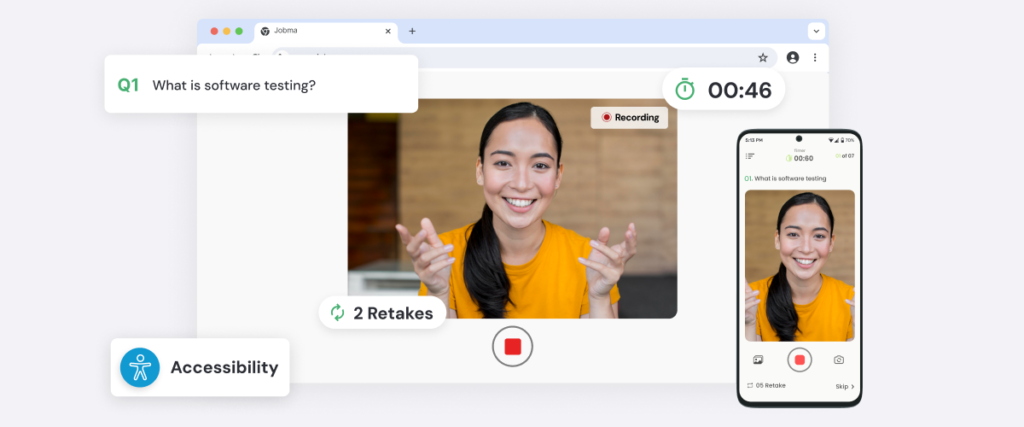
This approach offers several advantages:
- Recruiters can review interviews anytime, eliminating scheduling constraints
- Every candidate answers the same set of questions, improving fairness
- Hiring managers can evaluate candidates collaboratively without delays
- Interviews can be recorded and revisited for better decision-making
Enterprises that use structured video interview platforms, like Jobma, report up to 70% reduction in time-to-hire and, in turn, improve recruiter productivity. In modern hiring, video interviewing is not just about convenience. It is about creating a scalable and measurable evaluation system.
5. Optimize Candidate Experience
In enterprise-scale hiring, candidate drop-off is one of the highest hidden costs. Long application processes, lack of personalized communication, and delayed responses lead to lost candidates. And candidate experience directly impacts hiring outcomes. According to CareerPlug’s candidate experience report, 1 in 4 candidates declined a job offer due to a poor experience.
Key improvements that drive measurable results:
- Reduce the length of the application form to cut filling time to less than 5 minutes – ask only what’s necessary.
- Provide real-time and regular updates on application status. Candidates engage better when they know where they are in the process.
- Use mobile-friendly interfaces so candidates can apply and interview with you on the go.
- Ensure quick turnaround times between stages. If any step is taking longer than expected, let the candidates know.
In high-volume hiring, even a 5% improvement in completion rates can lead to hundreds of additional hires.
6. Leverage AI for Intelligent Screening and Matching
According to Safesthires, AI-driven systems are the core component of high-volume recruitment strategies, can:
- Identify strengths and performance gaps from pre-recorded video responses
- Analyze large volumes of candidate data
- Score and match candidates to roles based on skills and experience
- Identify top candidates faster than manual screening
However, it’s important to use AI responsibly. While bias mitigation, transparency, and compliance are critical, ensure that you use systems that help retain the final hiring decision with human recruiters.
7. Build and Maintain Talent Pipelines
Waiting until positions open to start sourcing candidates leads to delays and missed targets. Enterprises are shifting to proactive talent mapping and continuous talent pipeline strategies.

This involves:
- Building talent pools for recurring roles
- Engaging past applicants for new openings
- Using CRM systems to keep candidates engaged
For example, a logistics company hiring warehouse staff year-round can maintain a pool of candidates who have already passed initial screening. When demand spikes, hiring becomes a matter of activation rather than sourcing.
A strong pipeline reduces time-to-hire significantly because recruiters already have access to top candidates.
8. Use Data and Analytics to Drive Hiring Decisions
Instead of tracking everything, focus on the hiring data metrics that directly impact hiring speed and quality:
- Time-to-Hire: The number of days it takes to move a candidate from application to offer.
- Candidate Drop-off Rate: Where and how many candidates are quitting the process.
- Interview-to-Selection Ratio: How many candidates you interview vs how many you hire.
- Source Performance: Identify the candidate sourcing channels that are bringing the most qualified, high-quality candidates.
- Offer Acceptance Rate: The number of selected candidates who are saying yes.
The goal is to identify where things are breaking and to fix them. Ask yourself these questions:
- Are too many candidates dropping off after applying? If the answer is yes, your application process is likely too long or confusing. Cut it down to 3-5 minutes.
- Are you interviewing too many candidates but hiring very few? If your answer is yes, your present screening strategy may not be enough. Use more relevant assessments and screening parameters.
- Are too many candidates rejecting offers? This could indicate problems in your salary offer, communication speed, or candidate experience.
9. Enable Hiring Manager Collaboration and Accountability
In many organizations, bottlenecks like delayed feedback, unclear expectations, and inconsistent evaluations slow down hiring. To fix this, you need structured collaboration models.
Key elements:
- Defined feedback timelines to ensure that all stakeholders follow them
- Shared evaluation scorecards that every evaluator uses consistently
- Centralized platforms that allow reviewing candidates in one place, like Jobma
Set clear expectations and hold stakeholders accountable for following them. When hiring managers are aligned and accountable, hiring cycles become faster and more predictable.
Endnotes
High-volume hiring breaks when decisions are slow and processes are unclear. Too many candidates move forward without proper screening, feedback takes too long, and candidates drop off before you can make an offer. At scale, even small delays create lasting impact.
The fix is tightening your current workflows and implementing tools that scale with your hiring goals. Screen candidates early so only relevant profiles move forward. Set clear timelines for feedback and stick to them. Remove steps that do not directly help you make a decision. Track where candidates are dropping off and fix those points immediately.
Teams that hire well focus on speed, clarity, and consistency. When your process is structured and decisions are quick, hiring becomes predictable and easier to manage at scale.