10 Best One-Way Video Interview Software For Candidate Screening in 2027: Complete Guide
The best one-way video interview software for candidate screening in 2027 depends on four key factors: your candidate volume, how much AI assistance you want in evaluation, ability to detect candidate fraud, and how seamlessly the tool integrates with your existing tech stack and applicant tracking system (ATS).
One-way video tools began primarily as a way to record answers and review them later. Today, many platforms also offer transcripts, summaries, competency scoring, and integrity flags supported by AI. While these capabilities help recruiting teams evaluate large applicant pools faster, they make it essential to understand what the AI analyzes, how its output is presented, who retains final decision-making authority, and how the vendor manages privacy, security, and interview integrity.
In this guide, we break down 10 top one-way video interview platforms using product details taken directly from their official websites.
- Jobma
- Spark Hire
- VidCruiter
- Hirevue
- Hireflix
- Truffle
- Interviewer.AI
- Workable
- Criteria
- Willo
You will see what each tool does well, where its limits lie, and what it costs.
What is One-Way Video Interview Software?
One-way video interview software lets candidates record answers to a set of preset questions on their own schedule, with no interviewer on the call. Recruiters and hiring managers review the recordings later, rate them against the same criteria, and decide who moves to a live conversation.
You’ll also see it called asynchronous, pre-recorded, or on-demand video interviewing. A typical one-way interview runs like this:
- The recruiter builds a question set, often with a welcome video, think time, and a limit on retakes.
- Candidates get a link by email, SMS, or straight from the ATS.
- Candidates record answers on a phone or laptop, usually with no app download.
- The hiring team reviews responses, scores them on a rubric, and moves the strongest ones forward.
Most platforms now add AI evaluation along with step 4, such as transcripts, summaries, or suggested scores. How much of that AI you use, and how it’s governed, is one of the biggest differences between the tools below.
How We Evaluated These Platforms
Before choosing a solution, evaluate vendors based on these essential pillars:
- Candidate experience: Browser-based capability or app download requirement, practice questions, retakes, and personalization and branding options.
- AI & Automation Capabilities: Look for time-synced transcriptions, AI response summaries, objective competency scoring, and automated candidate reminders.
- Interview integrity: Proctoring, ID verification, and detection of scripted or AI-generated answers to prevent candidate fraud.
- Integrations: Native ATS and HRIS connections, plus Zapier or API access.
- Security and compliance: Certifications like SOC 2 and ISO/IEC 27001, and privacy compliance such as GDPR and CCPA.
A quick disclosure: Features and pricing change often, so confirm details with each vendor before you buy.
Quick Comparison: One-Way Video Interview Software in 2027
This comparison table is a summary and shows how the 10 platforms differ and what each platform is best for.
| Platform | AI Evaluation | Best For |
| Jobma | Yes, scoring, summaries, transcriptions, proctoring | Mid-size and large companies looking for structured, secure screening at scale |
| SparkHire | Yes, optional competency scoring | Lean teams that want one-way and live interviewing in one tool |
| Vidcruiter | Yes, optional | Mid-size companies looking for comprehensive interview management software |
| Hirevue | Yes | Large enterprises requiring robust skill validation |
| Hireflix | No AI scoring | Small teams that want simplicity |
| Truffle | Yes, scoring with visible reasoning | Emerging new platform for small teams combining resumes, video, and assessments |
| Interviewer.AI | Yes | AI-first screening |
| Workable | Limited, AI-generated questions | Teams already hiring in Workable ATS |
| Criteria | Optional AI scoring add-on | Assessment-led hiring |
| Willo | Light, transcripts, summaries, and flags | Small teams, Pay-per-role, Basic interview screening |
10 Best One-Way Video Interview Software for Candidate Screening
Below, we look at what each platform does, who it suits, and where it’s less specialized. The tools are listed in this order:
Jobma
Best for: Mid-size and enterprise teams that need structured, secure screening at volume with pre-hire skill assessments
- Price: Custom quote based on hiring volume, AI features, and integrations. Pricing is available on request.
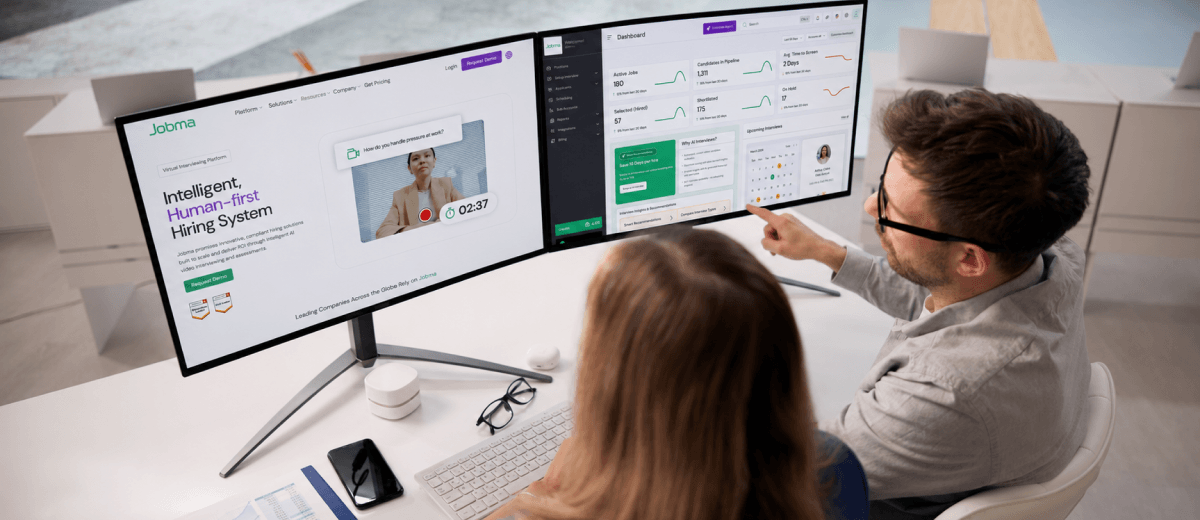
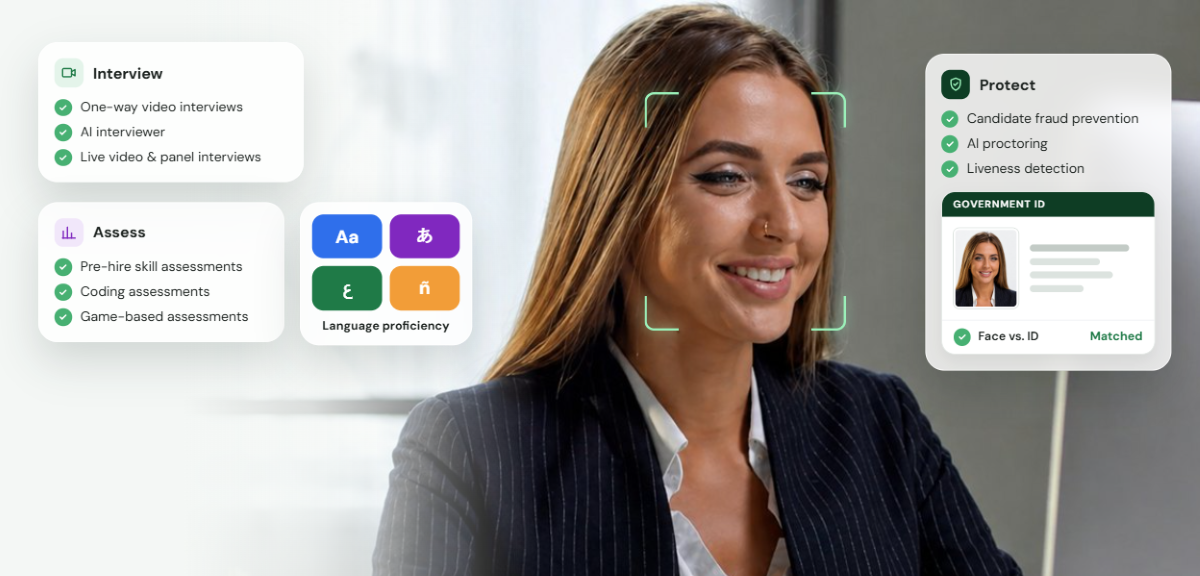
Jobma is an intelligent, human-first hiring system. Its one-way video interviews let candidates record answers 24/7 from any device, while recruiters review structured, easy-to-compare responses. One-way interviews sit alongside live and panel interviews, an autonomous AI interviewer, and skill assessments in the same platform.
It pairs one-way video with built-in integrity controls, which matters more now that candidate fraud is a problem. Candidates can be verified before the interview, and AI proctoring flags unusual activity such as multiple faces, copy-pasting, a second device, tab-switching, or AI assistance. Flags and AI scores are inputs for a recruiter to review, not automatic rejections.
Its AI generates scores and response summaries, highlights key moments, and maps answers to role competencies.
Jobma Key Features
- Multi-format interviews and pre-hire assessments: Combine video, audio, written, multiple-choice, game-based, and coding questions, all in one interview.
- AI scoring and summaries, with key-moment highlights and role-based competency mapping.
- Built-in ID verification plus AI proctoring that detects multiple faces, copy-paste, mobile devices, and AI assistance.
- Fully customizable controls to switch ID verification, AI proctoring, and AI scoring on or off based on hiring preferences and regional requirements.
- Collaborative review tools: shareable review links, standardized scorecards, answer-specific comments, and side-by-side candidate evaluations for hiring teams.
- Granular user management and enterprise governance to control access permissions by team, role, department, or location.
- Candidate interface in 16 languages, with AI-generated transcripts in almost all major languages.
- Branded interview pages, welcome videos, and prep resources for candidates.
- Integrations with 70+ ATS and HR platforms, including Workday, BambooHR, Greenhouse, iCIMS, Oracle, JazzHR, and Bullhorn.
- SOC 2 Type II and ISO/IEC 27001 certified, and compliant with GDPR and CCPA.
- Mobile apps for both hiring teams and candidates on iOS and Android.
Cons
Jobma uses custom pricing based on hiring volume, integrations, and the features your team requires. Configuring administrative workflows will require initial training. Feature availability will also depend on the plan tier.
2. Spark Hire
Best for: Lean HR and recruiting teams that want one-way and live interviews in one tool.
- Price: From $299/month billed monthly (varies by company size)
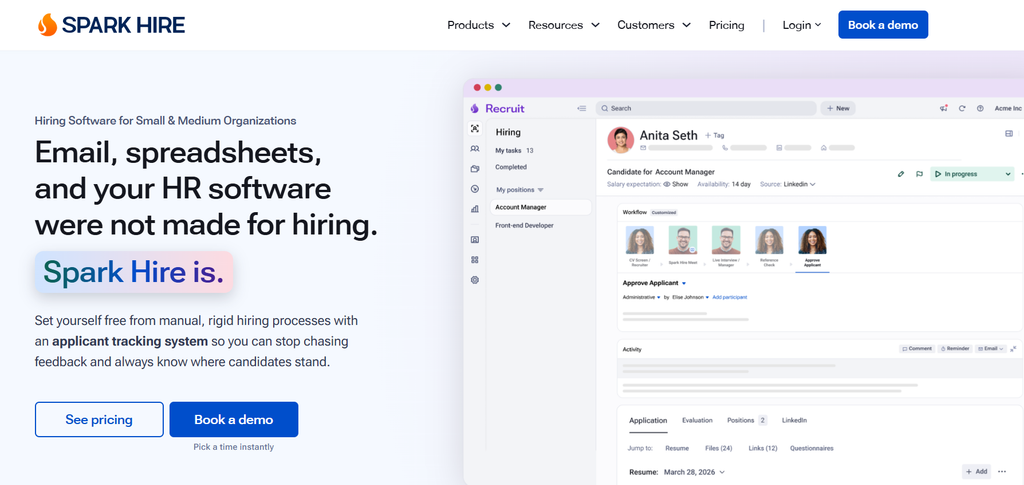
Spark Hire positions its one-way interviews as a replacement for phone and Zoom screens, built for lean teams. Candidates record on their schedule, every candidate gets the same questions, and hiring managers can review submissions without logging in. The company is clear that the product isn’t meant for teams that want to fully automate screening, which is a useful stance if you want AI to assist.
Its AI can transcribe responses in 50+ languages, summarize them, and score them against competencies, so reviewers can decide which candidates to fast-track.
Spark Hire Key Features
- Unlimited one-way and live video interviews on every plan.
- Branded candidate portal with intro and outro videos, plus recorded or uploaded video questions.
- Custom think time, take limits, and answer length for each question.
- Invites by link, SMS, or bulk CSV upload, with automated reminders and deadline extensions.
- Optional AI transcripts (50+ languages), response summaries, and competency-based scoring.
- Bulk sharing with hiring managers (no sign-in required) and configurable scorecards.
- 40+ ATS integrations, Zapier connections, and a Google Chrome extension.
- 24/7 support for recruiters and candidates; SOC 2 Type II audit available on request.
Cons
The monthly plan caps you at 5 active jobs and 5 users, so most growing teams end up on an annual contract. Some enterprise integrations need a paid add-on, as do API access and SSO.
3. VidCruiter
Best for: Mid-size and public-sector teams that need a comprehensive interview management system
- Price: Custom quote; available post-demo
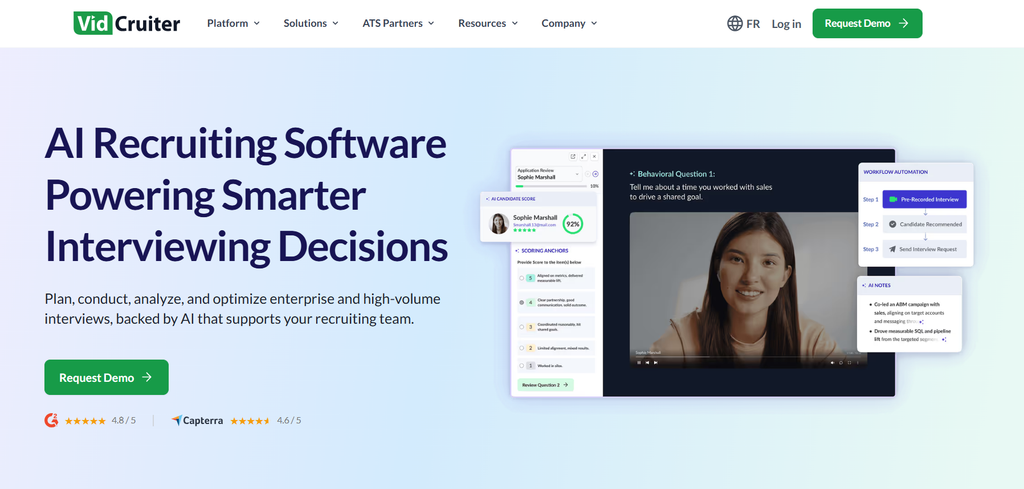
VidCruiter calls its video interview software offering an interview management system. Recruiters write questions as text or record them on video, attach a competency-based scorecard to each, and send a unique link. Candidates record from any device with no app download, and can review their answers before submitting.
It offers geo-specific data hosting with audit logs on every action. Its AI features (notes, summaries, scoring, and fraud detection) can each be switched on or off, which helps teams that need to control exactly where AI is used.
VidCruiter Key Features
- Per-question settings for think time, recording time, number of attempts, and review timers, with an audio-only option.
- Optional AI interview notes, transcripts, summaries, and competency-based scoring that reviewers can override.
- Fraud controls such as browser locking, copy-paste blocking, IP monitoring, and flags for scripted or AI-generated answers.
- Candidate experience in 30+ languages, with localized email and SMS.
- 24/7 live support for recruiters and candidates, and a dedicated account manager.
Cons
The breadth of configuration that suits complex enterprise processes can feel heavy for a small team that just wants to send a few interviews.
4. Hirevue
Best for: Large enterprises that want video interviews tied to assessments
- Price: Custom quote
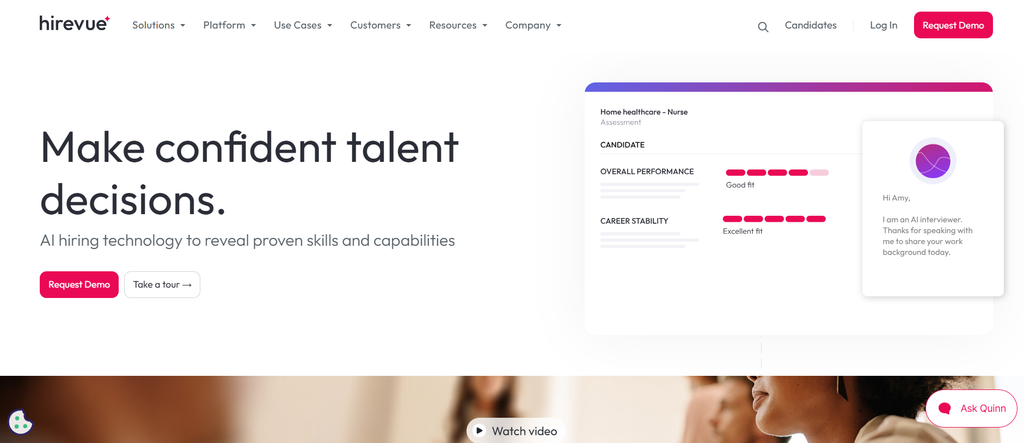
Hirevue is one of the longest-running names in video interviewing, and it now frames itself as an AI hiring platform. One-way (on-demand) interviews are one part of a wider system that includes an AI Interviewer, validated assessments, a live-interview co-pilot, and scheduling automation.
Its AI Interviewer evaluates each answer against role-specific criteria and explains why a response meets them, while Hirevue states that recruiters make the final decision.
HireVue Key Features
- On-demand video interviews that candidates complete on their own time, including from a mobile app.
- AI Interviewer that runs voice-based screening interviews around the clock, with evidence behind each recommendation.
- Assessments that include job-relevant skills tests, game-based assessments, and an Assessment Builder.
- Interview co-pilot that joins live interviews in your own Zoom or Teams to capture notes and summaries.
- Structured interview content developed with industrial-organizational (I-O) psychologists.
- Cheating and fraud mitigation, permissions, and audit-ready governance.
- Integrations with 45+ ATS platforms, plus HRIS and LMS connections.
Cons
Hirevue’s packaging is built for enterprise budgets and rollouts, which can be a lot for a mid-size team. The platform’s focus has shifted toward its AI Interviewer and assessments, so confirm how classic one-way interviews fit into the package. If your team only needs simple async screening, a lighter tool may be better-suited.
5. Hireflix
Best for: Small and mid-size teams that want basic one-way screening capabilities.
- Price: From $75/month billed annually (under 50 employees); $150/month billed annually (50 to 250 employees); custom for larger teams
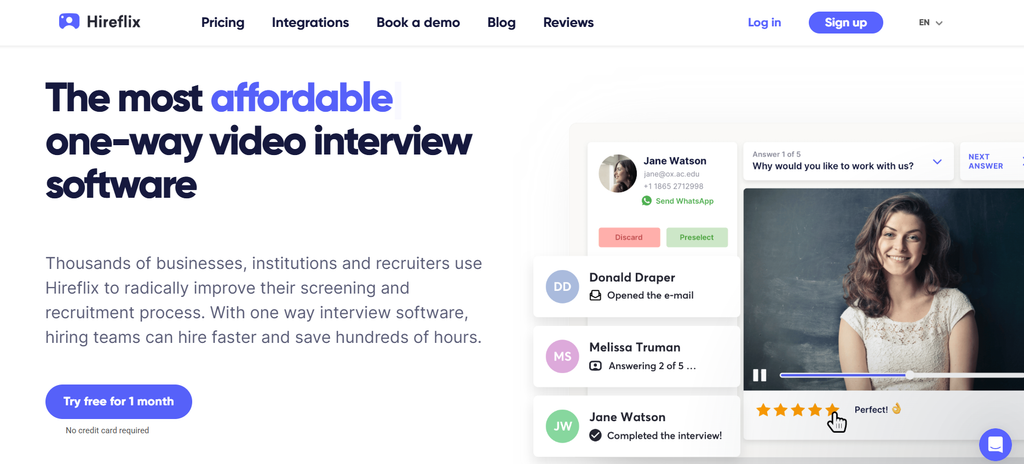
Hireflix does one thing: one-way video interviews. You build an interview once, invite as many candidates as you want, and share completed recordings with your team. There’s no live interviewing, no assessment library, and no applicant tracking, and that’s deliberate.
Hireflix Key Features
- Interview setup in minutes, with the ability to edit an interview even after it’s been shared.
- Candidates record from any device with no account or download.
- Automated reminders by email or SMS to keep completion rates up.
- Video transcriptions and team review, with shared responses and feedback in one place.
- Custom and multi-brand candidate experience included on every plan.
- Integrations with popular ATS platforms so that candidates can be invited from tools like Greenhouse.
- SOC 2 Type II certified.
Cons
Hireflix does not offer live interviewing tools or AI competency scoring. It also lacks compliance certifications, candidate identity verification, and proctoring features, making it less suitable for organizations requiring high-security integrity frameworks.
6. Truffle
Best for: Emerging new platform for small teams scaling their hiring efforts
- Price: From $49/month (Starter, billed monthly); Core from $99/month billed annually
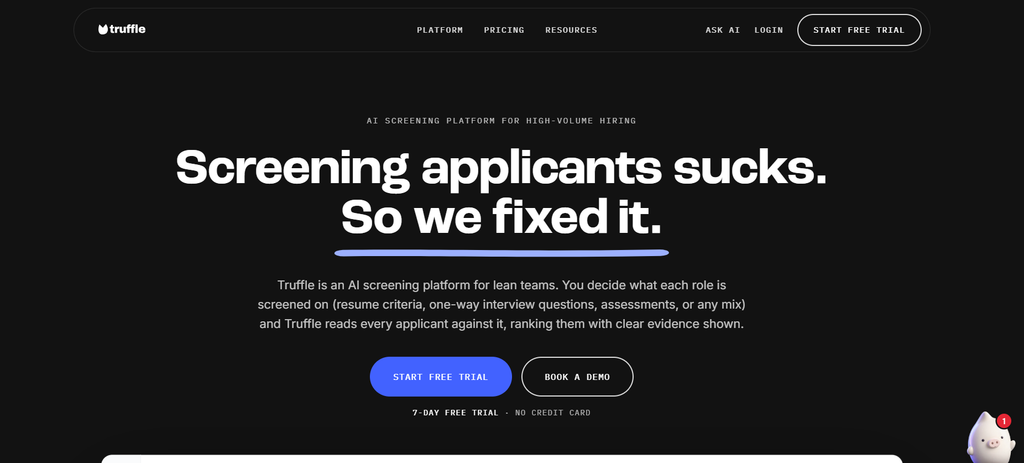
Truffle is a candidate screening platform that combines three layers: resume screening, one-way video or audio interviews, and short talent assessments. Candidates record on their phone through a single shareable link, and Truffle ranks everyone against criteria you set.
Each candidate gets an AI Match score with a plain-language reason behind it, a written summary, a full transcript, and a 30-second highlight reel of the most relevant moments.
Truffle Key Features
- AI question generator that drafts interview questions and a scorecard from your job description.
- Written, video, multiple-choice, and code questions, with think time and retakes set per question.
- One Position Link to share on job boards, careers pages, or by text, plus ATS auto-invites and bulk invites.
- AI Match scoring with visible reasoning, transcripts, and 30-second Candidate Shorts.
- Personality, Situational Judgment, and Environment Fit assessments included on every plan.
- Unlimited positions and team members, with native ATS, Zapier, API, and webhook connections.
Cons
It does offer ID verification and also skips webcam and tab monitoring by design, making organizations more susceptible to interview fraud.
7. Interviewer.AI
Best for: Teams that want AI-scored async screening with a conversational avatar option
- Price: Essential from $199/month; Professional from $399/month; Enterprise custom
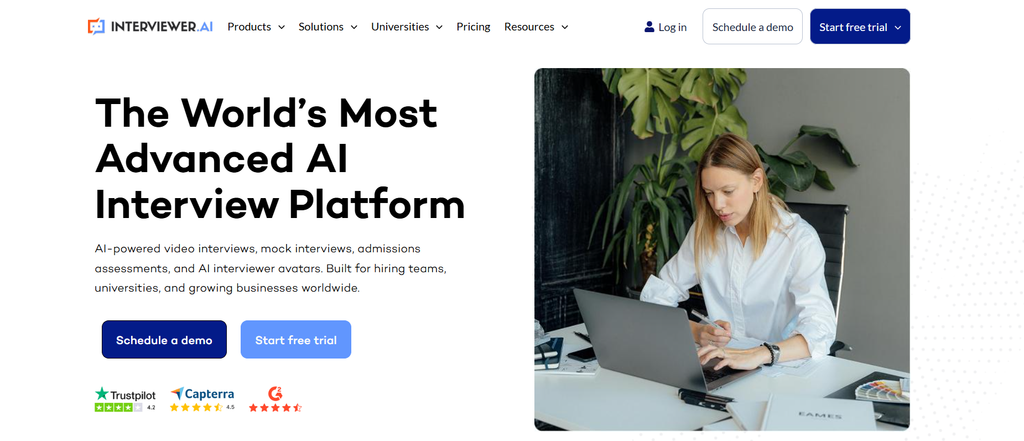
Interviewer.AI is built around AI analysis of video responses. Recruiters create timed one-way interviews, invite hundreds of candidates, and receive an AI assessment report for each one. Its fraud checks flag multiple voices, lip-sync anomalies that may signal manipulated video, and signs of screen or prompt assistance, which recruiters review before deciding.
Interviewer.AI Key Features
- AI-powered one-way video interviews with response relevancy scoring and human-in-the-loop review.
- AI resume screening and candidate matching, plus a WorkMap competency and behavioral assessment.
- Branded application portal and AI-generated job or program descriptions.
- Interview transcript summaries, detailed score breakdowns, and custom scoring weights.
- Interview fraud checks and ID verification for passports or licenses.
Cons
Major ATS integrations are only available on Enterprise as a quote-based add-on. The Essential plan also doesn’t include transcript summaries and fraud checks.
8. Workable
Best for: Companies that already run hiring in Workable ATS
- Price: Video Interviews is a $109/month add-on on the Standard plan (Standard starts at $299/month for 1-20 employees), Premier at $599/month, and Enterprise at 719/month.
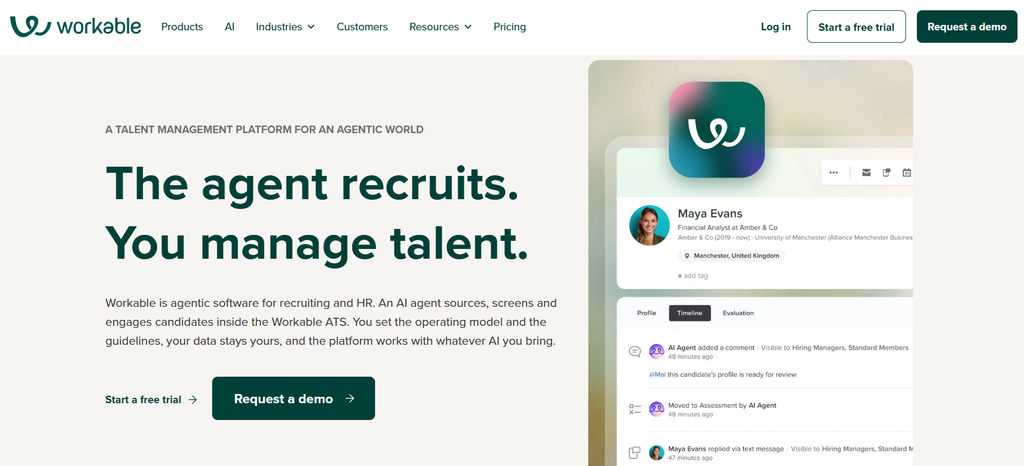
Workable is an all-in-one recruiting and HR platform, and its one-way video interviews are a premium feature built into the ATS. Recruiters add a video interview to a pipeline stage, send it with a click or through automated actions, and review responses right on the candidate’s timeline. There’s no separate login and no data sync to worry about. We included Workable in this list because it’s convenient for its existing customers.
Workable Key Features
- One-way video interviews built into the Workable ATS pipeline.
- AI-generated interview questions, or fully custom question sets.
- Deadlines plus per-question think time, answer time, and number of takes.
- Manual sends or automated actions that trigger interviews at a pipeline stage.
- Team evaluation of responses alongside scorecards and interview kits.
- Access to Workable’s wider platform.
Cons
Workable Video Interviews cannot be purchased or used as a standalone product, requiring an active core Workable ATS subscription and making it unusable for teams relying on other recruiting software.
9. Criteria
Best for: Teams that want one-way interviews scored along with skill assessment
- Price: Custom quote for the interview product
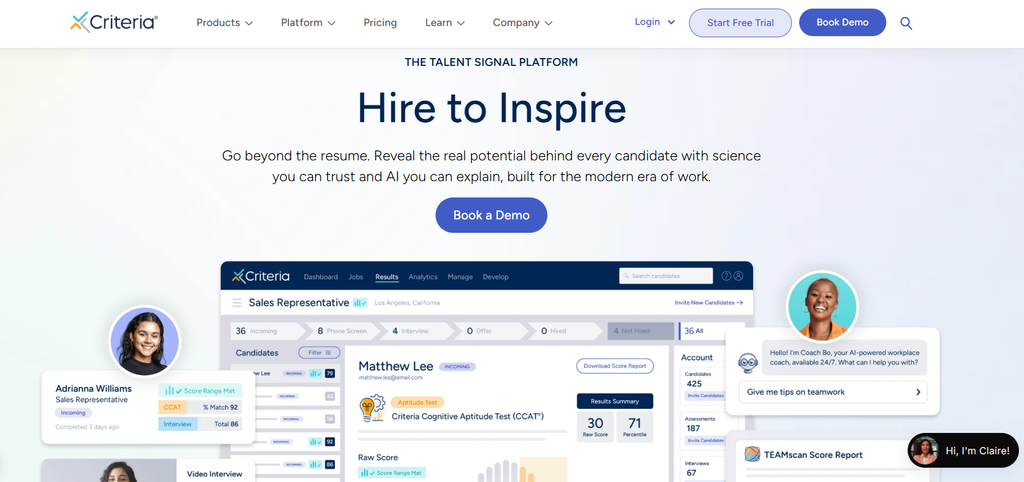
Criteria is best known for pre-employment assessments, and its Async Video Interview product plugs into that same platform. Recruiters pick from a library of validated, job-relevant questions and stock videos, or record their own. Candidates complete the interview from any device, and their scores sit alongside assessment results in one view. Reviewers score independently so they can’t influence each other, and its blind review mode hides candidate identifiers.
Criteria Key Features
- Library of validated interview questions and stock question videos, or self-recorded questions.
- Independent reviewer scoring and blind review mode to reduce groupthink and bias.
- Optional AI scoring add-on with auto-generated evaluation guides and BARS rubrics.
- Scores shown next to cognitive aptitude, personality, emotional intelligence, and skills test results.
Cons
Criteria’s video interviewing tool on its own offers fewer candidate integrity and anti-fraud features – such as live ID verification, tab-switch monitoring, or copy-paste blocking- than dedicated screening platforms. Additionally, adopting on its own can be cost-prohibitive.
10. Willo
Best for: Smaller teams looking for basic video screening and looking to pay per role
- Price: Lite at $59 per live role; Enterprise from $3,799/year
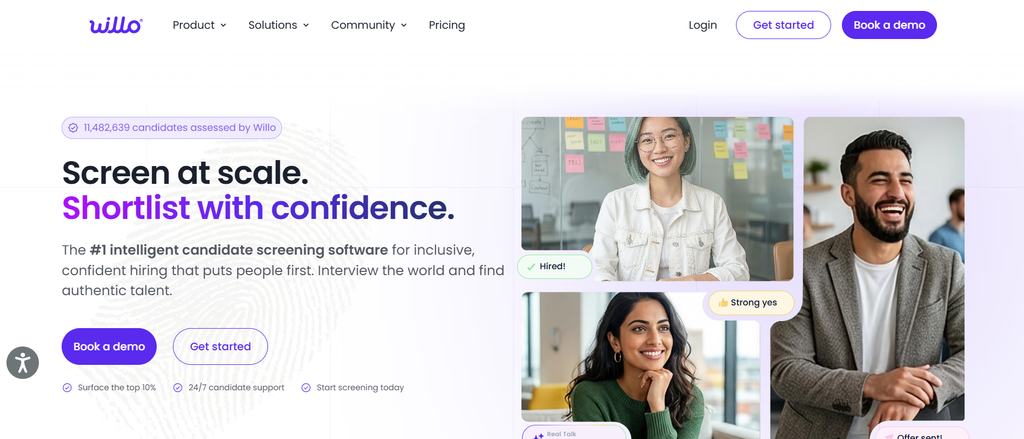
Willo is a UK-based one-way screening platform focused on keeping the candidate experience simple. The platform is browser-based, works on low-bandwidth connections, and is localized for 18 languages.
Its AI feature transcribes and summarizes interviews, and flags answers that may be scripted or AI-generated as signals for a human to check, not verdicts.
Willo Key Features
- Bulk invites by CSV, individual invite, or job-board link, with automated email and SMS reminders.
- AI question generator and suggested follow-up questions.
- Willo Intelligence for transcripts, summaries, and surfacing skills and gaps.
- Anti-cheat tools, including detecting scripted and AI-generated answers.
- 50+ native ATS integrations, 5,000+ apps through no-code connectors, and an open API.
- ISO 27001 certified, GDPR compliant, 2FA, and WCAG 2.0 compliant.
Cons
Some of its AI and anti-cheat features depend on the plan. Its per-role pricing can also add up quickly if you’re running many roles at once.
How to Choose the Right One-Way Video Interview Software
Start with the problem you’re solving: a team screening 2,000 applicants a month needs something very different from a team hiring engineers. These questions help narrow the field fast:
- How many candidates do you screen per month? At high volume, look for AI summaries, scoring with visible reasoning, and bulk invites. At low volume, simple pricing and fast setup matter more.
- Which ATS do you use? Check for a native integration that sends scores, transcripts, and video links back to the candidate record. Note whether that integration costs extra.
- How worried are you about candidate fraud? If proxy candidates or AI-written answers are showing up, prioritize ID verification and proctoring or scripted-answer detection.
- Where are your candidates? Hiring across countries means checking candidate interface languages and transcript language support.
- What compliance do you need to prove? Ask for SOC 2 Type II reports, ISO/IEC 27001 certificates, data residency options, and audit logs.
- Do you need more than one-way? Some teams want live interviews, assessments, or an AI interviewer on the same platform. Others prefer a focused tool.
Questions to Ask in Every Demo
- Can you show me the candidate experience on a phone, from invite to submit?
- What exactly does your AI score, and can a reviewer see why a candidate got that score?
- Can we turn AI scoring off and still use transcripts and summaries?
- What data syncs back into our ATS, and is that integration included in our price?
- How do you handle candidate consent, data deletion requests, and AI hiring laws in the states where we hire?
- What does implementation look like, and who supports our candidates if they get stuck?
Using AI Responsibly in One-Way Video Interviews
AI can save reviewers hours, but it shouldn’t make hiring decisions on its own. Every tool on this list positions its AI as support for human review, and that’s the right framing. AI scores and flags are a starting point. A recruiter still needs to watch the answer, apply judgment, and own the decision.
It also isn’t just good practice. Some laws already apply to AI in video interviews:
- Illinois: The Artificial Intelligence Video Interview Act requires employers that use AI to analyze recorded interviews to notify applicants, explain how the AI works and what it evaluates, and get consent first. Employers must also delete videos within 30 days if requested by an applicant.
- New York City: Local Law 144 requires employers using automated employment decision tools to complete a bias audit within the year before use, publish a summary of the results, and notify candidates about the use of the automated employment decision tool (AEDT) and how it’s used.
Before you switch on AI scoring in any platform, confirm these basics:
- You know what the AI measures (spoken content, competencies, or something else) and can explain it to a candidate.
- The vendor can share bias testing results or an audit summary.
- Reviewers can see the reasoning behind a score and override it.
- Candidates get clear notice, consent options, and a way to request accommodations or deletion.
- A person makes the final call on who moves forward.
This guide isn’t legal advice, so talk to your legal or compliance team about the rules that apply where you hire.
Conclusion: Pick the Tool That Fits Your Hiring Workflow
One-way video interviews work best when they replace the slowest part of early screening without taking people out of the decision. Most of the tools here do the basics well. The real differences are in AI transparency, integrity controls, integrations, and how pricing scales with your volume.
If you’re a lean team hiring a few roles at a time, Hireflix, Willo, Truffle, or Spark Hire will get you running quickly. If you already live in Workable or Criteria, their built-in options keep everything in one place. And if you’re screening at volume across regions, with fraud and compliance on your mind, Jobma, VidCruiter, and HireVue are built for that level of structure.
Whichever you shortlist, run a real role through a trial or demo, invite a few colleagues as test candidates, and check how the results land in your ATS. That hour of testing will tell you more than any comparison table.
Want to see how structured one-way interviews, built-in ID verification, and AI-assisted review work together? Book a demo with Jobma.