Healthcare Hiring Has Hit a Breaking Point – Here’s What Actually Needs to Change
Demand for healthcare workers continues to climb, yet critical roles remain open, existing teams are stretched thin, and recruiters are under pressure to fill positions faster than ever.
This points to a hiring system struggling to keep up with workforce demands.
The Numbers Reveal a Growing Hiring Gap
Healthcare has been one of the most consistent drivers of U.S. job growth for years, and it still is, according to early 2026 data. But that growth is masking a harder truth: healthcare and social assistance job openings have hovered near 1.3 million since late 2024, and the sector is filling a smaller share of its open roles, with longer average time-to-fill, than any other industry tracked in recent labor market analysis.
Openings are staying open longer because qualified candidates are harder to find and slower to move through traditional pipelines. Federal workforce projections make this shortfall concrete:
- Physicians: By 2038, the U.S. faces a projected shortage of over 141,000 full-time equivalent (FTE) physicians.
- Nurses: More than 4 million RNs, LPNs, and APRNs were in the workforce in 2024. RN numbers grew 9.4% from 2020 to 2024, while LPNs declined 6.0%.
- Access to Care: Nearly 92 million Americans currently live in a primary care health professional shortage area.
This isn’t a temporary blip tied to one difficult hiring season. It’s a structural mismatch between workforce supply and the demand for care.
Let’s Address the Elephant in the Room
At first glance, the numbers seem contradictory; while millions of Americans are struggling to find work in a tough labor market, healthcare and social assistance added roughly 690,000 jobs in 2025 alone and now account for about 15% of the U.S. workforce. It’s tempting to read that as healthcare absorbing workers from every corner of a struggling job market. There’s some truth to that; a Medical Care Research and Review study using federal labor data found that the large majority of health industry entrants, across nearly every demographic group, come from outside the field entirely or from outside the labor force altogether. Recruiters are watching people move from hotel and restaurant management into senior-living management, and from supply chain and logistics into hospital materials management.
But two things complicate the “healthcare as lifeline” narrative. First, that same study found this pattern has held roughly steady since 2018 rather than accelerating. Second, Indeed’s data shows the sector’s capacity to absorb outside workers is shrinking, not expanding: job postings by healthcare companies for non-healthcare roles fell from 43% in 2018 to 35% as of January 2026, as licensing requirements keep raising the bar for who can make the jump.
So if career changers have always made up most entrants, and healthcare is one of the only sectors still hiring at scale, why does the staffing crisis persist? The answer lies in a critical skill mismatch:
- Support Roles are Filling; Clinical Roles are Starving: Career changers can transition into administrative, operational, or entry-level support functions. But they cannot fill specialized, credentialed clinical roles – like ICU nurses, surgical techs, or physicians overnight.
- The “Leaky Bucket”: Accelerated burnout means experienced bedside clinicians are leaving faster than support staff can be onboarded.
- Pipeline Friction: Even for accessible roles, sluggish screening and multi-week hiring loops cause eager career changers to drop out before their first day.
Healthcare is absorbing talent the rest of the market can’t place, yet it remains structurally short-handed where patient care happens most. Shuffling stretched teams to patch clinical gaps isn’t a long-term staffing strategy; it’s a symptom of a process that needs modernizing.
Core Challenges Crippling Healthcare Workforce Teams
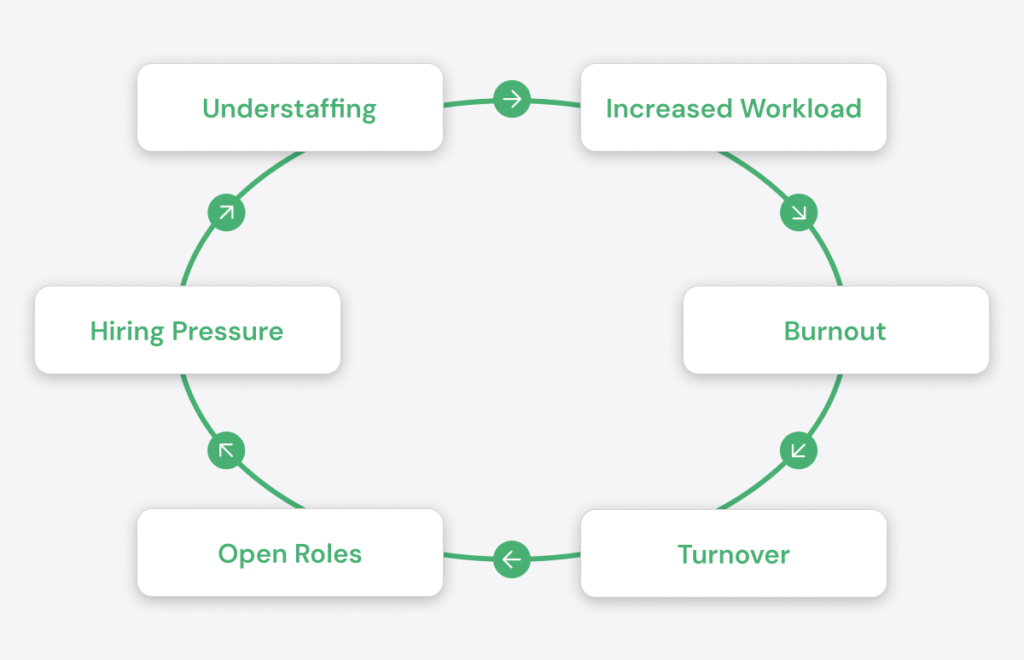
Burnout: It’s tempting to treat retention and recruiting as separate problems. They aren’t. A 2025 JAMA Internal Medicine study found that 47.9% of U.S. physicians work with an incompletely staffed clinical team more than a quarter of the time. Among that group, 61.1% reported burnout, compared with 35.8% of physicians on fully staffed teams, and after adjusting for other factors, working with an incomplete team more than doubled the odds of burnout.
The relationship runs both ways: understaffing drives burnout, and burnout drives the departures that cause understaffing in the first place. Burnout-driven turnover is itself expensive, in dollars and in patient-care continuity, which suggests short-staffing isn’t a strategy so much as a cycle nobody’s found how to break.
Rapid Churn & Aging Workforce: A 2024 National Council of State Boards of Nursing survey found that 35% of RNs and 38% of LPNs experience burnout at least a few times a week, and separate research shows more than a quarter of healthcare workers (28.7%) and 41% of nurses specifically intend to leave their jobs within two years. That churn means recruiting teams aren’t just filling new roles; they’re refilling the same roles again and again, often faster than they can onboard the last hire.
The workforce is also aging. In the U.S., the average RN is 43.3 years old, per HRSA/Census data. The picture is similar globally: the WHO’s State of the World’s Nursing 2025 report found that in 20 countries, mostly high-income, nurse retirements are on pace to outnumber new entrants in the coming years. Hiring pipelines built for a younger, more stable workforce weren’t designed for this.
Hiring Efficiency & Cost Pressure: Traditional healthcare hiring was built around resumes, phone screens, and multiple rounds of scheduling back-and-forth, a process that assumes recruiters have the luxury of time. High applicant volumes for hourly and frontline roles, combined with credential-heavy positions that need careful vetting, put recruiters in an impossible spot: move fast enough to compete for scarce talent, but thoroughly enough to make sure a candidate can actually do the job.
Recruiters end up spending hours on phone screens that don’t tell them much more than a resume already did, while stronger candidates accept offers elsewhere because another employer moved faster.
Rethinking the Early Stages of Healthcare Hiring
he fix is rethinking where time gets spent in the first place. A few shifts are proving out across health systems and staffing organizations:
Replace Phone Screening with Asynchronous Video Interviews: Traditional phone tag wastes days. One-way video interviews let candidates respond to role-specific questions on their own time (even between shifts), while recruiters review responses in a fraction of the time. Recruiters can evaluate communication skills, availability, and core credential requirements in minutes, cutting days off the hiring cycle for both frontline staff and high-volume clinical support roles.
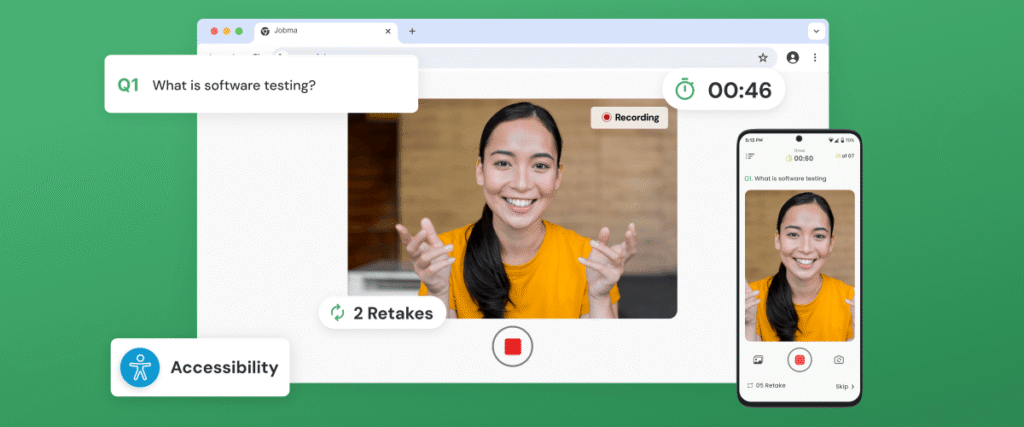
Run Credential Vetting and Video Screening in Parallel: Instead of waiting for a manual phone screen to complete before checking licenses, recruiters can trigger credential verification and video interviews simultaneously. Integrating video screening directly into ATS and credentialing platforms turns two sequential, multi-day bottlenecks into a single, automated step.
Standardize Evaluation to Verify Skills: When every candidate answers identical structured prompts scored against a uniform rubric, hiring managers evaluate objective skills and credential fit rather than relying on “gut feel.” In a heavily regulated industry where hiring decisions face strict compliance scrutiny, standardized scoring creates an audit-ready paper trail for every applicant.
Automate Scheduling: A surprising amount of time-to-fill is spent in coordinating calendars. Giving candidates control over booking their own interview slots removes unnecessary friction and speeds up the interview loop.
Optimize for Hard-to-Staff Roles: Rural facilities, night shifts, and high-turnover frontline positions need hiring processes that meet candidates where they are. It should be mobile-friendly, quick to complete, and clear about what the job actually involves. Well-designed lead form examples can also help recruiters simplify candidate intake and collect only the information needed to move applicants to the next stage. Multi-language support matters here too, in facilities where frontline staff and candidates don’t all interview in English.
What Modern Healthcare Hiring Teams Can Achieve with Jobma
When speed, intelligence, and candidate experience drive early hiring decisions, healthcare organizations can:
- Fast-track qualified talent for urgent clinical and operational roles.
- Reduce recruiter workload without sacrificing candidate quality or consistency.
- Reduce costly early-stage turnover by setting clear expectations upfront.
- Fill open shifts faster, directly easing the workload on existing clinical staff.
The Stakes Are Different in Healthcare
In healthcare, a slow hiring process costs patients timely care and costs staff their mental well-being.
The organizations winning the talent war aren’t necessarily the ones with the largest budgets. They are the ones that have modernized their early hiring stages around speed, consistency, and accessibility.
Healthcare hiring may be at a breaking point. The workforce shortage won’t disappear overnight, but organizations can remove the hiring friction making it harder to manage. The tools to do that already exist.