Video Interview Software for Healthcare Hiring: A Complete Guide for Recruiters
Key Takeaways
- Healthcare recruitment has unique hiring challenges, including staffing shortages, shift-based schedules, high-volume hiring, and strict compliance requirements that make traditional interview processes difficult to scale.
- Video interview software helps healthcare recruiters hire more efficiently by combining one-way, live, and AI-powered interviews to streamline candidate screening and reduce time-to-fill.
- Healthcare organizations should prioritize platforms with role-specific interview workflows, enterprise security, compliance support, ATS integrations, identity verification, and mobile-friendly candidate experiences.
- Successful implementation goes beyond technology. Structured interview questions, transparent AI usage, credential verification, and hiring manager alignment are essential for consistent and compliant hiring.
- Track measurable outcomes such as time-to-fill, interview-to-offer conversion, candidate drop-off, recruiter hours per hire, and compliance readiness to evaluate the platform’s impact.
- Choosing the right platform can help healthcare organizations improve hiring efficiency, enhance the candidate experience, and build a more scalable recruitment process.
The healthcare industry faces a perpetual hiring crisis. With rising burnout rates, critical shortages in nursing and allied health professions, and an urgent demand for 24/7 staffing, talent acquisition (TA) teams in healthcare operate under extraordinary pressure.
Traditional recruitment cycles, plagued by phone tag, slow manual screening, and rigid scheduling, are not sustainable. When top-tier clinical talent gets hired within days, a delay in interviewing can mean losing a qualified candidate to a competing facility.
According to HRSA’s health workforce projections, health systems are navigating an 8% to 10% national shortage of RNs and a 17% to 20% shortage of LPNs, and average time-to-fill for nursing roles has climbed past 80 days at many hospitals. Turnover isn’t helping matters either; losing an experienced RN costs a hospital tens of thousands of dollars once recruiting, onboarding, and lost productivity are factored in. Against this backdrop, a slow interview process is an inconvenience.
Video interview software has become one of the more practical responses to this pressure. This guide breaks down the operational challenges of healthcare recruitment, what to actually look for in a platform, how to use one well, compliance requirements, how leading options compare, and best practices for implementation.
What is Video Interview Software?
Video interview software is a recruitment technology designed to evaluate candidate skills, communication, and qualifications through audio-visual responses. It lets candidates and hiring teams conduct interviews on camera instead of in person or by phone, in these formats:
- Asynchronous (One-Way) Interviews: Candidates receive a set of pre-recorded or text-based prompts and record their answers on their own schedule. Recruiters review the responses in batches at their convenience, without needing to coordinate a live call.
- Live (Synchronous) Interviews: A scheduled video call replaces an in-person or phone interview, often supporting multiple interviewers on a panel at once. This could be with one interviewer or multiple interviewers.
- AI Interviewer (autonomous AI interviews): An AI-driven interviewer conducts a real-time, conversational interview with the candidate directly, asking follow-up questions and adapting based on responses.
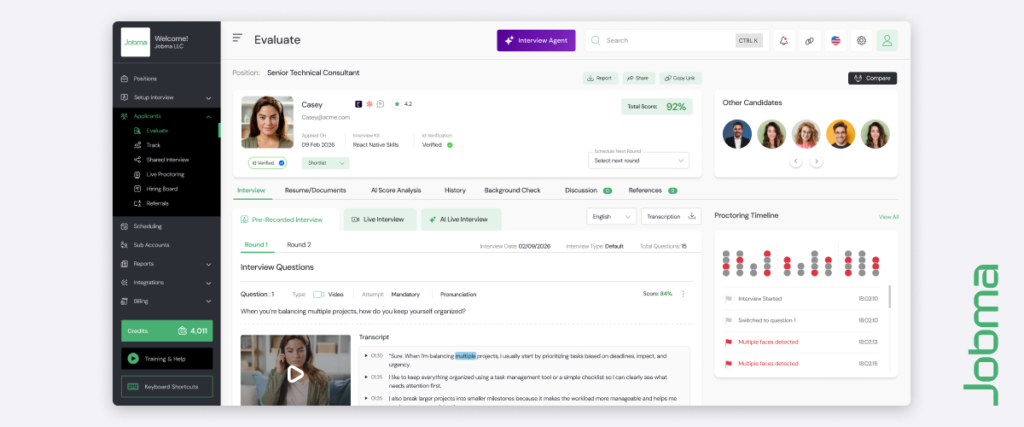
Most platforms built for high-volume hiring combine two or more of these formats: one-way or AI-interviewer screening for early-stage volume, and live video for the more in-depth conversations that follow with hiring managers and clinical leadership.
Beyond recording and playback, platforms in this category add scoring and evaluation tools, ATS integrations, identity verification, and compliance features that turn video into a defensible part of the hiring process.
Why Do Healthcare Organizations Need Video Interview Software?
Healthcare recruitment isn’t like corporate hiring. TA teams must manage high applicant volumes across diverse roles, from frontline clinical staff (RNs, ICU nurses, physicians) to allied health professionals (radiologists, physical therapists) and administrative roles (medical billers, intake coordinators).
The standard interview process- job post, resume screen, phone call, one or two live interviews, and offer- assumes candidates and recruiters can find overlapping windows of time relatively easily. In healthcare, that assumption falls apart for a few specific reasons, including:
Unpredictable Shift Schedules: Nurses and physicians working night shifts or 12-hour rotations rarely have time for a scheduled 15-minute phone screen during standard business hours. Chasing them for a live phone or video screen often means voicemail tag, last-minute cancellations, and no-shows.
High-Volume & Time-Sensitive Demands: Urgent clinical vacancies directly impact patient care ratios and facility operations. In addition, high-demand postings, including ER, ICU, and travel nursing, can pull in hundreds of applications, but only a small fraction of applicants may clear the licensing and clinical bar. Recruiters need a way to screen at volume without adding headcount.
Evaluating Soft Skills Early: Clinical certifications verify hard skills, but evaluating soft skills, like empathy, communication, and composure under pressure, traditionally required in-person time.
Strict Regulatory & Security Requirements: Healthcare hiring requires rigorous candidate verification and compliance to protect patient safety and institutional integrity. Increasingly, state and local laws govern the use of AI in hiring decisions, such as New York City’s Local Law 144 and Illinois’s AI Video Interview Act.
Multi-Facility Coordination Overhead: Large health systems are frequently hiring across dozens of locations simultaneously, each with its own hiring managers, timelines, and staffing gaps.


Benefits of Video Interview Software
For healthcare TA teams working under the pressures listed above, video interviewing addresses several of these pain points directly:
- Faster Time-to-Fill: Screening candidates asynchronously, in batches, removes the scheduling back-and-forth that stretches out early-stage hiring, often the single biggest source of delay in a nursing or clinical req.
- Higher-Quality Shortlists Earlier: Structured, role-specific questions surface communication style, composure, and situational judgment before a candidate ever reaches a live interview, so hiring managers spend their time on stronger finalists.
- Standardized & Fair Evaluation: Multi-person scoring grids and uniform prompts reduce bias, ensuring candidates are evaluated purely on competencies and situational judgment.
- Better Accommodation for Shift-based Candidates: Recording a response between shifts or on a day off removes a major source of candidate drop-off that live scheduling introduces.
- Documentation for Compliance: Recorded interviews and structured scoring create an audit trail that can support compliance with state and local AI-in-hiring laws, and provide a clearer record if a hiring decision is ever challenged.
- Lower Cost Per Hire: Cutting down recruiter hours spent on scheduling and first-round phone screens frees up time for higher-value work, without adding to headcount.
What to Look for in a Video Interview Software for Healthcare
Not every video interviewing platform is built with healthcare’s constraints in mind. When evaluating options, a few categories matter more here than in most other industries.
Asynchronous (One-Way) Video Interviewing Capability: One-way video interviews allow recruiters to send pre-set, role-specific prompts. Candidates record their answers when and where it suits them, whether that’s at 2:00 AM after a shift or on a day off. Recruiters can then review responses in batches.
Live & Panel Interviewing Capabilities: Once initial screening is complete, seamless live video capabilities enable multi-person panel interviews with managers, department heads, and HR directors without requiring everyone to be in the same room.
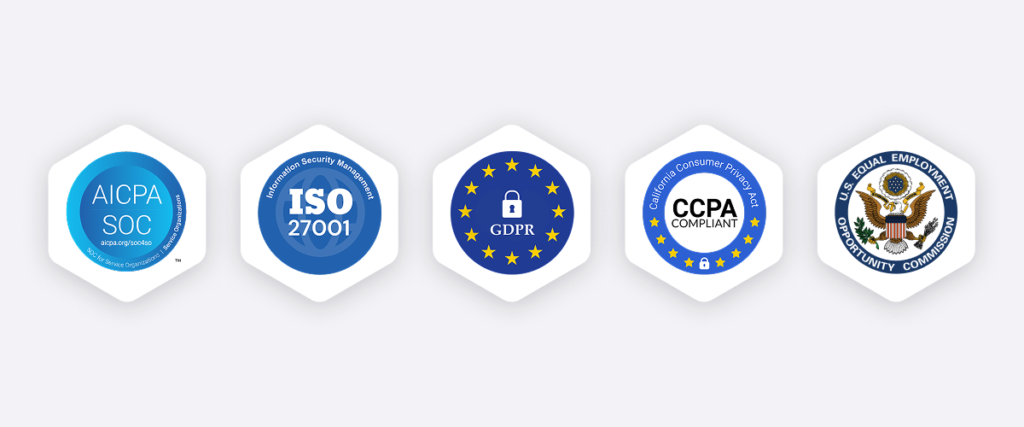
Compliance and Data Security: Look for SOC 2 and ISO 27001 certification at minimum, along with GDPR and CCPA compliance if you hire across regions with those requirements. Given the regulatory attention on AI-assisted hiring, ask specifically whether the platform is built to support compliance with laws like NYC’s AEDT rule and Illinois’s AIVIA; this typically means clear disclosure to candidates, audit trails, and limits on automated decision-making.
Identity Verification & Interview Integrity: Due to credentialing requirements in healthcare, software must include safeguards to verify that the person taking the interview is the actual applicant. Features like identity check integrations and AI proctoring preserve hiring integrity.
Self- Scheduling Flexibility: Look for a tool that supports self-scheduling for candidates, where the recruiter can set their open time, and candidates can choose a time that works for them. Asynchronous interviews with a reasonable, configurable response window (rather than a rigid single deadline) accommodate the reality of rotating shifts far better than anything requiring a live call.
Structured, Role-Specific Assessments: Generic interview templates don’t capture whether a candidate can handle the pace of an ICU or communicate clearly with anxious patients. Platforms that support customizable, role-specific question sets and skills or situational-judgment assessments give hiring teams more signal before a live interview is ever scheduled.
Mobile Friendliness & Accessibility: Given the diversity of the healthcare workforce, features like screen reader support, full-screen and voice-command navigation, and multiple ways to complete an assessment matter – both for candidate experience and for reducing legal exposure.
Integrations: A video interviewing tool that doesn’t sync cleanly with your existing medical system, HRIS, or applicant tracking system just adds another manual step to an already overloaded recruiting workflow. This extends to background verification and specialized credentialing software, since license and credential checks need to move in step with interview screening.
Best Practices for Using Video Interview Software in Healthcare Recruiting
Keep Questions Job-Relevant and Structured: Standardized questions tied directly to the role’s clinical or interpersonal demands produce more comparable, defensible results across a large candidate pool than open-ended or generic prompts.
Give Candidates a Real Window to Respond: Because the workforce you’re recruiting from is disproportionately working irregular hours, a 24-72 hour response window (rather than same-day deadlines) reduces drop-off without meaningfully slowing your pipeline.
Disclose AI Use Clearly: If your platform uses AI in any part of screening or evaluation, tell candidates plainly what it does and doesn’t do. This isn’t just good practice in a growing number of jurisdictions; it’s the law.
Use It as a Filter, Not a Final Decision: The strongest healthcare hiring processes use one-way video to narrow a large pool efficiently, then bring a smaller, better-qualified group into live conversations with clinical leadership before any offer is made.
Loop in Credentialing Early: Video screening shouldn’t happen in isolation from license and credential verification; building the two into the same workflow catches disqualifying issues before a hiring manager invests time in a live interview.
How the Leading Platforms Compare for Healthcare Hiring
Here’s how four of the more commonly evaluated options compare.
| Feature / Capability | Jobma | VidCruiter | Spark Hire | HireVue |
|---|---|---|---|---|
| Primary Target Market | Mid-Market & Enterprise | Mid-Market & Public Sector | SMB & Mid-Market | Large Enterprise |
| Healthcare Customization | High (Role-specific kits & custom workflows) | High (Highly custom workflows) | Moderate (Standard templates) | High (Enterprise-level modeling) |
| Setup & Ease of Use | Fast setup, intuitive interface | Complex setup, steep learning curve | Fast setup, straightforward | Complex deployment, long onboarding |
| Compliance & Governance | High enterprise compliance & security | Strong compliance & security features | Basic compliance features | High enterprise compliance & security |
Jobma: Purpose-built for organizations that need compliance depth, accessibility, and scale in the same platform. Strongest fit for health systems balancing high-volume clinical hiring with strict regulatory requirements.
VidCruiter: Frequently shortlisted by organizations where compliance documentation is the top priority, with a long audit history that regulated industries recognize.
Spark Hire: A more affordable option for smaller or mid-market employers with lower hiring volumes. Less suited to high-volume, multi-location clinical hiring, where manual review starts to add up.
Hirevue: Built for very large enterprises, delivers strong AI-assisted assessment capability at scale, but the cost and configuration overhead can be a poor fit for mid-size health systems.
How Jobma Solves Healthcare Recruiting Challenges
Several generalist video platforms exist; Jobma stands out as a purpose-built, highly scalable solution for healthcare recruitment teams. Here is how Jobma transforms clinical and non-clinical hiring workflows:
Tailored Role Workflows: Jobma enables recruiters to quickly deploy structured interview kits specifically designed for clinical roles (e.g., assessing situational awareness under stress), allied health, or admin positions.
AI-Powered Screening Assistance: Jobma’s ethical AI provides automated response transcriptions, multi-language support (supporting 16+ languages), and standardized scoring summaries to help recruiters pinpoint top talent faster.
Seamless ATS & HR Tech Integrations: Jobma integrates natively with over 70+ ATS and HR platforms – including iCIMS, Workday, and Greenhouse – allowing TA teams to trigger video invites directly from their existing workflow.
White-Labeled Candidate Experience: Medical centers can fully brand the candidate portal with custom logos, colors, emails, and video introductions from leadership, creating a professional and trustworthy first impression.
Enterprise Security & Compliance: Built for privacy-conscious environments, Jobma is SOC 2 Type II and ISO/IEC 27001 certified. It operates in full compliance with global privacy regulations, including GDPR and CCPA, while adhering to strict AI governance standards such as the EU AI Act. This includes end-to-end encryption for candidate data, transparent opt-in AI features, and human-in-the-loop decision-making controls.
Measuring the Impact: What to Track
Adopting video interview software isn’t a one-time decision; it’s worth tracking whether it’s actually moving the numbers that matter to healthcare hiring teams. A few metrics are worth building into your regular reporting:
Time-to-Fill by Role and Specialty: Track this before and after adoption, broken out by specialty (ER, ICU, behavioral health, allied health) rather than as a single blended number. Shortages hit specialties unevenly, and a platform that helps significantly with general nursing roles may move the needle less on harder-to-fill specialty positions.
Interview-to-Offer Conversion Rate: If video screening is working as an effective filter, the live interviews that follow should convert to offers at a noticeably higher rate than they did under a phone-screen-first process. A conversion rate that doesn’t improve is a sign the screening questions or evaluation criteria need revisiting.
Candidate Drop-off at Each Stage: Healthcare candidates, especially in high-demand specialties, have options and limited patience for slow processes. Watching where candidates disengage – after the application, after the video invite, after screening – tells you whether the tool is actually reducing friction or just moving it to a different stage.
Recruiter Hours per Hire: One of the clearest ROI signals is whether recruiters are spending less time on scheduling and initial screening and more time on higher-value work like candidate relationship-building and closing offers.
Compliance and Audit Readiness: For regulated jurisdictions, track whether disclosure and documentation requirements are being met consistently, not just at initial rollout. This matters most during external audits or if a hiring decision is ever challenged.
None of these metrics matter in isolation; a shorter time-to-fill that comes with a worse candidate experience or weaker hires isn’t actually progress. The goal is to track enough of the picture that a platform’s real impact, positive or negative, becomes visible within a hiring cycle or two.
Getting Started: Rolling Out Video Interviews Without Disrupting Hiring Managers
Even a strong platform can stall if hiring managers and clinical leadership aren’t brought along. A few practices tend to smooth adoption:
Start with One or Two High-Volume Roles: Rather than rolling out video screening across every open requisition at once, pilot it with a role that has high application volume and a clear, well-understood set of screening criteria; general nursing openings are a common starting point. This gives recruiting teams a controlled way to refine question sets before expanding.
Involve Clinical Hiring Managers in Question Design: Recruiters often draft the initial question set, but clinical leaders know which situational or competency questions actually predict success in a given unit. Their input up front reduces the number of “this doesn’t tell us what we need to know” complaints later.
Set Expectations with Candidates Clearly: A short note in the interview invitation explaining why the organization uses video screening, how long it should take, and what happens next helps reduce drop-off from candidates unfamiliar with the format.
Review Evaluation Results Together Early On: In the first few weeks, have recruiters and hiring managers review a sample of completed interviews together to calibrate expectations and confirm the scoring or evaluation approach is capturing what actually matters for the role.
Ready to modernize your healthcare recruiting strategy? Discover how Jobma helps hospital systems and healthcare organizations hire qualified, patient-ready talent faster. Request a demo today!