Is Your Hiring Process Ready for the AI Interview Era?
AI is changing how recruiters and job seekers approach each stage of the hiring process. Recruiters use AI to write job ads, then job seekers use those ads to create AI-assisted applications. Recruiters volley back by using AI to screen those applications, and candidates do the same by using AI to prepare for interviews.
So, how do you tell who really has the skills they claim, and who’s using AI to refine their responses?
With both sides relying heavily on AI, this question matters more than ever. A 2026 Clutch survey found that 67% of companies now use AI in recruiting, while 78% of job seekers use it somewhere in their job search.
For employers, AI makes hiring much faster. It assists with everything from sifting through resumes to conducting AI-led interviews. On the other side of the coin, job seekers use the same technology to enhance how they present their qualifications.
Understanding how AI is changing recruitment on both sides will help you identify where traditional practices are no longer enough. It also helps you effectively use AI in hiring while staying transparent and fair.
How Employers Are Already Using AI in Hiring
For many companies, AI has already become part of the hiring routine. According to SHRM, 43% of HR professionals said they used AI in 2025, up from 26% in 2024.
Resume screening and skills matching are two popular applications of AI. Instead of manually sifting through hundreds of resumes, AI matches candidate skills with the job’s requirements to quickly identify top candidates.
During the interview stage, AI can analyze one-way video responses and score them based on factors like clarity, communication, and expertise. Some hiring teams have also been experimenting with autonomous AI interviewers, which ask candidates questions in real time.

AI also speeds up hiring by automating live interview scheduling, so you don’t have to email back and forth to find a time that works for both interviewers and the candidate. After the interview, the AI can score candidates based on recruiter-defined criteria. For example, a candidate interviewing for a lead developer role may be scored on relevant factors such as familiarity with coding languages, leadership skills, hands-on experience with diverse projects, etc. These extra data points can help you make more objective hiring decisions.
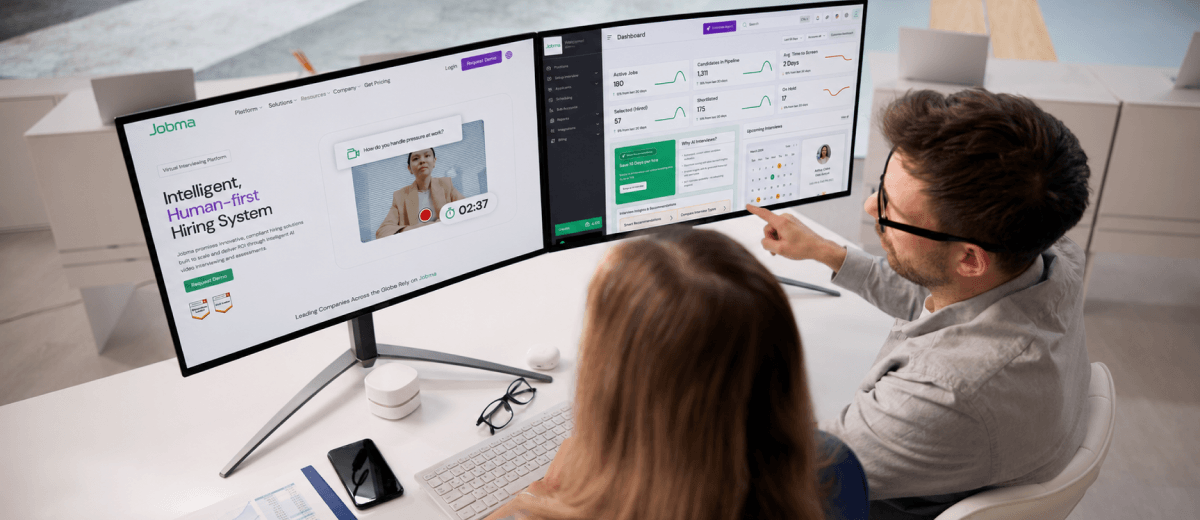
Using even one or two AI tools can have a huge impact on efficiency. For example, teams that use platforms like Jobma for structured AI-assisted interviewing decrease time-to-hire by 70%. They also reduce hiring costs by 75%.
One sticking point is transparency around when and how companies use AI in interviews. If a candidate joins a live interview expecting to speak with a human recruiter, they may feel taken aback when they realize they’re talking to an AI agent instead. They also grow apprehensive about whether AI will be making the decision to hire them, rather than a human.
It’s interesting to see that candidates aren’t just walking away. Many are using AI in response.
The Candidate Side: How Job Seekers Are Using (and Gaming) AI
Job seekers are well aware of AI-driven hiring, and they’re not just sitting back while it happens. They’re using AI, too. In fact, the Clutch survey found that 80% of candidates have used AI tools at some point during their job search.
AI makes it easy to polish and tailor applications. According to Clutch data, 84% of job seekers have used AI to edit their resumes, while 66% used it to write cover letters. This type of AI assistance is broadly considered acceptable, like asking a grammar-savvy friend to look over a resume. Using AI to prepare and rehearse for interviews is also generally seen as reasonable.
But when it comes to using AI during actual interviews, the water gets much muddier.
Candidates who use AI during interviews may not actually have the knowledge or skills they claim. That can lead to performance gaps if their AI-assisted responses convince recruiters to hire them. For instance, a nonprofit manager recently told Bloomberg about how they hired a grant writer after a “polished” interview. Within a month, they realized that their new hire couldn’t do the project he was interviewed for.
But every company’s stance on AI use can be different. L’Oréal considers interviews an ‘AI-free zone,’ asking candidates to interview in person, and Anthropic bars the use of AI in live interviews and take-home assessments. However, companies like Meta and Canva actively encourage candidates to use AI during coding tests. That’s because these roles are often AI-assisted, making AI literacy an essential skill.
That’s why blanket banning AI in interviews isn’t necessarily the answer.
What’s Actually Breaking?
When both sides use AI, you need to set guardrails to keep the hiring process reliable. The interview still needs to reflect a candidate’s expertise and fit, while clearly stating where AI is part of the process.
That makes transparency and human oversight more important than ever. Keep an eye on how AI influences candidate responses and evaluations, while making sure human recruiters remain responsible for the final hiring decision.


For Employers Using AI to Screen
AI screening tools promise to help you find qualified candidates faster. That’s a major perk, but it also comes with its concerns.
Potential bias is one of the biggest drawbacks. A Stanford study of four million job applications found that AI screening software can reinforce racial bias and other systemic inequalities. If an AI tool relies on biased algorithms or incomplete data, using it on more applications only scales the problem instead of fixing it.
Return on investment also remains an area of concern. In a 2025 Gartner survey, 88% of HR leaders said AI tools haven’t created significant business value for their organization, despite widespread adoption.
Many qualified candidates are opting out, too. If your hiring process is AI-heavy or lacks transparency, it may affect candidate experience and their willingness to join your organization. According to the Greenhouse 2026 Candidate AI Interview Report, 38% of candidates interviewed have walked away from roles that included AI interviews, and another 12% say they would.
For Employers Dealing With AI-Assisted Candidates
As more candidates rely on AI to make a good first impression, recruiters are facing a new issue: skillfishing. It occurs when job seekers overstate their abilities or credentials, often with the help of AI. For instance, someone might use AI to give convincing answers about Ruby during a tech interview, even if they’ve never actually used the programming language.
Skillfishing can lead to selecting candidates who interview brilliantly with AI assistance, but flounder once they get the job. These performance gaps also put a greater burden on the existing team members who have to make up for them.
To truly understand a candidate’s abilities, you need to pair interviews with evaluation methods that AI can’t replicate or adopt more rigorous methods to detect AI assistance.
How to Update Your Hiring Process for the AI Era
More isn’t always better, especially when it comes to using AI in hiring. The teams gaining ground are using this technology more deliberately instead of simply adding more tools. At the same time, they’re creating evaluation stages that candidates can’t easily game.
Here’s what that looks like in action:
Move Skills Verification to the Top of the Funnel
Recruiters need to hire candidates with the right skills. That approach still makes sense, but resumes and applications alone don’t always give you a clear picture of what someone can actually do.
In other words, don’t just filter candidates out based on keywords. A candidate may have the right skills without using the exact terms you’re looking for, while AI can also make it easier to polish how those skills are presented.
Instead, move low-cost, high-signal skills assessments earlier in the hiring process, before the interview round. If you’re hiring for technical roles, ask candidates to complete a short debugging exercise or coding challenge. Scenario-based tasks and language proficiency tests can also help you measure their abilities.
Evaluating skills early gives you a stronger signal of what candidates can actually do, rather than relying mainly on how well they write or present their applications.
Shift Toward Structured, One-Way Evaluation
Traditional interviews and take-home coding tests don’t always give you enough visibility into how candidates complete the process, especially when AI tools are part of the equation.
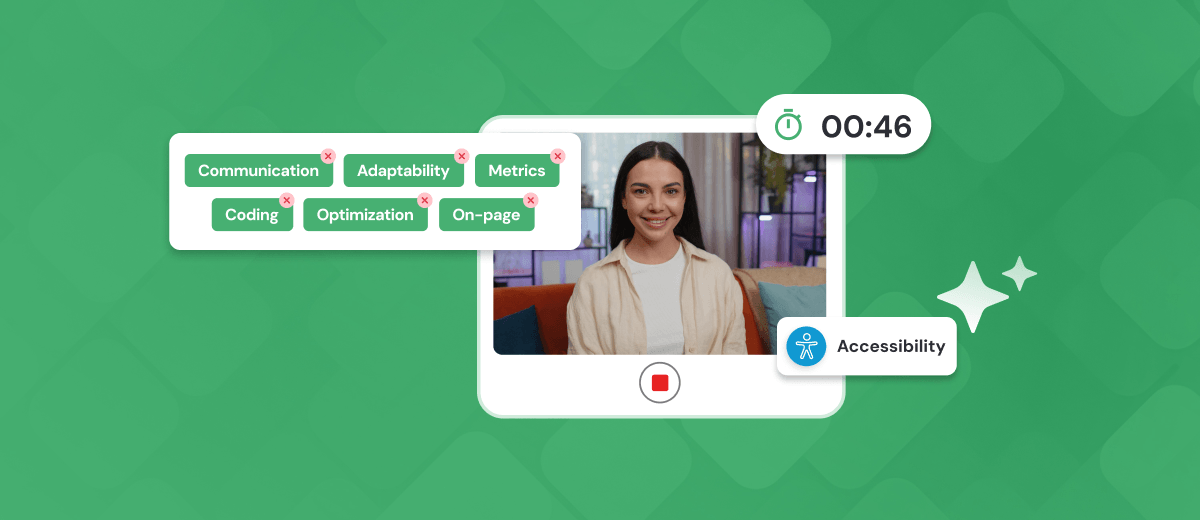
One-way video interviews are another practical option. Ask candidates to solve a problem, walk through how they would use a tool, or explain a sample of their work. Built-in identity verification and liveness detection can help confirm who is completing the interview. Smart proctoring detects and flags unusual activities like switching between browser tabs, copy-pasting answers from an external resource, or using a mobile device to answer questions. This gives candidates a consistent way to demonstrate their skills while helping you understand how the assessment was completed.
Consider using AI to build role-based assessments and scoring rubrics to use for all candidates and assess key skills required for a role.
Be Transparent About AI in Your Process
Always be upfront about when your hiring team uses AI and what it measures. Candidates tend to trust you more when you’re transparent and feel more prepared for how they can represent their skills better.
For example, if you use AI to screen resumes, mention it in the job post. You should also explain where a human reviews the results and how you minimize potential bias. To maintain ethical AI use, follow a human-in-the-loop and ensure a recruiter is responsible for making any hiring decision.
Keep Humans in Charge of Decisions
While AI helps filter and surface top candidates, it doesn’t replace human recruiters. The years of experience of a seasoned HR professional are essential to decide whether to select a candidate or not. This step matters both for quality control and for legal defensibility as lawmakers scrutinize AI hiring more closely.
Job seekers need to know there’s a human in charge, too. According to the Greenhouse report, 38% of U.S. candidates want confirmation that a person reviews AI output before hiring decisions are made.
Focus on developing collaborative review processes that help make AI-assisted hiring smarter, not just faster. For instance, create dashboards where hiring managers, recruiters, and panelists can share feedback in one place. Be sure to include standardized rubrics and criteria for consistency and fairness.
Adapt to the New Hiring Norm
AI has become a constant but often invisible part of the hiring process. From candidates writing resumes with AI models like ChatGPT and Claude, to companies using AI to interview and assess candidates, both sides are adopting this technology at a rapid rate.
Resist the urge to try to AI-proof your hiring practices. It’s not realistic to expect candidates to stop using this technology altogether. Instead, look for ways to assess genuine skills and catch unauthorized AI use.
Above all, be honest. When candidates understand how you use AI and where humans have a say, they’re more likely to trust your company. Over time, that can help you attract candidates who know how to use AI while still having non-negotiable skills to perform well at the job.

Disclaimer: This article was authored by a guest contributor or third party. The views expressed are their own and do not necessarily reflect those of Jobma. Jobma does not endorse any products, services, or claims mentioned. This content is for informational purposes only.