Top AI Recruitment Tools for Enterprises in 2026
As we move through 2026, the conversation around AI in recruitment has shifted. It is no longer about which tool can “automate” the most, but about how systems are orchestrated, governed, and defended against risks like bias and AI-driven fraud.
With the EU AI Act in full enforcement and the EEOC tightening its grip on algorithmic bias, organizations can benefit more from transparent, agentic systems.
This guide profiles 11 enterprise recruitment tools your team already trusts, ranked by adoption and compliance fit. Core capabilities have been sourced directly from vendor claims for accuracy.
What are AI Recruitment Tools?
Different recruitment tools support different stages of hiring, including sourcing, screening, candidate engagement, video assessment, evaluation, and pipeline analytics, while also aligning with growing regulatory requirements.
Unlike earlier solutions, the most effective platforms in 2026 are built to integrate into existing ATS and HR systems. They provide outputs that recruiters can review, question, and override, supporting requirements like bias audits, transparency, and human oversight for high-impact decisions.
Core capabilities include:
- Skills-based resume parsing (rather than relying on demographic proxies)
- AI-powered video screening for competencies like communication and problem-solving
- Conversational screening via chat or SMS with opt-out options
- Pipeline forecasting based on actual hiring outcomes
- Detection of manipulated content and tools to ensure candidate authenticity
Most organizations use these tools alongside their core systems, where they support specific parts of the hiring process rather than replacing them entirely.
Why Are Enterprises Adopting AI Recruitment Tools?
As hiring volume increases and processes become more distributed, teams need better ways to manage time, maintain consistency, and make informed decisions. Adoption has grown quickly, 87% of talent acquisition professionals now use AI tools regularly for tasks like sourcing, screening, scheduling, and interview documentation. But adoption isn’t the same as impact, fewer teams check whether AI saves time once the tools are in place. At the same time, regulations are raising the bar, requiring both speed and precision. As AI adoption expands across business functions, understanding AI advertising on ChatGPT is becoming increasingly relevant for organizations evaluating how generative AI is reshaping both recruitment and marketing.
Key drivers include:
- Scale Amid Complexity: High-volume sectors require continuous, large-scale screening. Modern tools help teams handle this volume without sacrificing consistency.
- Compliance Imperative: Regulations such as Colorado SB 24-205 and California’s Automated Decision Systems (ADS) framework require risk assessments, transparency notices, and auditability. Organizations must ensure their hiring systems can withstand regulatory scrutiny.
- Fraud Defense: Generated resumes, deepfake interviews, and identity manipulation are growing concerns. Many platforms now include verification and proctoring features to ensure candidate authenticity.
- Bias Mitigation: Regulations such as Illinois HB3773 place strict limits on discriminatory outcomes. Skills-based evaluation helps reduce reliance on proxies like age or location.
- Maintain Consistency in Evaluation: Structured workflows ensure candidates are assessed against standardized criteria, reducing variability across hiring teams.
Ultimately, organizations are adopting these tools to turn compliance and consistency into a competitive advantage.

Top AI Recruiting Tools Defining Hiring in 2026
Here are the top tools, ranked by adoption and compliance fit. Each embeds AI purposefully, whether it’s for sourcing, video interviewing, or CRM, while supporting audits and human loops.
Here are the top AI recruiting tools currently defining the hiring landscape:
- Workday
- Jobma
- Zapier
- Paradox
- HireVue
- Manatal
- Bullhorn
- Recruit CRM
- Eightfold AI
- Beamery
- Qureos
- Recruitment Management 365
1. Workday
Workday functions as a unified HRIS, ATS, and talent management system with embedded AI capabilities such as skills-based matching, internal mobility recommendations, and predictive hiring insights.
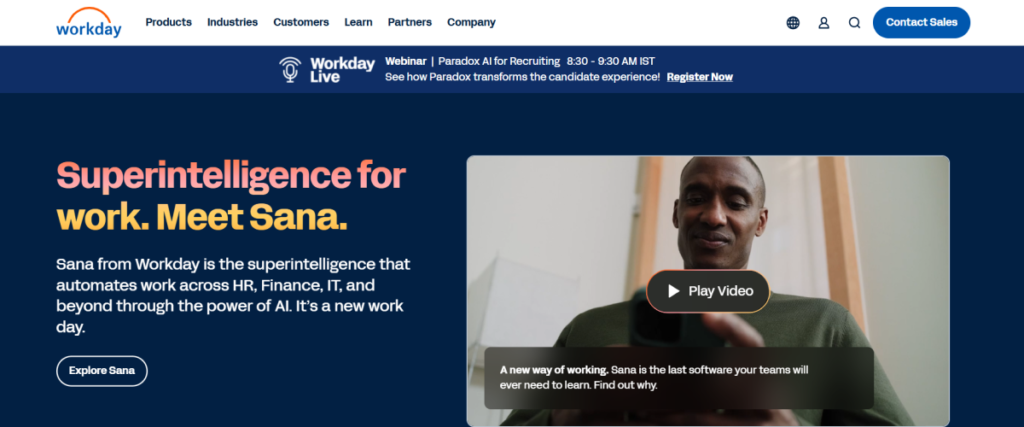
Through its HiredScore AI tool for recruiting, Workday enables organizations to analyze talent pipeline holistically while maintaining governance controls, audit logs, and compliance-ready reporting structures.
It surfaces top talent from internal/external sources while generating compliance-ready dashboards for bias monitoring. It is widely used in large corporations where hiring decisions must align with strict regulatory and retention requirements.
Strengths: Enterprise-grade integrations, predictive analytics to tie activity to outcomes, and compliance infrastructure.
Limitations: Complex implementation cycle and high deployment cost.
| For enterprises that rely on Workday as their core HR and recruiting system, adding structured video interviews can make the hiring workflow more efficient. See how the Jobma Workday integration helps teams connect video interviewing, assessments, and candidate evaluation directly with their Workday hiring process. |
2. Jobma
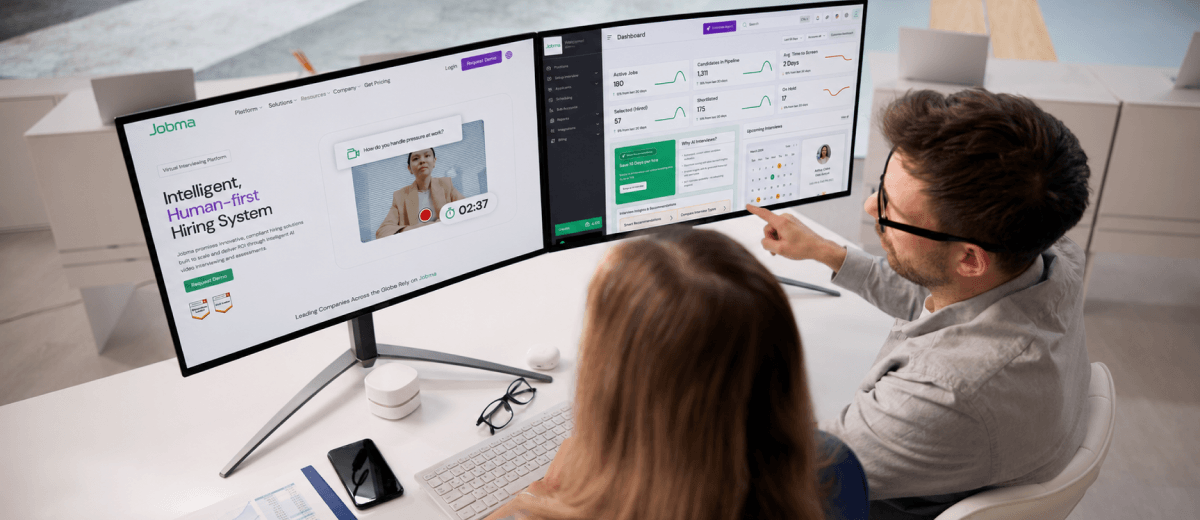
Jobma is an AI video interviewing and assessment platform designed to bring structure, flexibility, and integrity to early-stage hiring. It supports asynchronous (one-way), live, and autonomous interview formats, allowing teams to adapt their screening approach based on role complexity and hiring volume.
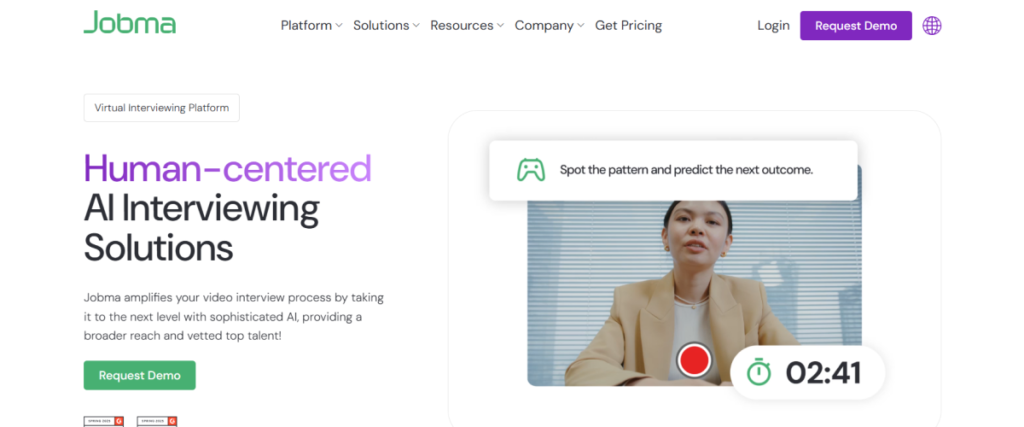
The platform combines video interviewing with built-in assessments, including skills testing, language proficiency evaluation, and game-based assessments. Features such as automated self-scheduling, SMS-based interview invites, and custom-branded candidate portals help reduce coordination friction while maintaining a strong candidate experience.
Its AI capabilities support interview summarization, candidate response analysis, multilingual transcription, and evaluation consistency across hiring teams. Features such as video-based ID verification and AI-driven proctoring (including detection of multiple faces, tab switching, and suspicious activity) support integrity in high-volume hiring environments.
Strengths: Flexible formats, strong proctoring and verification, structured evaluation, ATS integration, multilingual support
Limitations: Best suited for structured, high-volume hiring workflows; may require change management for teams transitioning from traditional interview processes.
3. Zapier
Zapier connects ATS platforms, communication tools, and HR systems, allowing teams to automate workflows into a unified workspace. With 9,000+ integrations, it enables teams to automate workflows across tools like Workday, Bullhorn, Slack, and Teams without relying on engineering resources.
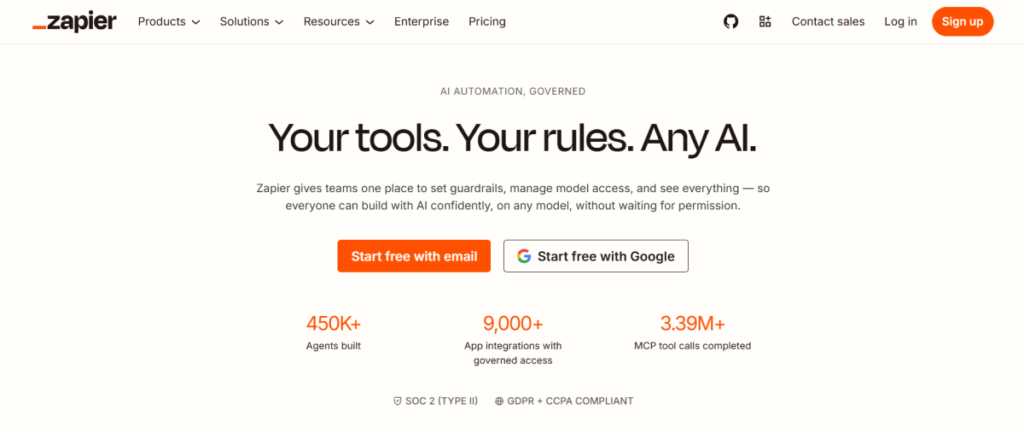
Beyond AI workflow automation, Zapier provides a controlled environment for scaling AI across the It allows teams to connect AI models (e.g., ChatGPT, Claude) to business workflows while maintaining centralized guardrails, access controls, and policy enforcement. Every action is logged through a unified audit trail, giving IT and compliance teams full visibility into how automation and AI are being used.
Strengths: Extensive integrations, strong AI governance and auditability, no-code workflow automation, full visibility across systems.
Limitations: Not a standalone recruiting platform, lacks recruitment-specific intelligence or decision-making capabilities.
4. Paradox
Paradox uses conversational AI to automate high-volume hiring through chat and SMS. Its AI assistant handles candidate screening, interview scheduling, and real-time engagement, allowing candidates to apply and move through the funnel instantly.
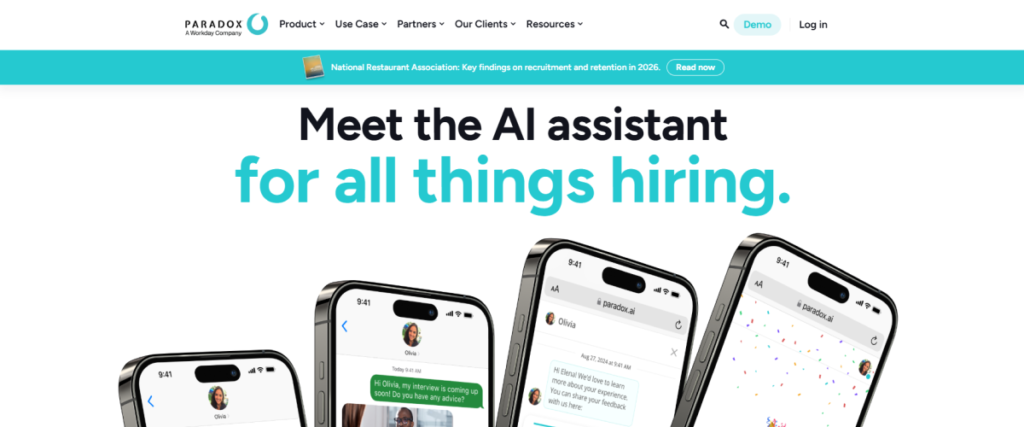
Beyond engagement, Paradox streamlines key hiring workflows, including interview scheduling, candidate preparation, hiring events, and onboarding coordination, significantly reducing time-to-apply and recruiter workload.
Strengths: High-volume hiring automation, strong conversational engagement, real-time scheduling, and multilingual support.
Limitations: Primarily focused on front-of-funnel workflows; limited depth in candidate evaluation and advanced analytics.
5. HireVue
HireVue combines structured video interviewing with scientifically designed assessments to deliver a more holistic view of candidate potential. Beyond asynchronous video responses, the platform incorporates game-based evaluations that measure cognitive traits such as memory, adaptability, and problem-solving.
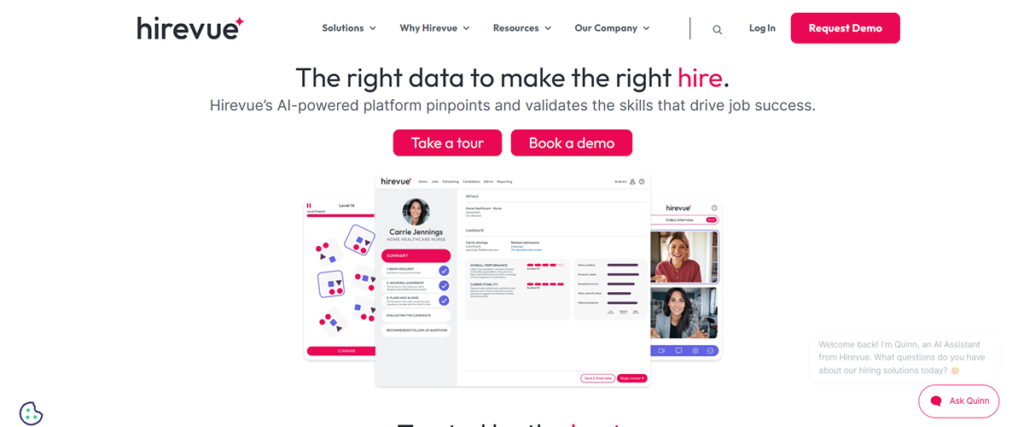
It offers pre-built competency frameworks, virtual job tryouts, technical and language assessments, and live or panel interview capabilities, allowing organizations to standardize evaluation across different roles and hiring scenarios.
Strengths: Scalable structured assessments, multi-format evaluation (video + game-based), strong adoption, consistent competency-based screening
Limitations: Requires careful human calibration to avoid over-reliance on automated scoring
| Looking for a HireVue alternative with structured video interviews, assessments, proctoring, and flexible hiring workflows? Explore this Jobma vs HireVue comparison to see which platform fits your hiring needs better. |
6. Manatal
Manatal is an AI-powered recruitment software that’s designed to source and hire candidates faster. It combines candidate sourcing, enrichment, and automated screening in a single platform. It enables teams to publish roles across thousands of job boards, manage pipelines through a customizable interface, and centralize hiring workflows.
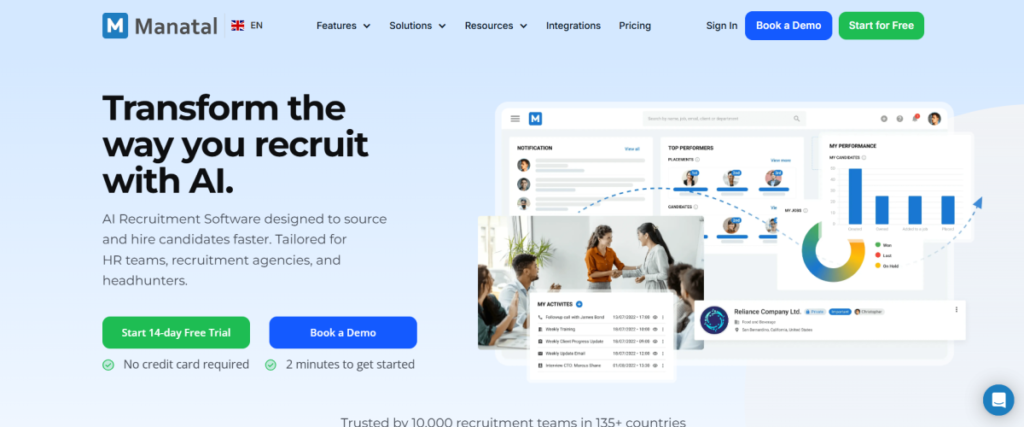
Its AI engine supports candidate matching and ranking, while profile enrichment pulls data from LinkedIn and other public platforms to build more complete candidate profiles. Features like an AI interviewer, automated screening, and integrations with tools such as ChatGPT and other LLMs allow recruiters to analyze candidates, generate insights, and streamline communication directly within the platform.
Strengths: All-in-one ATS + CRM, strong sourcing reach (2,500+ job boards), candidate enrichment, quick setup, and cost-effective scaling.
Limitations: Less depth for highly complex workflows; AI features require oversight to ensure accuracy and relevance.
7. Bullhorn
Bullhorn is a staffing-focused ATS and CRM platform designed to optimize high-velocity recruiting and drive placement outcomes. Built specifically for staffing agencies, it combines front-office recruitment workflows with back-office operations to create a unified system for managing candidates, clients, and revenue pipelines.
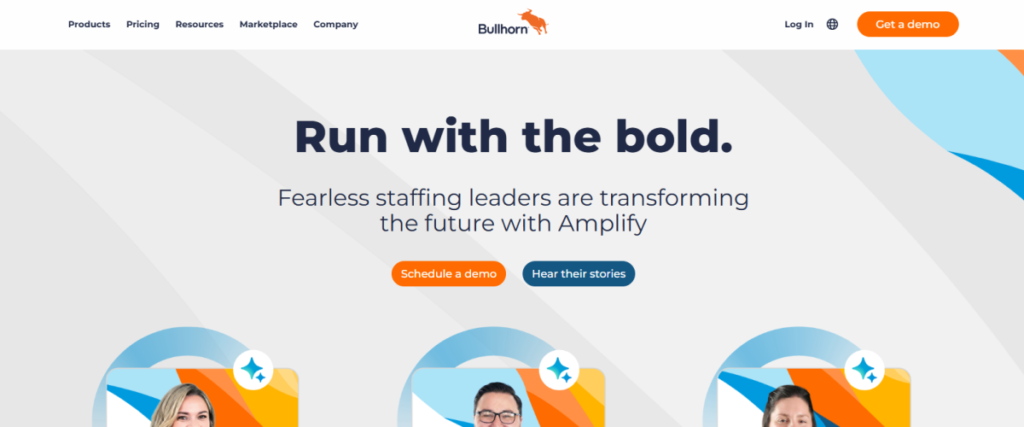
Its AI capabilities focus on automating repetitive tasks such as sourcing, screening, and outreach, while improving candidate matching and submission quality. Features like AI-assisted search and match, messaging support, and predictive pipeline insights help recruiters make faster, more informed placements without increasing headcount.
Strengths: Deep staffing specialization, strong AI CRM + ATS integration, revenue and placement-focused analytics, scalable automation for high-volume environments
Limitations: Less suited for non-staffing or corporate HR teams; requires onboarding to fully leverage its ecosystem.
| Already using Bullhorn and want to add structured video interviews to your hiring workflow? Learn how the Jobma Bullhorn integration helps staffing teams simplify interview management, reduce manual coordination, and keep candidate data connected within their existing Bullhorn ecosystem. |
8. Recruit CRM
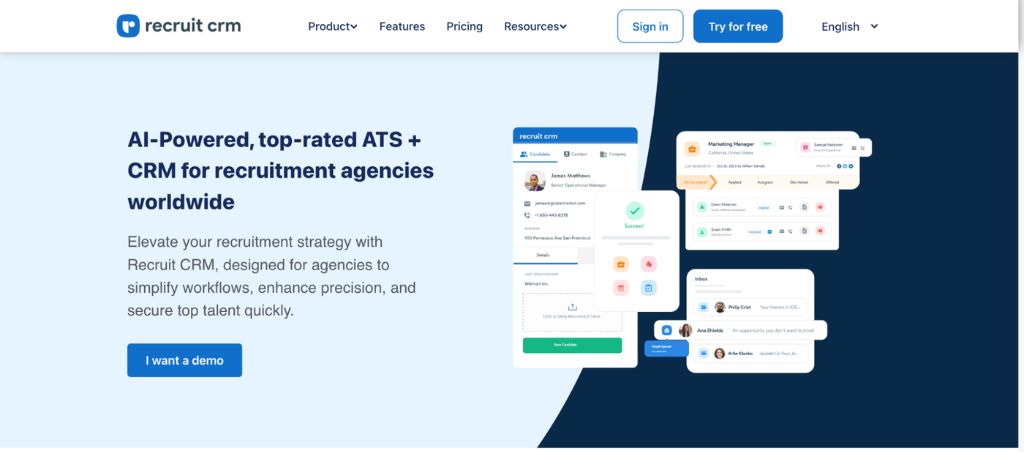
Recruit CRM is a cloud-based ATS and CRM platform built specifically for recruitment and staffing agencies to manage the full hiring cycle, from sourcing to placement, within a single system. It combines AI-powered resume parsing, candidate-client pipeline management, and email/workflow automation, allowing agency recruiters to move candidates through stages, track client relationships, and manage revenue pipelines without switching between separate tools.
Beyond core ATS-CRM functionality, Recruit CRM offers a Chrome sourcing extension, customizable pipelines, automated email sequences, and integrations with job boards, calendars, and communication platforms. For agencies weighing their options against more established, heavier-setup platforms, this comparison of bullhorn alternatives breaks down how Recruit CRM and similar tools stack up on cost, onboarding speed, and ease of use.
Strengths: Purpose-built for staffing/recruitment agencies, fast onboarding, AI-assisted resume parsing and candidate matching, strong automation for outreach and pipeline management, competitive pricing relative to legacy platforms.
Limitations: Less suited for large corporate HR teams outside the staffing/agency model; fewer enterprise-scale workforce planning features compared to platforms like Eightfold AI or Beamery.
8. Eightfold AI
Eightfold AI is a talent intelligence platform built around deep skills-based matching and workforce planning. It uses large-scale career data and AI-driven skills inference to match candidates across both external pipelines and internal talent pools.
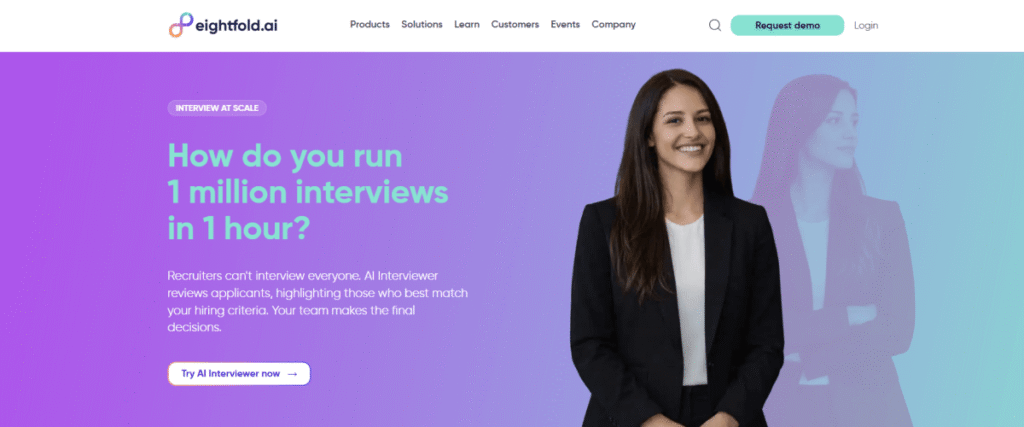
It is a data-rich AI engine trained on billions of career trajectories and millions of skills, enabling organizations to identify best-fit talent, uncover adjacent skills, and support long-term workforce decisions. Its agentic AI workflows automate repetitive talent tasks while surfacing real-time insights, helping organizations shift toward a more dynamic, skills-based “infinite workforce” model.
Strengths: Deep skills, intelligence and data scale, strong internal mobility and workforce planning capabilities, unified talent lifecycle approach, real-time matching across internal and external talent.
Limitations: Complex implementation and longer onboarding cycles; requires organizational maturity to fully leverage its capabilities.
9. Beamery
Beamery is a talent lifecycle and workforce intelligence platform that connects hiring, workforce planning, and talent engagement through a unified skills-based data layer. It enables organizations to model future workforce needs, identify skill gaps, and align talent strategy directly with business outcomes.
Beyond traditional CRM capabilities, Beamery uses AI to infer skills from candidate and employee data, delivering real-time recommendations for sourcing, internal mobility, and pipeline development. Its platform supports long-term talent engagement, proactive pipeline building, and scenario-based workforce planning. It acts as an intelligence layer across the talent lifecycle, enhancing both recruiting and broader workforce decisions.
Strengths: Strong workforce intelligence and skills inference, deep talent lifecycle coverage (hiring to retention), strategic workforce planning capabilities, robust integrations.
Limitations: Requires integration with ATS/HRIS for full execution; best suited for mature organizations with defined talent strategies.
10. Qureos
Qureos is an AI-powered talent acquisition platform and managed services provider that helps companies reach candidates they couldn’t find on their own and hire them faster. Its recruiting agents handle the heavy lifting: surfacing hard-to-find talent through automated multi-channel sourcing, running custom phone and video screening, and managing end-to-end recruitment operations. This saves talent acquisition teams hundreds of hours of manual work and frees them to focus on relationships, judgment calls, and candidate experience.
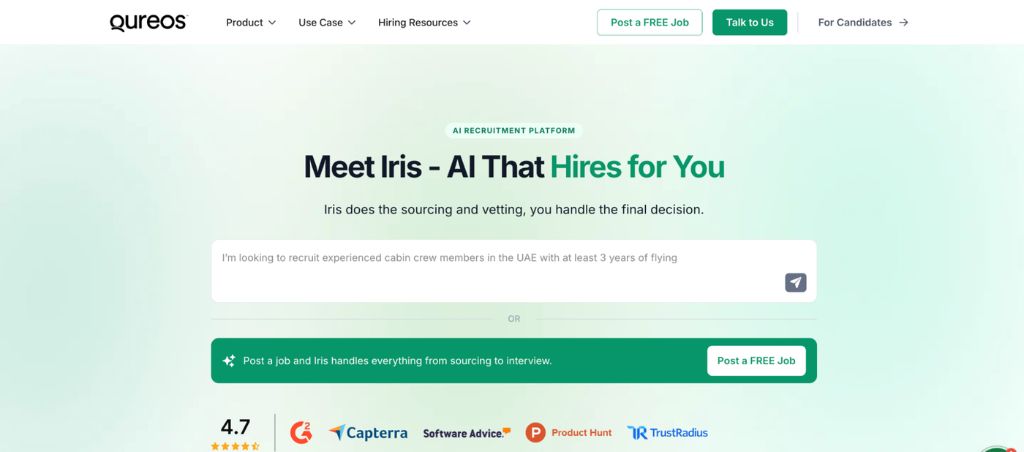
It lets HR teams either run the software themselves or fully outsource hiring on an outcome-based model, so companies hire better talent in less time, at lower cost, with leaner teams. It is widely used across the GCC, powering hiring for Qatar Airways, Baan Holdings, Yousef Al-Rajhi Group, Alzayani Investments, Union Properties, and Saudi Development and Export Services Co. Ltd (SDRS).
Strengths: Automated multi-channel sourcing, custom phone and video screening, end-to-end managed services with outcome-based pricing, and strong regional proof across major GCC enterprises.
Limitations: Deepest track record is concentrated in the GCC rather than globally.
Recruitment Management 365
Recruitment Management 365 is an AI Recruitment Software built on Microsoft 365 that helps HR teams manage the entire hiring process from job posting to onboarding in one centralized platform. As a Microsoft Recruitment Software and SharePoint Recruitment Software, it combines AI-powered resume screening, intelligent candidate ranking, interview scheduling, automated workflows, and real-time hiring insights all within SharePoint, Microsoft Teams and Outlook. This enables recruiters to reduce manual work, improve collaboration and make faster, data-driven hiring decisions without leaving the Microsoft ecosystem.
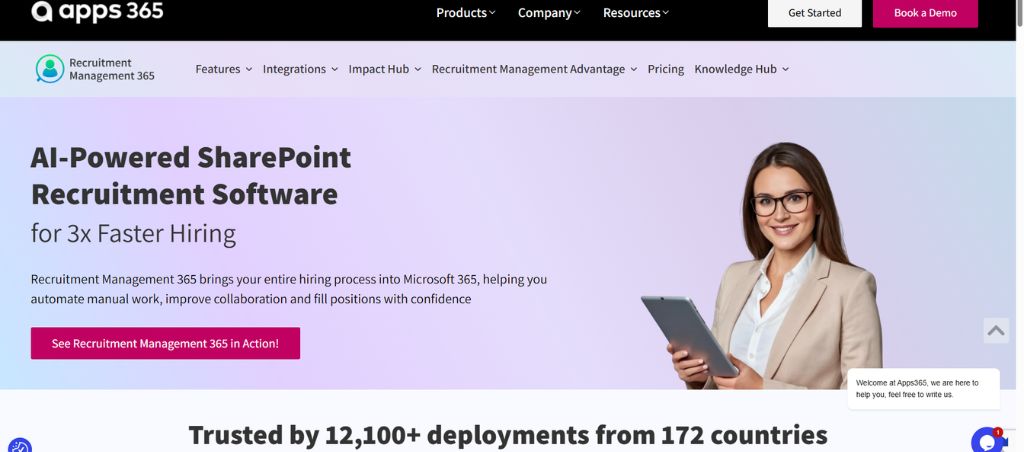
Beyond AI-powered recruitment automation, Recruitment Management 365 provides a secure Microsoft 365 environment with role-based access, centralized candidate records, workflow automation, seamless integration with SharePoint, Teams, Outlook and Microsoft Copilot. Organizations gain complete visibility into recruitment activities while keeping hiring data protected under Microsoft security and compliance standards.
Strengths: End-to-end recruitment management, AI resume screening and candidate ranking, Microsoft 365 and SharePoint native integration, automated hiring workflows, interview scheduling, secure role-based access, real-time recruitment dashboards and built-in AI Copilot assistance.
Limitations: Designed primarily for organizations using the Microsoft 365 ecosystem, advanced capabilities and integrations are optimized for Microsoft tools and environments.
Considerations
Despite rapid adoption, AI recruitment tools introduce new challenges that organizations must actively engage with:
Vendor Accountability: Legal precedent increasingly suggests that employers remain responsible for outcomes produced by AI systems. Vendors, including IT services providers, are therefore being treated as extensions of organizational decision-making infrastructure making it essential to vet them carefully through verified reviews platforms loke SelectedFirms before committing to any platform.
Integration Complexity: While many tools offer integrations, aligning multiple AI systems across ATS, CRM, and HRIS platforms requires significant implementation effort.
Auditability Requirements: Organizations must ensure regular bias testing, documentation, and transparency reporting.
Human-in-the-Loop Necessity: Automated decisions should not be final; humans should make the final decision to ensure ethical and contextual judgment.
Choosing the Right AI Recruitment Tool
As the market matures, the selection criteria are shifting from features to governance readiness:
- Transparency: Can the vendor clearly explain how decisions or recommendations are generated?
- Audit Readiness: Does the system support compliance documentation and reporting?
- Data Provenance: Can it identify manipulated or questionable candidate inputs?
- Integration Depth: How seamlessly does it fit into your existing ATS and HR workflows?
- Human Control: Can recruiters review, adjust, and make the final call when needed?
- Override Capabilities: Does it allow recruiters to easily review, question, and override an AI recommendation without breaking the workflow?
In 2026, the idea of selecting the single “best” platform has become obsolete. It is about building a system that works together across sourcing, screening, assessment, engagement, and analytics, much like a SaaS backlink marketplace builds visibility.
For example, an ATS like Workday often acts as the system of record, while platforms like Jobma support structured video interviews and assessments. When these two are integrated, hiring teams can create an end-to-end, high-integrity pipeline.
Tools like Zapier help connect workflows across systems, ensuring data and actions move smoothly between platforms. In other cases, solutions like Manatal or Bullhorn strengthen sourcing, CRM, and pipeline management within the broader hiring stack.
The value comes from how well these systems work together, not just how strong they are individually.
Final Perspective: Building a Connected Recruitment Ecosystem
Because recruitment demands everything from deep database compliance to identity verification, the most resilient talent functions are built as layered ecosystems rather than standalone silos.
True efficiency is found in interoperability, not individual feature depth.
- A core ATS or HRIS that anchors candidate data and workflows
- Specialized tools for structured assessment, screening, and engagement
- Integration layers that ensure data flows cleanly across systems
Ultimately, the goal is not to build an automated, human-free hiring pipeline, but to leverage a well-orchestrated ecosystem. AI remains a powerful co-pilot, not an autopilot. Modern recruitment systems are most effective when they support human judgment rather than replace it.
Beyond dedicated recruiting software, many enterprise teams now add a general-purpose AI layer that connects across their existing tools. Platforms like Coworker AI act as an AI assistant that plugs into the apps a business already runs, so recruiters and hiring managers can pull candidate context, draft outreach, and automate follow-ups without switching tabs. Paired with a purpose-built interviewing platform like Jobma, teams get both depth in hiring and breadth across everyday work.