How Can AI Video Interviews Reduce Time-to-Hire?
Hiring speed has become a competitive advantage in the modern talent market. Top candidates expect to receive offers within days, leaving organizations with little room to rely on lengthy recruitment processes, scheduling delays, and manual screening.
AI video interviews help transform recruitment by automating early-stage screening and eliminating bottlenecks in traditional interviewing workflows. AI-powered video interviewing platforms enable faster candidate evaluation, improve recruiter productivity, and significantly reduce time-to-hire.
Why Time-to-Hire Matters
Time-to-hire measures the number of days between a candidate entering the hiring pipeline and accepting a job offer. A lengthy hiring process can create business challenges, including:
- Loss of qualified candidates to faster-moving competitors
- Increased recruitment and operational costs
- Delays in project delivery and compromised team productivity
- Higher workloads for recruiters managing large candidate pools
As organizations compete for talent, reducing time-to-hire is a key recruitment priority.
How AI Video Interviews Accelerate the Hiring Process
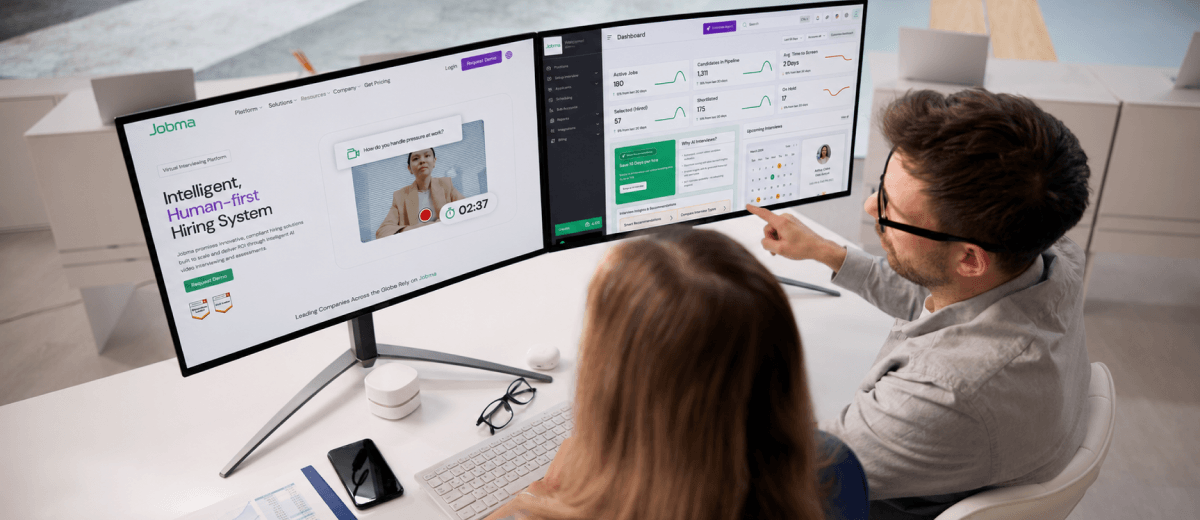
AI video interviews are used to conduct initial candidate screening without requiring a recruiter to be present in real-time. Candidates interact directly with an AI agent, which asks role and skill-based questions, proctors the interview, and captures and analyzes responses to highlight key performance insights and summaries. Video interviewing platforms like Jobma also generate interview scores, transcribe answers, and provide recruiters with structured insights that support faster and more consistent candidate evaluation.
1. Eliminating Scheduling Bottlenecks
One of the biggest causes of hiring delays is coordinating screening interviews between recruiters and candidates. Traditional phone screens often require multiple emails, calendar coordination, and rescheduling.
Autonomous AI video interviews can be conducted without requiring recruiter availability. Candidates can interact with an AI agent and complete interviews at their convenience. You can later access smart summaries, performance scores, and key skills to select the top candidates. This flexibility allows screening more candidates without extending hiring timelines.
2. Faster Candidate Screening
Reviewing hundreds of resumes and conducting initial screening calls consumes significant recruiter time. AI interviews streamline this process by autonomously conducting first-round interviews and highlighting key performance indicators. Instead of spending hours on repetitive screening conversations, you receive structured insights highlighting key skills, qualifications, experience, and role-fit. This helps hiring teams identify qualified candidates faster and move them to the next stage faster.
3. Automated Candidate Prioritization
High-volume hiring often makes it difficult to determine which candidates are the best fit for the role. Video interviews help solve this challenge by organizing interview data about experience, skills, and performance into structured insights and scores that make candidate comparison easier. You can quickly identify top-rated applicants who demonstrate the strongest alignment with job requirements, reducing the time spent sorting through large candidate pools and accelerating shortlisting decisions.
4. Consistent First-Round Interviews at Scale
With video interviews, you can ensure that every candidate is evaluated using the same questions, instructions, and evaluation criteria. This standardized approach reduces variability between interviews and helps assess applicants more consistently, fairly, and objectively. It also makes it easier to compare candidates side by side, leading to more confident and efficient hiring decisions while maintaining a uniform candidate experience.
The Business Impact of AI Video Interviewing
Research shows that organizations using AI recruitment tools can reduce time-to-hire by 40% or more through automation and streamlined screening workflows. Autonomous AI interviews improve recruiter productivity by reducing administrative work, eliminating repetitive screening calls, and enabling faster candidate evaluation. For enterprise organizations hiring at scale, these efficiencies translate into faster hiring decisions, lower recruitment costs, and improved candidate experiences.