Smarter Hiring with AI Scoring and Summarization
Hiring decisions are rarely limited by a lack of candidate data. If anything, hiring teams are overwhelmed with it. Interviews, notes, scorecards, feedback threads – all of it exists, but very little of it is structured in a way that makes decision-making easier.
But this core problem can be solved with smart and intuitive AI tools.
Instead of expecting recruiters to manually interpret hours of interview content, AI helps convert raw response recordings into clear, structured, and comparable insights. The result is not just faster hiring, but more consistent and reliable decisions.
To understand the impact, you have to first look at where traditional evaluation starts breaking down.
The Inefficiency of Traditional Interviews
Traditional interviews were designed for small-scale hiring environments where decisions were made by a handful of stakeholders. In that context, subjectivity was manageable. At scale, the scenario becomes different.
When multiple recruiters and hiring managers evaluate candidates across different roles, locations, and timelines, three problems consistently show up:
- Evaluation Inconsistency: Each interviewer interprets responses differently, leading to uneven assessments across candidates. Two equally qualified candidates can receive completely different outcomes based on who evaluates them. Over time, this leads to missed talent and poor hiring decisions.
- Decision Delays: Reviewing interviews takes significant time, especially when hiring volumes increase. Decision delays directly impact business performance. When roles remain unfilled, productivity drops, teams stretch thin, and growth slows.
- Weak Comparability: Candidates are evaluated based on subjective opinions, making it difficult to rank them objectively. If you cannot reliably compare candidates, you cannot confidently select the best one. You’re effectively making decisions in isolation rather than in context.
Individually, these challenges feel manageable. Together, they create a system that doesn’t scale well.
AI scoring and summarization address these challenges by ensuring that every interview is processed using the same framework, without relying on individual competence. Let’s discuss how it works in Jobma:
AI Scoring: Consistency at Scale
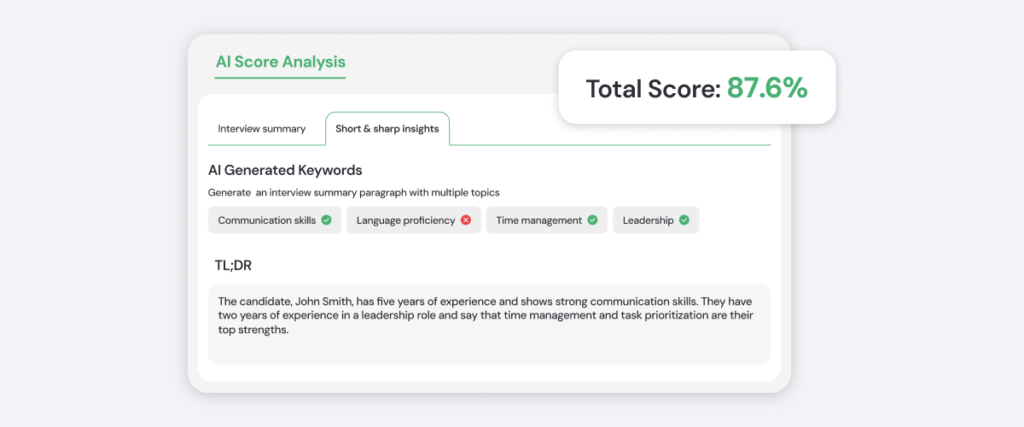
The AI scoring system analyzes a candidate’s pre-recorded interview responses and recommends a score based on how well they perform against the role requirements. The same predefined parameters are applied to every candidate, ensuring evaluations remain consistent and comparable.
- Response Relevance and Structure: The AI evaluates how directly a candidate answers the question, whether the response is structured logically, and how clearly ideas are communicated. This ensures that candidates who provide well-organized, job-relevant answers are scored better than those who give vague or unfocused responses.
- Skill and Expertise Alignment: The system identifies the skills demonstrated within responses and matches them against the job requirements. It checks how effectively candidates showcase their knowledge and whether their expertise aligns with what the role demands, reducing dependence on subjective interpretation.
- Depth of Experience: The AI looks at how thoroughly a candidate answers a question, not just what they say on the surface. It considers whether the response includes real examples, clear explanations, and measurable outcomes, or if it stays general and lacks detail. This helps distinguish candidates who have hands-on experience from those who speak in broad or theoretical terms.
- Role-fit: Beyond individual answers, the AI considers how well the candidate aligns with the overall role. It studies consistency across responses, ensuring that candidates who show steady alignment and relevance are rated higher than those whose answers feel disconnected or inconsistent.
Based on the candidate’s overall performance and role-fit parameters, the system recommends a percentage score. This level of consistency is difficult to achieve manually, especially at scale. By standardizing evaluation, AI scoring removes variability and creates a more reliable baseline for decision-making.
AI Summarization: Making Interviews Actionable
While scoring provides a numerical recommendation, summarization provides the context behind it. Jobma’s AI converts full interview recordings into structured insights that highlight what matters most, eliminating the need to watch every response over and over again.
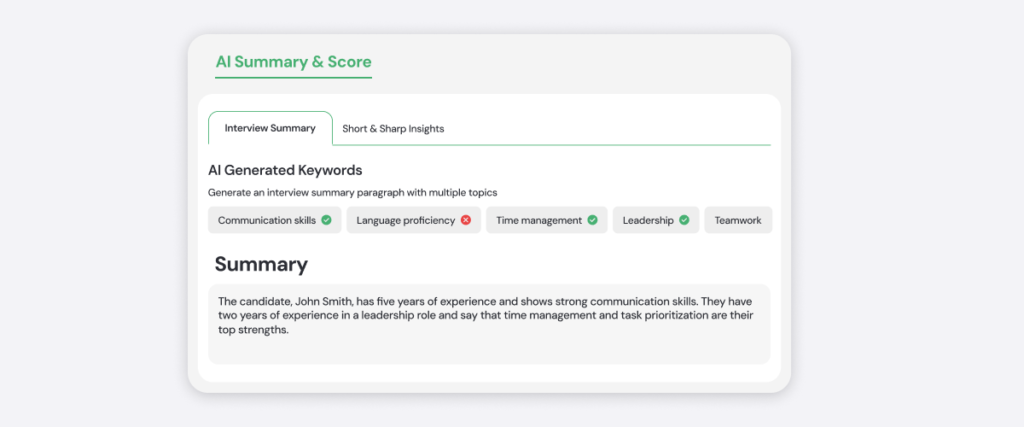
- Performance Overview: The AI creates a clear summary of how the candidate performed throughout the entire interview. It highlights the overall quality of their answers, how clearly they communicated their thoughts, and how consistent they were from one response to the next. This gives recruiters a quick but reliable understanding of whether the candidate meets the expected standard of performance or not.
- Key Strengths Identification: Instead of recruiters having to pick out strengths on their own, the system highlights where the candidate performed well. It points to specific skills they demonstrated, strong examples they shared, and moments where they showed clear expertise or confidence. This makes it easier to understand what the candidate brings to the role and where they stand out compared to others.
- Areas of Improvement: The AI also highlights where the candidate may fall short. This could include answers that lack depth, responses that are unclear, or gaps in required skills. By identifying these areas clearly, the system ensures that recruiters get a complete view of the candidate’s performance for a more balanced evaluation. It helps them know the avenues where the candidate needs upskilling before moving ahead.
- Role Alignment Insights: The summary connects the candidate’s performance directly to the requirements of the role. It helps recruiters understand not just how the candidate performed in general, but how relevant their skills, experience, and responses are for the specific position. This makes it easier to decide whether the candidate is truly a good fit for the role.
AI-powered summaries transform interviews from passive recordings into actionable insights. The system identifies factors and skills that the human eye may miss or may be overlooked due to prejudice. So, candidates are reviewed fairly and more closely in decision-making.
From Detailed Analysis to Quick Decisions
Recruiters need a clear and focused view of a candidate’s most relevant skills to better understand their performance and role fit. Instead of sorting through entire interviews, Jobma’s AI engine highlights key skills and extracts relevant keywords, helping recruiters quickly identify what truly matters for the role. This makes it easier to assess how closely a candidate aligns with the job requirements while still supporting a more informed, evidence-backed evaluation.
- Skill Extraction: The AI identifies and highlights the key skills a candidate talks about or demonstrates through their video responses. It doesn’t just pick up mentioned terms – it also analyzes how those skills are explained and applied in answers. This helps recruiters quickly understand whether the candidate has the core competencies needed for the role at a glance.
- Keyword Mapping: The system extracts relevant keywords from the candidate’s responses and matches them to the job requirements. This makes it easier to see how closely the candidate’s experience and expertise match what the role demands. It also helps bring consistency to evaluation, especially when recruiters are reviewing a large number of candidates and need reliable data to compare them.
- TL;DR Summaries: Using the identified skills and keywords, recruiters can generate short, focused summaries that highlight the most important aspects of a candidate’s profile. These summaries give a quick but meaningful overview of the candidate’s strengths, experience, and role fit. This helps recruiters review profiles more efficiently while still having the context needed for a proper evaluation.
This balance between depth and speed ensures that recruiters can move efficiently without losing critical context.


Standardized Candidate Comparison
Comparing candidates is where hiring often gets most subjective. Without a clear structure, decisions can come down to who made a stronger impression, who communicated better, or simply what an interviewer remembers. When different people are involved, each with their own way of evaluating, it becomes even harder to compare candidates fairly.
Through Jobma’s smart insights, recruiters get consistent data and information that makes comparisons simpler and more reliable.
- Skill-based Comparison: Instead of judging candidates based on how confident or polished they sounded, recruiters can see the actual skills each candidate demonstrated during the interview. It becomes easier to answer questions like – who really showed problem-solving ability, who has hands-on experience, and who understands the role better. This keeps the focus on what matters, not just how someone presents themselves.
- Strengths and Gaps: The system clearly shows what each candidate did well and where they may be lacking. You don’t have to figure this out by making guesses or reading long notes. It points out strong moments, like clear examples or solid answers, and also highlights gaps, like unclear responses or missing relevant experience.
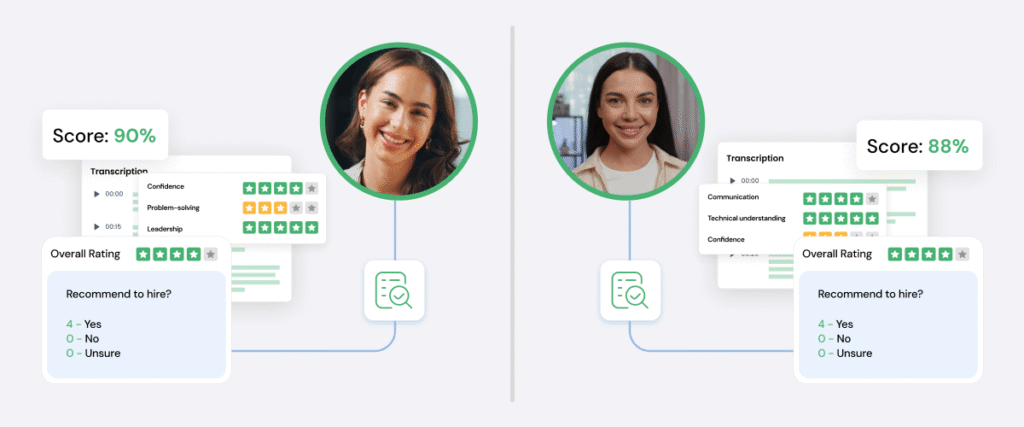
- Score-backed Evaluation: The AI also recommends a score that reflects how the candidate performed overall. Since every candidate is scored using the same criteria, it becomes much easier to compare them. Instead of going back and forth between notes, recruiters can use the score as a starting point and then look deeper into specific skills. It helps speed things up without taking away control from the recruiter.
When comparisons are structured like this, decisions feel more grounded. Recruiters don’t have to rely on guesswork or memory – they have clear, consistent information to make better hiring choices.
Additional AI Capabilities to Increase Decision Efficiency
AI Transcripts
One of the most common challenges in hiring is going back to an interview to find a specific detail. Without transcripts, recruiters often have to rewatch entire recordings just to locate one moment in a response, which takes time and slows down the process.
AI tools like Granola AI solve this by automatically converting every interview into a time-stamped, multilingual transcript. So, recruiters have the complete record they can go through at any point, without depending on memory or scattered notes.
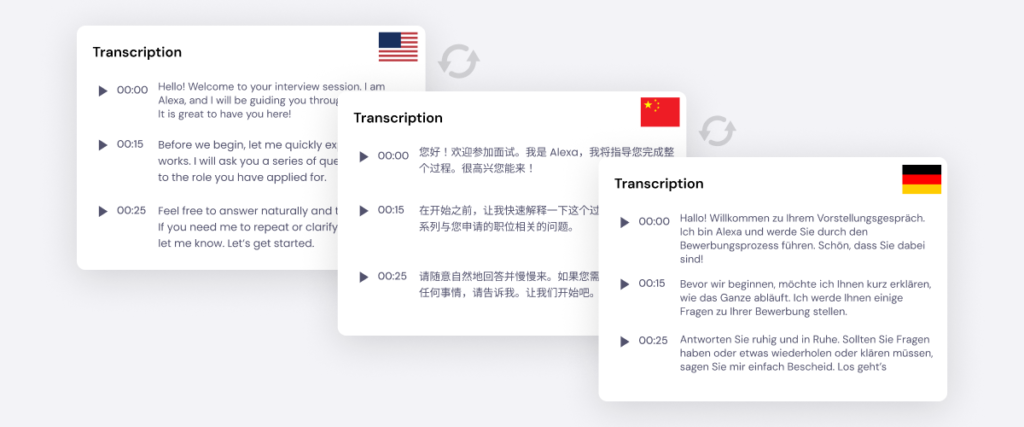
Transcripts also make it easier to share candidate information with others involved in the hiring process. Team members can quickly read through responses, align on feedback, and make decisions faster. Overall, it makes it much easier to review and validate candidate responses in a structured way. For teams comparing transcription workflows, Feisworld’s AI notetaker comparison covers capture methods, summaries, privacy, and workflow fit.
AI Proctoring
In pre-recorded interviews, recruiters are no longer in the same room as candidates. This makes it harder to ensure that the process is fair and that responses are genuinely the candidate’s own.
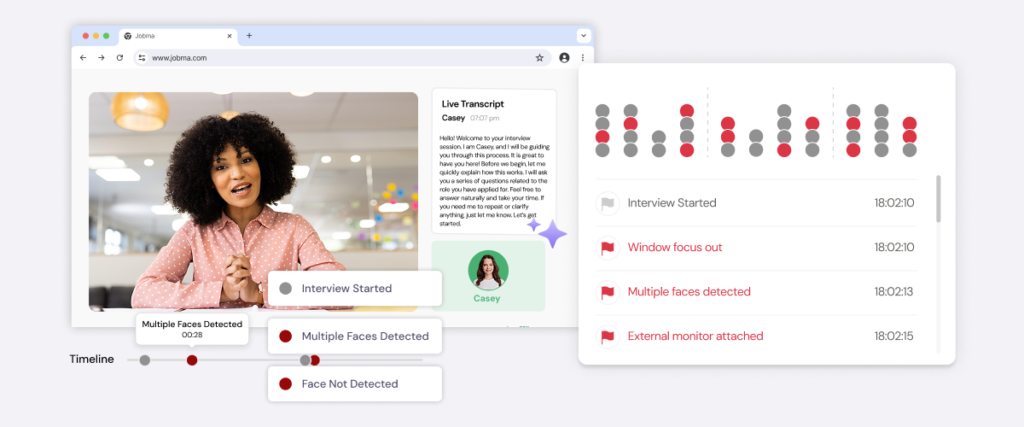
With AI-powered proctoring, rest assured, you get the information about any unethical activity that happened in the interview. The system detects unusual activities, like using multiple screens, copy & paste actions, using a mobile device, etc., and flags them in the interview timeline for the recruiter. This ensures that recruiters stay in control of the final decision, while the system helps ensure that nothing important is missed.
Autonomous AI Interviews
Jobma’s autonomous AI interviews remove the dependence on interview scheduling, especially when dealing with large volumes or candidates in different time zones. The AI simulates an interview in a structured way, asking questions and following up based on the candidate’s responses. This helps gather deeper insights into their skills and experience, similar to how a real conversation would unfold.
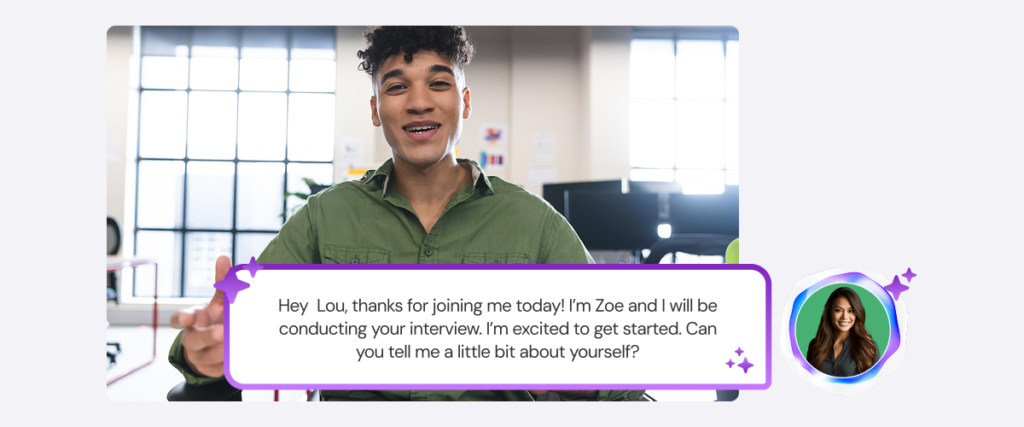
Since every candidate goes through the same structured interview flow, the information collected remains consistent and easy to compare. At the same time, candidates have the flexibility to complete the interview when it works best for them, and get a chance to show their true potential without the anxiety of interacting with an interviewer. Recruiters still receive detailed, structured insights without needing to attend each interview. This makes the entire process more efficient and scalable, allowing teams to move faster.
Why AI Matters in Modern Hiring
- Reduced Time to Hire: AI speeds up the most time-consuming parts of hiring, like scheduling and conducting interviews, taking notes, sharing feedback, and extracting performance indicators. Recruiters can move from screening to shortlisting much faster, which helps fill roles in less time and reduces delays caused by manual processes.
- Lower Cost Per Hire: When hiring takes less time and fewer resources, overall costs naturally go down. AI reduces the need for multiple interview rounds, large interview panels, and repeated evaluations, helping teams optimize both time and budget without compromising on quality.
- Improved Recruiter Productivity: Instead of spending hours on phone calls, syncing calendars, and writing notes, recruiters can focus on decision-making and candidate engagement. AI handles repetitive tasks like summarization, scoring, and transcription, allowing teams to manage higher volumes without increasing workload.
- More Structured Evaluation: Every candidate is evaluated using the same criteria, which brings consistency to the process without losing momentum. This reduces dependence on subjective opinions and ensures that decisions are based on comparable data.
- Reduced Bias in Decision-making: By focusing on responses, skills, and role relevance, AI helps minimize the impact of personal preferences and subjective judgment. It creates a more balanced evaluation process where candidates are assessed on the skills they demonstrate, not how they are perceived.
- Stronger Candidate Experience: Faster responses, consistent interviews, and a more organized process create a smoother experience for candidates. This reflects positively on the employer brand and helps attract better talent over time.
For healthcare organizations, hiring delays can directly affect patient care, team coverage, and operational efficiency. A Workday Integration for Healthcare Hiring helps recruiters move candidate data, interview updates, and evaluation insights between systems without manual work. When paired with AI scoring and summaries, this integration gives hiring teams a faster, more structured way to review candidates, reduce administrative delays, and keep healthcare recruitment workflows more consistent across departments.
The Bigger Shift
AI in hiring doesn’t replace recruiters or take over decision-making. AI in hiring doesn’t replace recruiters or take over decision-making. Modern AI agents in HR help recruiters automate screening, candidate evaluation, and interview workflows while keeping humans in control. Instead, it strengthens how hiring decisions are made by removing inefficiencies that slow teams down.
Jobma’s AI scoring and summarization bring structure to candidate evaluations. By turning raw video responses into clear, comparable, and actionable insights, recruiters spend less time searching for information and more time actually engaging with candidates. This shift improves efficiency in real time – decisions are faster, discussions are more focused, and hiring teams can move forward with greater clarity.
More importantly, this directly impacts ROI. When hiring becomes faster and more consistent, teams reduce time-to-hire, lower operational costs, and minimize the risk of inaccurate hiring decisions. Instead of relying on memory, scattered notes, or subjective impressions, recruiters work with structured data that supports better judgment.