Is Your Candidate Real? How to Verify Tech Talent Without Compromising Candidate Experience
How do you make sure the candidate you’re hiring for a technical role is real? You verify four things: that they can do the job, that they actually did the job written on their resume, that they’re the same person at every stage of assessment, and that they’re who they say they are.
The most reliable starting point is to watch them demonstrate their skills. Give them a short, skills-based assessment, then ask them to explain their approach. A resume can be borrowed, and an interview answer can be rehearsed. Resumes can be borrowed, and an interview can be scripted. But understanding the reasoning behind a solution, including the decisions and trade-offs involved, is harder.
But if you pile on too many assessments, lengthy interviews, and excessive monitoring, you risk losing the very candidates you’re trying to hire. A five-hour unpaid take-home assignment is an easy reason to pick another offer.
The Short Answer: 4 Ways to Make Sure Candidates Are Real
- Test Skills Hands-on Early: Use a short coding, troubleshooting, or scenario task tied to the real job, before anyone books a long interview loop.
- Make them Explain their Own Work: Follow up with a video or live walkthrough of their solution, plus a few unscripted questions.
- Check Consistency Across Every Stage: Look for the same person and the same depth of knowledge from the first screen to the final round. Proctoring flags tell you where to look closer.
- Verify Identity and Employment History: Verify identity during assessment and save background and reference checks for the later stages, typically at or after the offer.
The rest of this guide breaks down how to approach each step, with a particular focus on technical assessments. The goal is to separate demonstrated ability from a convincing profile while keeping the process reasonable for candidates.
What Should You Assess When Evaluating Tech Candidates
A single coding test won’t tell you everything. Strong tech hires combine hands-on skill with reasoning, judgment, and the ability to explain their thinking. Match each one to the format that tests it best.
| Skill Area | What It Tells You | Best Way to Assess It |
| Hands-on technical skill | Can they write, configure, or build what the role needs? | A timed coding challenge or practical task in the language or tool they’ll use |
| Debugging and troubleshooting | Can they find and fix a problem they didn’t create? | Hand them broken code, a failing test, or a simulated outage and see how they work through it |
| Problem-solving and reasoning | How do they approach an unfamiliar challenge? | Logic and pattern-based exercises, including game-based assessments |
| Judgment with AI tools | Can they spot when AI-generated code is wrong, insecure, or slow? | Give them AI-written output to review, if your AI policy allows it |
| Technical communication | Can they explain a decision to a teammate or a non-technical stakeholder? | A short video answer or live walkthrough of their own solution |
| Adaptability | How fast do they get productive with something new? | A short task with an unfamiliar library or slightly ambiguous requirements |
You don’t need every row for every role. A junior developer might get a coding challenge and a reasoning exercise. A senior sysadmin might get a troubleshooting scenario and a walkthrough of how they’d explain the fix to leadership.
Why You Shouldn’t Rely Only On Resumes and Interviews
A resume tells you where someone has been. It doesn’t tell you how much of that work they did on their own, or whether they could do it again today.
Credentials have the same problem from a different angle. Tools change every few months. What matters is whether someone can adapt, use judgment, and deliver with the stack in front of them.
So when you ask “Is this candidate real?”, you’re really asking three questions:
- Is this the person they say they are? Identity fraud and proxy interviews are a growing problem in tech hiring.
- Did they actually do the work on their resume? Inflated titles and borrowed project stories are far more common than outright fakes.
- Can they do this job? Even honest candidates may have skills that are out of date or never tested outside a tutorial.
A well-designed skill assessment helps answer all three. The first through proctoring and identity checks, the second and third through hands-on work that’s hard to fake.
How to Design a Technical Assessment That Actually Verifies Skills
1. Start With the Job’s Real Work
List the three or four tasks this person will do most in their first 90 days and build the assessment based on those. A cloud engineer might troubleshoot a misconfigured deployment. A support engineer might triage a set of tickets. A backend developer might extend an existing API.
Realistic tasks are harder to answer through memorization alone and more respectful of a candidate’s time, because the effort feels connected to the actual job.
2. Decide Your AI Policy Before You Send the Test
AI is part of how many employees work now. The question isn’t whether they use it on the job, but what you want to measure. Decide up front:
- Which parts must be done without AI help?
- If AI is allowed, does the candidate need to disclose it?
- Are you testing whether they can catch mistakes in AI output?
Include your AI policy in the invitation. Clear rules set fair expectations and make intentional violations easier to flag.
3. Layer Short Formats Instead of One Long Test
Marathon assessments drive top talent away. Short, multi-stage steps keep candidates engaged while revealing inconsistencies. A practical sequence could look like this:
- A 10- to 15-minute role-based screener with a few scenario questions.
- A 30- to 45-minute hands-on coding or troubleshooting task.
- A short reasoning or game-based exercise for problem-solving.
- A 2-minute video explaining one decision from the task.
Each format measures a different dimension. Together, they make it nearly impossible for a borrowed resume or a coached proxy to pass undetected.
4. Score Against a Rubric, Not a Gut Feeling
Define success metrics before candidates take the test. Score execution correctness, structural approach, code cleanliness, and handling of edge cases. Structured rubrics ensure objective, defensible hiring decisions.
5. Protect the Integrity of the Results
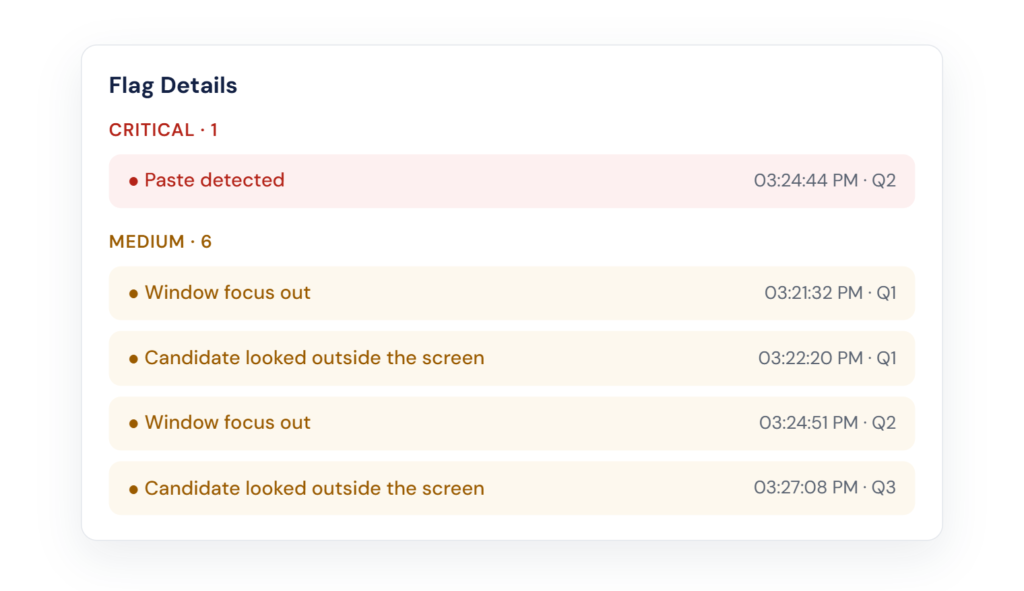
Assessment guardrails ensure results reflect the candidate’s independent work. Monitor for signals like excessive tab-switching, large pasted code blocks, or secondary faces on camera. Treat flags as indicators to investigate, not automatic rejections – a copy-paste alert may simply mean a candidate pasted code from their own local scratch file.
6. Follow Up With a Walkthrough
This is the step that catches what tests miss. Ask the candidate to walk you through their own solution and answer a few unscripted follow-ups:
- “Why did you choose this approach over the obvious alternative?”
- “What would break first if traffic doubled?”
- “What would you change if you had another hour?”
Someone who did the work can talk about it easily. Someone who didn’t usually stalls by the second question.
How Jobma Helps You Verify Tech Talent Without Deterring Top Candidates
Executing a layered evaluation manually across dozens of applicants takes significant time. Jobma’s skill assessment software automates this workflow, allowing talent acquisition teams to verify real ability early so hiring managers spend time interviewing only qualified candidates.
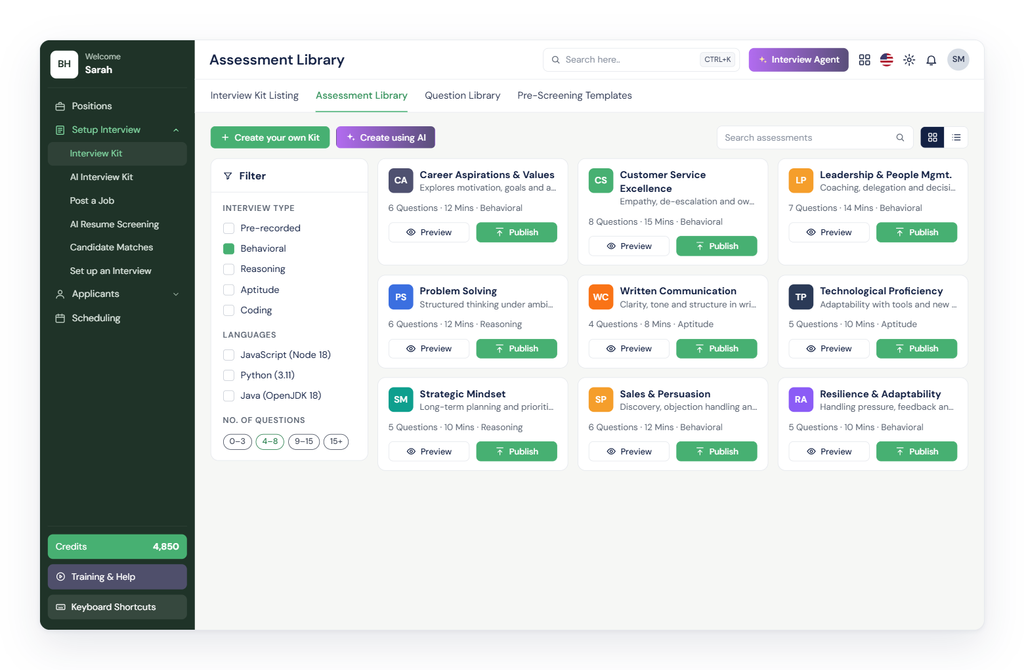
Technical & Coding Assessments for Hands-On Skill
Jobma lets candidates write, test, and debug code in a built-in coding environment, in more than 20 programming languages, including Python, Java, JavaScript, PHP, and C++.
- Choose from 100+ ready-made coding kits, or build your own.
- Set the language, difficulty, code stubs, test cases, and time limit for each challenge.
- Submissions are auto-evaluated against the parameters you define, with built-in AI code validation and human oversight.
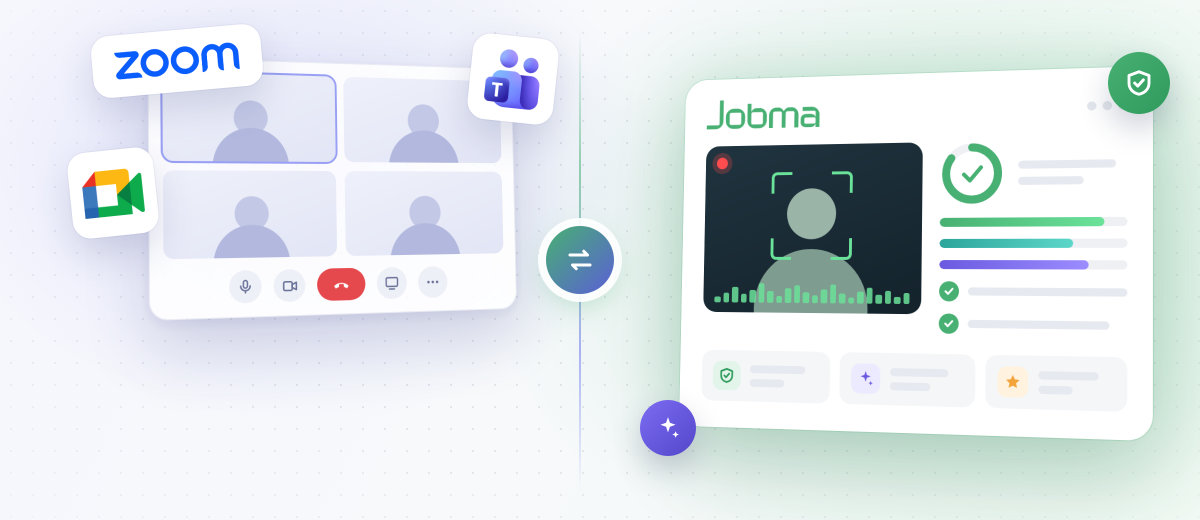
- Pair a coding challenge with a one-way or live video interview, so candidates can explain the solution they just wrote.
Game-Based Assessments for Reasoning
Game-based assessments measure specific cognitive abilities, including logical reasoning, attention to detail, working memory, and problem-solving speed.
Candidates complete short challenges involving sequence matching, sliding puzzles, and more. These exercises offer another perspective on a candidate’s cognitive abilities. They’re best used alongside role-specific assessments rather than as standalone evidence of technical proficiency.
Role-Based Assessments for the Real Job
Combine multiple evaluation formats into one to assess a role in-depth: scenario-based prompts, practical coding tasks, video answers, and work sample uploads. Start with pre-configured role templates or build custom kits tailored to your team’s specific stack.
Integrity and Evaluation Built In
Jobma also brings identity checks, assessment monitoring, and evaluation tools together, so recruiters can trust the results and prevent candidate fraud.
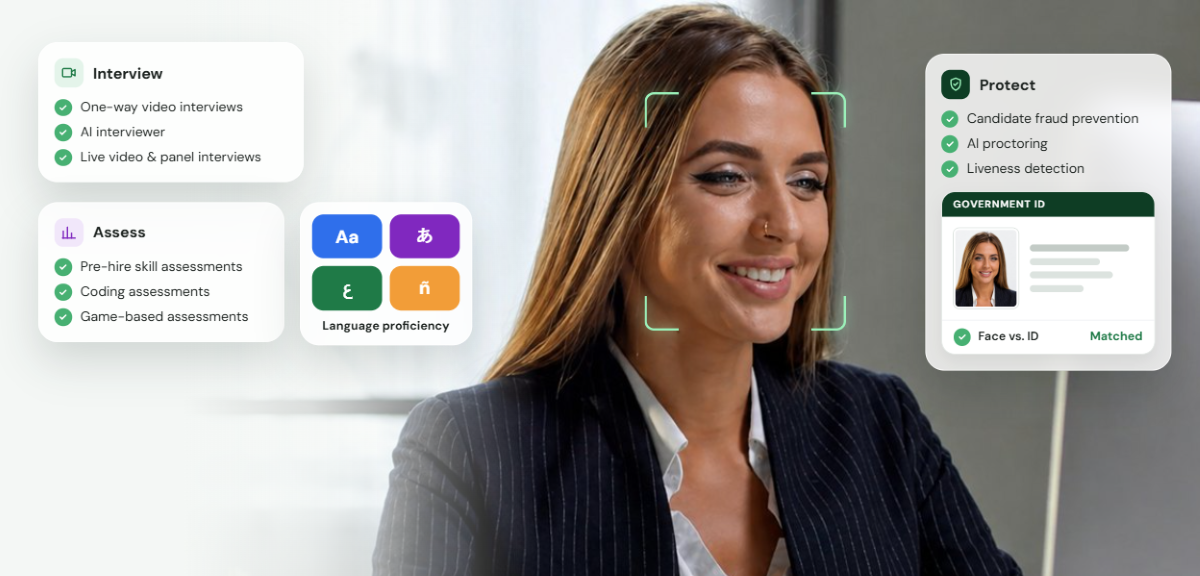
- ID verification validates candidate identity using government-issued documents before they begin, with selfie verification and liveness detection to help guard against deepfakes.
- AI proctoring flags signals like tab-switching, copy-pasting, AI assistance, multiple faces on screen, a second monitor, or a phone in the camera frame, so you can review them alongside the candidate’s results.
- Audit-ready records place flags on a timeline with candidate activity logs and downloadable reports, so every decision has a clear trail.
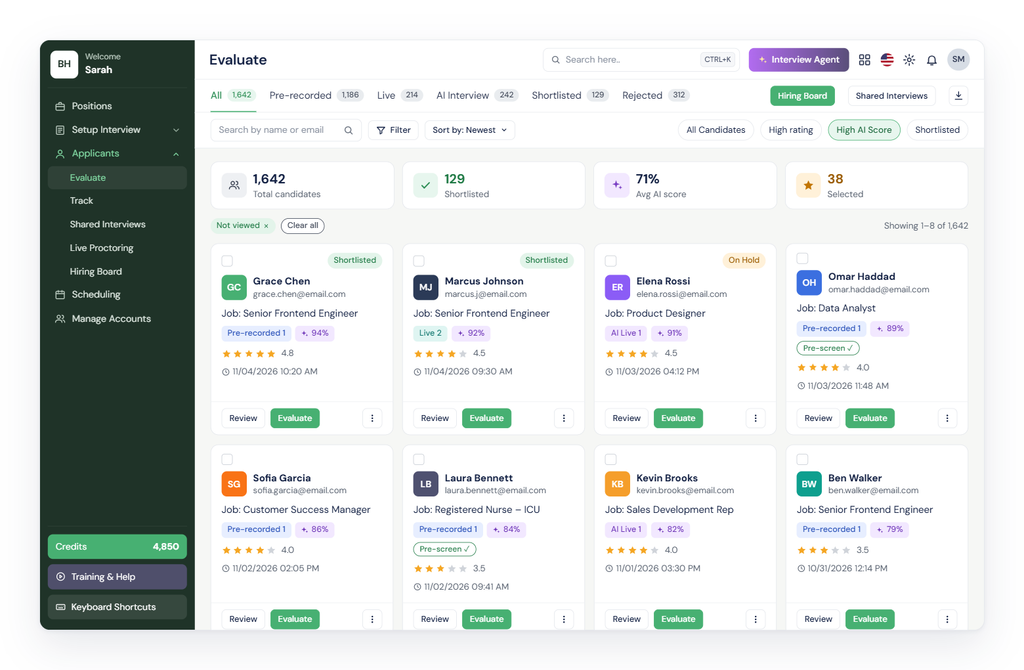
- AI-generated summaries highlight strengths and skill gaps against job-specific competencies.
- Side-by-side comparison lets recruiters and hiring managers review the same scores together and invite other evaluators.
AI scores and proctoring flags are there to support your team’s decisions, not to make them. Use them to decide where to look closer, and keep a human in the loop on every hire.
Signs a Candidate’s Skills Don’t Add Up
No single signal proves a candidate is fake or exaggerating. But when several of these show up together, it’s worth a closer look:
- A brilliant resume and a weak practical result. For example, ten years of claimed Kubernetes experience, but they can’t fix a basic pod configuration.
- Perfect code they can’t explain. The solution is clean, but the walkthrough is vague, or they describe an approach different from the one they submitted.
- Identical answers across candidates. Several applicants submit the same unusual solution, down to the variable names.
- Repeated tab-switching, large pasted blocks, or a second face on camera, all during the hardest question.
- Textbook answers to time-anchored questions. Ask about a bug they shipped last month, and they describe a generic debugging process.
- Seniority that doesn’t match the reasoning. A “staff engineer” who never talks about trade-offs, constraints, or what they’d do differently.
- Candidate discrepancy between different rounds. The voice, pace, or depth of knowledge shifts noticeably between the assessment and the live interview.
The important thing is to look for patterns rather than isolated incidents. When something doesn’t add up, clarify before you reject. Give candidates a chance to clarify or invite them to a brief live session to walk through the problem together.
The Bottom Line
You cannot verify technical talent from a resume alone, nor can you do it by subjecting candidates to gruelling multi-day take-home assignments.
The most effective strategy is a short, layered evaluation built around the actual job: a practical technical task, a quick reasoning check, assessment integrity guardrails, and a walkthrough where the candidate explains their own work. Authentic talent excels in this environment, while borrowed resumes and coached proxies fall away.
Make informed technical hiring decisions
Request a free demo to see how Jobma assessments can help your team evaluate talent with greater confidence.
Frequently Asked Questions
Keep early-stage technical assessments strictly under 45 to 60 minutes. Senior candidates with multiple opportunities will routinely walk away from 4-to-8-hour unpaid take-home projects. Bounding the evaluation to a short, role-relevant coding task or troubleshooting exercise respects candidate time while providing enough signal to verify competence.
Proctoring alerts should be treated as signals to investigate, not automatic grounds for rejection. Candidates frequently copy code snippets from their local IDEs or switch tabs to check official language documentation. Always pair technical scores and proctoring flags with a short video walkthrough or a human review before making a final decision.
You can introduce basic visual or document verification during the assessment phase to confirm candidate continuity. However, formal background checks, legal identity verification, and employment history audits should be reserved for the later stages – typically after a conditional offer of employment has been made.
Transparency is key. Explain clearly in the invitation why the assessment is being conducted, how long it will take, and that the recording will be used solely for evaluating the specific role. Clearly stating your privacy policy and offering candidate-friendly flexibility (such as allowing them to complete the test on their own schedule) significantly reduces drop-off rates.
This depends on your team’s internal engineering policy. Since developers routinely use AI tools on the job, many companies allow AI assistance but evaluate the candidate on how effectively they review, debug, and explain the output. Whatever policy you choose, state it explicitly in the test invitation so expectations are transparent.