Scaling Campus Hiring with AI Video Interviews
Every fall and spring, campus recruiting teams face the pressure of thousands of applicants, dozens of campuses, and a tight window to convert top students into offers before they commit to other companies.
At most campus hiring drives, evaluation doesn’t begin with insight; it begins with a line. Students wait, recruiters rush, conversations are brief, and decisions are even briefer. Somewhere in that process, promising candidates are filtered out, not because they lack potential, but because there simply isn’t enough time.
This has long been the reality of campus hiring. Not because organizations want it this way, but because managing volume leaves little room for anything else.
As competition for talent intensifies and campuses produce a massive applicant pool of engineering, business, STEM programs, and more, traditional campus‑hiring models quickly buckle under volume.
The Real Challenge of Campus Hiring Isn’t Volume, It’s Visibility
Campus hiring has never been short on applicants. If anything, the challenge is the opposite.
Hundreds, sometimes thousands, of students apply within a short window. Many come from similar academic backgrounds, with resumes that look almost identical on paper. That similarity is often more surface-level than it appears: two students with comparable GPAs can differ sharply in analytical reasoning, time management under pressure, and written communication – the exact traits standardized academic preparation is designed to build. Recruiters are left trying to make quick decisions with limited context, often relying on surface-level indicators.
In this environment, hiring becomes less about identifying the best candidates and more about managing constraints. In this context, strong candidates can slip through unnoticed, decisions become inconsistent, and hiring teams spend more time managing the process than actually evaluating talent.
Why Traditional Campus Hiring Struggles at Scale
Campus hiring teams typically work with a mix of large public universities, private colleges, and graduate programs. A single role can attract 500-2,000 applicants per campus, and active programs often run 10-20 campuses per season. Traditional methods were never designed for this level of hiring volume.
Scheduling interviews across campuses is time-consuming. Coordinating between recruiters, hiring managers, and candidates adds friction at every step.
On-campus interviews are logistically painful. Managers and interviewers must travel, block calendars, and squeeze in back-to-back interviews. And with the time constraints, it limits how many students can realistically be evaluated.
Even when interviews happen, they’re often rushed. Not every candidate gets the same time, questions, or attention. When interviewers hold conversations, it’s hard to compare students across different campuses or interviewers. What one manager sees as “strong communication”, another might see as “average,” simply because questions and expectations differ.
And perhaps most importantly, this model assumes that candidates can adapt to the recruiter’s schedule, but that’s no longer how students engage with opportunities today.
What AI Video Interviews Do for Campus Hiring?
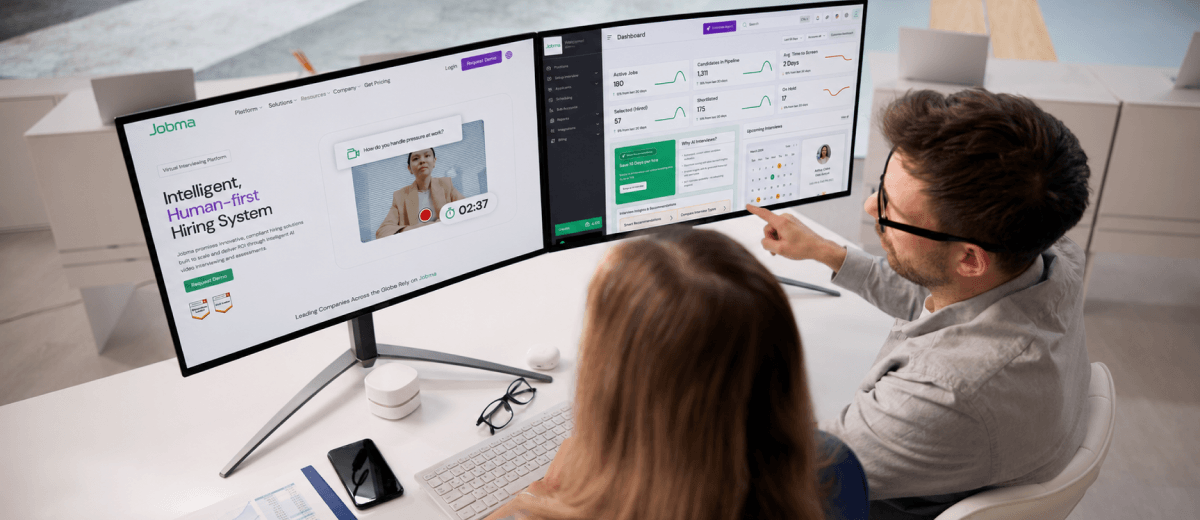
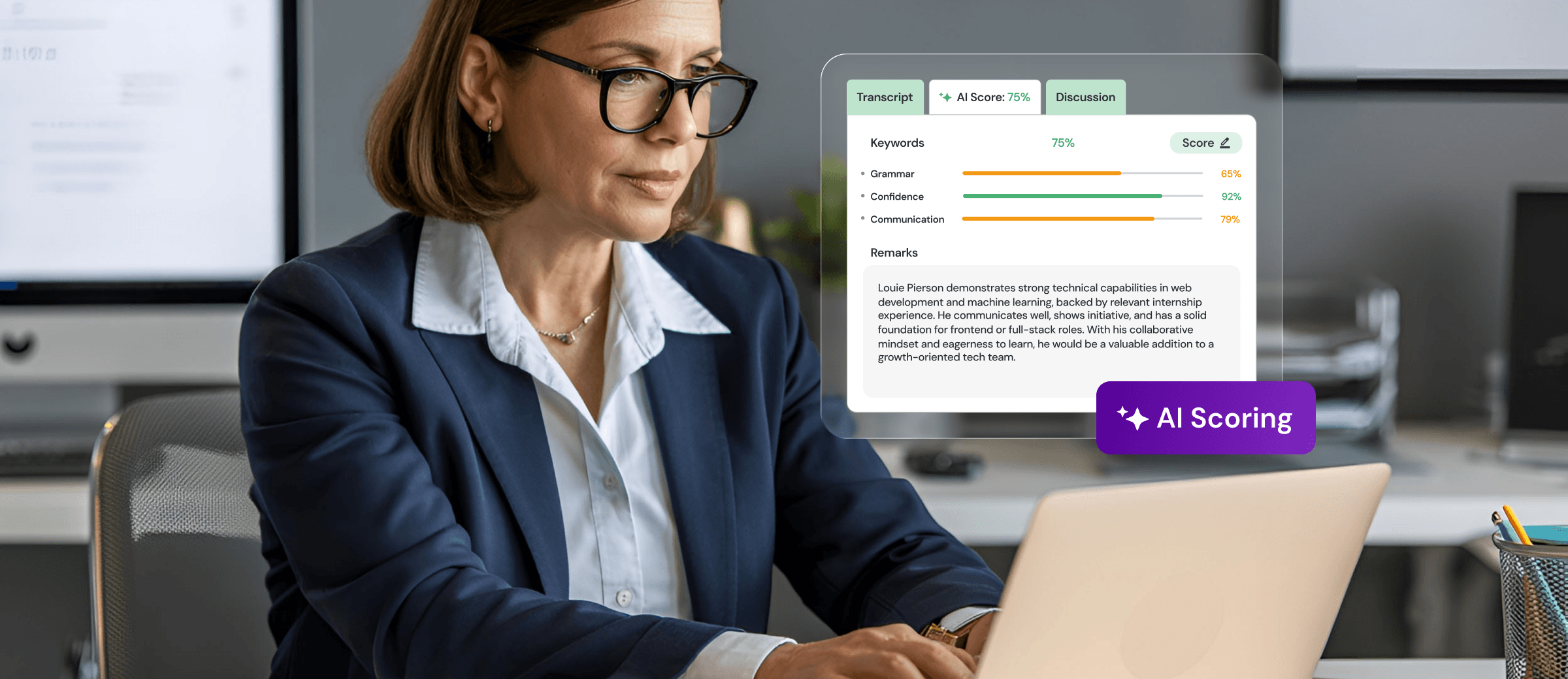
AI video interviews are structured, asynchronous, and use speech‑ and language‑processing AI to analyze the content, fluency, clarity, skills, and surface calibrated scores and highlights for recruiters.

For campus hiring, this translates into major wins:
1. Speed: Thousands of students can complete a video interview in the same 24-48-hour window, without overlapping interviewers’ calendars. There’s no need to “queue” everyone for live calls.
2. Standardization: Every candidate responds to the same set of questions, scored against the same rubric. That means a student from a state university in the Midwest is evaluated on the same criteria as someone from a private college on the East Coast.
3. Data-Driven Shortlisting: Recruiters get more than a binary “yes/no” decision. They see transcripts, key phrases, and composite scores that quickly help them triage from 10,000+ applicants down to a few hundred strong candidates for live interviews.
AI video interviews become the stage in a scalable campus‑hiring funnel. They let recruiters shortlist and make decisions based on how candidates communicate, think, and present themselves.


Key Use Cases of AI Video Interviews In Campus Hiring
Campus hiring programs are often divided by role type, including engineering, finance, sales, operations, and more. AI video interviews can be adapted for different roles. These are some of the strongest use cases:
First-Round Screening: For large‑volume programs, AI video interviews are ideal as the first filter. Instead of manually scanning every resume and coordinating schedules, recruiters can:
- Ask 3-5 core questions (e.g., “Tell us about a time you solved a complex problem,” “How do you approach working in a team?”).
- Use AI to score fluency, clarity, and relevance to role‑specific competencies.
- Shortlist 10-20% of applicants for live interviews based on those scores, plus a quick recruiter review.
- Let every candidate answer the same set of structured questions to create consistency across the board.
This approach can compress the shortlist‑to‑offer timeline from weeks to days, especially when you’re running multiple campuses at once.
Skill Assessment: Ask the candidates to explain a simple concept or walk through a problem‑solving approach. For technical roles, this helps you understand how they think, not just what they’ve studied. You can also include coding tasks if needed.
Equally helpful if you’re evaluating communication and collaboration skills, which are critical for technical roles but often hard to judge from a resume alone.
For non-technical roles like sales, HR, operations, or marketing, you can focus on real-world scenarios. Questions around handling challenges, working with teams, or managing stakeholders give a better sense of how candidates would perform in the role.
Evaluate Everyone, Not Just the First Few: Many hiring teams focus their in-person visits on target schools, but you can still tap top talent from other universities. Using video interviews, recruiters can:
- Run virtual screening across dozens of campuses without travel.
- Give students flexibility to record during evenings or weekends, accommodating busy academic schedules.
This creates a more equitable pipeline where candidates from less‑visible schools aren’t deprioritized simply because there’s no budget to visit their campus. Every applicant can participate. Every response can be reviewed. Every candidate has the same opportunity to present themselves, regardless of timing, location, or circumstance.
Structured & Consistent Screening: When every candidate is asked the same set of questions, it becomes much easier to compare responses fairly. Instead of relying on different interview styles or gut-based impressions, hiring teams can evaluate candidates on the same criteria, across campuses and roles.
This brings more clarity to decision-making. Everyone is working from the same inputs, which reduces inconsistencies and makes it easier to align as a team.
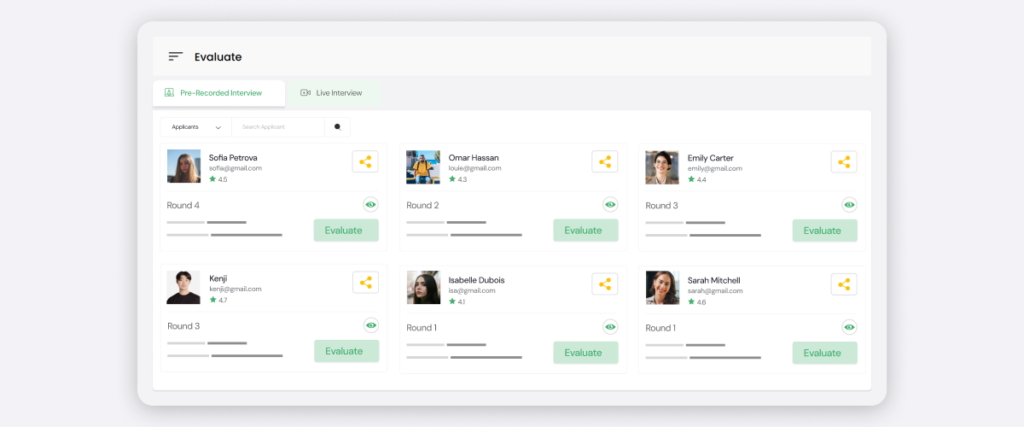
It also simplifies collaboration. Recruiters and hiring managers can review candidates on their own time, share feedback easily, and make decisions without the back-and-forth of scheduling. As hiring volumes grow, this kind of structure helps teams stay consistent without adding more complexity.
How to Implement AI Video Interviews
To implement AI video interviews at scale, you won’t just be buying a tool; it’s about aligning it with your existing campus‑hiring process. Here’s a practical, five‑step playbook:
1. Map Your Campus Hiring Funnel:
Begin by understanding your baseline: how many campuses are you targeting? How many roles and how many open positions per campus? What’s your current time‑to‑shortlist and time‑to‑offer?
When you have this data, you can define where AI video interviews fit (e.g., as the first round for all roles) and what volume you expect to process.
2. Design Standardized Question Sets by Role
Standardization works best when it’s intentional. Instead of using a generic set of questions across all roles, create structured question sets tailored to each position. This ensures every candidate is evaluated on the same role-specific competencies while keeping the process fair and consistent. It also makes it easier for hiring teams to compare responses and make faster, more objective decisions.
Technical roles get more problem‑solving or project‑based prompts; business and sales roles get more customer‑ or stakeholder‑focused scenarios. Focus on competency‑based questions that align with your job description (problem‑solving, collaboration, adaptability, leadership).
3. Integrate with Your ATS and Campus‑Programs Stack
Most campus‑hiring teams already use an ATS (like Workday, Greenhouse, or Lever) and often rely on university career‑portal integrations or third‑party platforms. Choose an AI video‑interview solution that:
- Integrates and pulls candidate data directly from your ATS or CSV exports.
- Pushes scores, transcripts, and video links back into candidate profiles.
- Integrates with your existing campus‑hiring workflow so recruiters don’t have to toggle between too many tools.
When AI data lives inside your ATS, hiring managers can review candidates in the same place they already review resumes and interview feedback.
For teams focused on hiring for Higher Education, AI video interviews can make campus recruitment more organized, scalable, and candidate-friendly. Higher education hiring often involves large applicant pools, multiple departments, and tight academic timelines. A structured video interviewing platform helps recruiters evaluate candidates consistently, reduce scheduling delays, and give every applicant a fair opportunity to present their skills. It also supports faster collaboration between hiring teams while keeping the final decision human-led.
4. Combine AI with Human Reviewer
AI is only as good as the bar you set. When you start, run a calibration phase:
- Have AI and human reviewers score the same batch of candidates.
- Compare where AI and humans agree and where they differ.
- Adjust your rubrics and prompts until AI‑generated scores align with your hiring standards.
This step is especially important for campus hiring, where you want to avoid over‑weighting certain signals (like accent or speaking speed) that could introduce unintended bias.
5. Communicate Transparently with Candidates
Students are increasingly familiar with AI tools, but transparency still matters. When you implement AI video interviews:
- Explain what they are, how long they’ll take, and what kind of questions to expect.
- Reassure candidates that this is just one step in the process, not the sole determinant of their candidacy.
Good communication improves completion rates and candidate experience, which feeds back into your employer brand on campus.
6. Keep the Final Decision Human
Recruiters and hiring managers bring context, assess potential beyond predefined criteria, and evaluate factors like adaptability and team fit. Keeping humans in the loop ensures that hiring remains both efficient and thoughtful, especially in campus hiring, where potential often matters more than experience.
One concern many hiring teams face is bias in Video Interviews, especially when evaluating students from different campuses, backgrounds, and communication styles. AI video interviews should be used to support structured screening, not replace human judgment. By using consistent questions, clear rubrics, and human review, recruiters can reduce subjectivity and make evaluations more fair. This helps campus hiring teams scale faster while keeping decisions balanced, transparent, and candidate-focused.
Metrics that Matter for Campus Hiring
When you’re scaling campus hiring with AI video interviews, it’s important to track outcomes. Focus on three buckets:
Efficiency Metrics:
- Time‑to‑shortlist (e.g., how many days from application to live‑interview invite).
- Volume processed per recruiter (e.g., how many candidates can one recruiter manage in a week with AI video vs. without).
Quality‑of‑Hire Metrics:
- Shortlist‑to‑offer ratio (how many shortlisted candidates actually receive offers).
- First‑year performance or retention data for hires who went through AI video interviews.
Candidate‑Experience Metrics:
- Candidate satisfaction rate or simple survey questions like “How fair and transparent did you find the AI video interview?”
- Completion rates and drop‑off points in the video‑interview flow.
Over time, these metrics help you refine your question sets, scoring thresholds, and integration workflow decisions.
Looking Ahead: Hiring for Potential at Scale
For campus hiring, AI video interviews are a powerful lever to compress timelines, standardize evaluations, and unlock access to a broader talent pool across campuses.
When implemented thoughtfully – aligned with your role‑specific competencies, integrated into your ATS, and paired with clear communication and human input, it can help you scale.