Which Virtual Interviewing Platforms Support One-Way and Live Interviews?
Many virtual interviewing platforms support both one-way (asynchronous) and live (synchronous) interviews, including Jobma, Hirevue, Spark Hire, and VidCruiter.
These platforms allow hiring teams to use one-way interviews for early-stage screening and live interviews for deeper candidate evaluation, helping recruiters manage more of the hiring process within a single system. While all four offer both interview formats, they differ in areas such as integrations, candidate experience, compliance features, hiring volume support, and workflow automation.
Let’s take a deeper look at the leading options:
1. Jobma
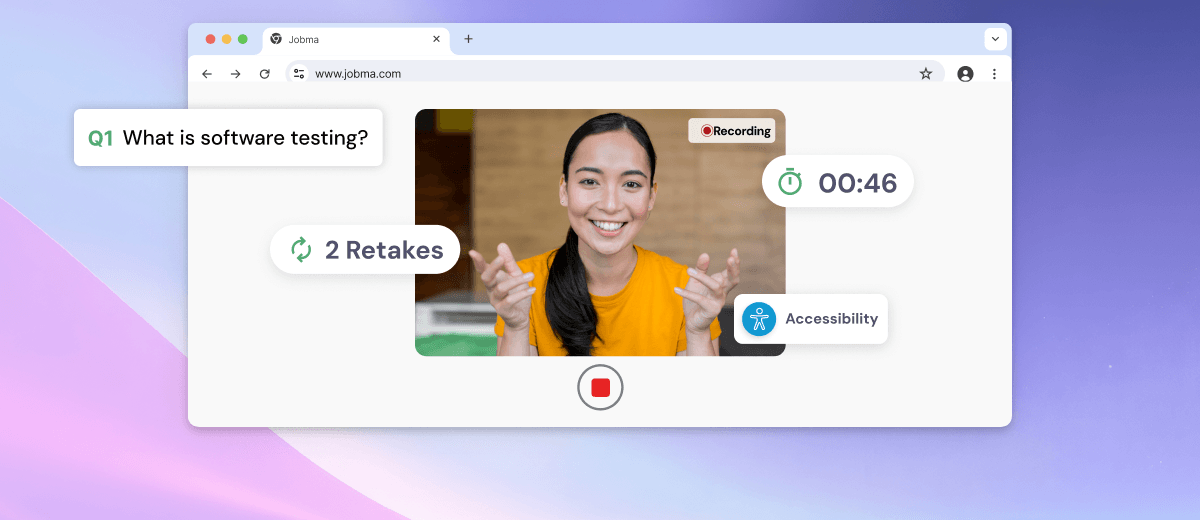
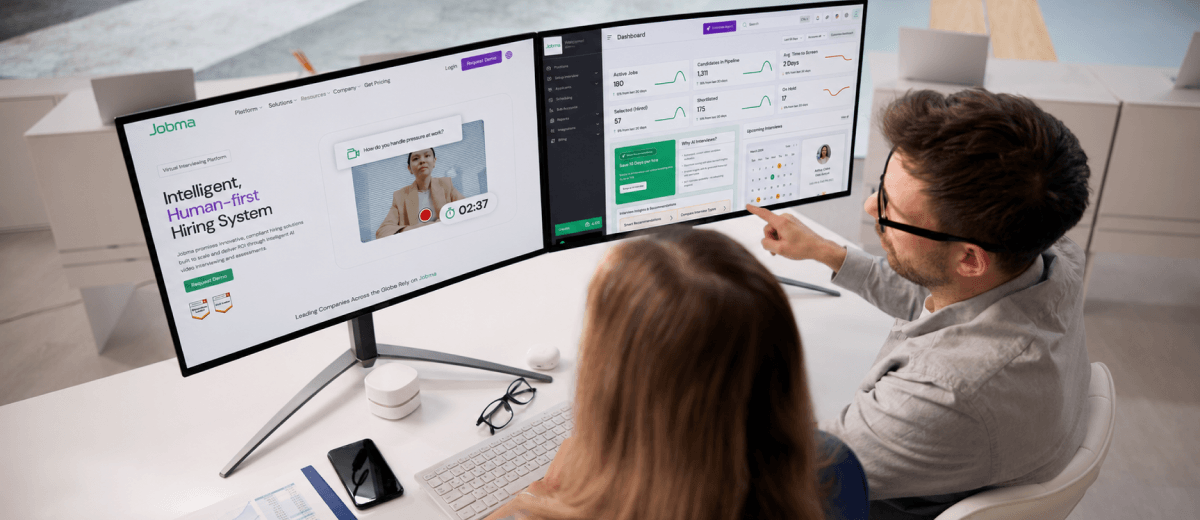
Jobma combines video interviewing with assessments, scheduling automation, and structured candidate evaluation tools in a single platform. Hiring teams can use one-way and agentic AI interviews to screen applicants at scale, as well as conduct live interviews with shortlisted candidates. The platform also lets you evaluate skills through coding, language proficiency, aptitude, and other assessment types.
The platform is designed to support high-volume and specialized hiring workflows. Features such as self-scheduling, SMS interview invitations, branded candidate experiences, and structured scorecards help reduce administrative work while maintaining a consistent hiring process.
To help maintain interview integrity, Jobma has built-in identity verification and remote AI proctoring capabilities that can detect activities such as multiple faces, tab switching, mobile devices, and other suspicious behaviors. Additional features such as AI summaries and candidate comparison, multilingual transcription, and ATS integrations help recruiters move candidates through the hiring process more efficiently.
Strengths: AI video interviewing and assessments, interview integrity management, 24/7 human support, enterprise-ready hiring automation tools, and unmatched ATS integration support.
2. Hirevue
Hirevue places a strong emphasis on structured candidate evaluation. In addition to video interviewing, the platform includes assessments designed to help organizations evaluate skills, competencies, and job readiness earlier in the hiring process.
The platform offers a range of evaluation methods, including competency-based interview frameworks, technical and language assessments, virtual job simulations, and game-based assessments that measure attributes such as problem-solving and adaptability. These tools can help hiring teams create more consistent screening processes across large candidate pools and multiple hiring locations.
Strengths: Structured assessments, competency-based hiring, video and assessment workflows in one platform, enterprise scalability, and consistent candidate evaluation.
| Want a deeper breakdown of features, pricing approach, candidate experience, and enterprise hiring capabilities? Compare HireVue vs Jobma to see how both platforms differ. |
3. Spark Hire
Spark Hire focuses primarily on simplifying the interviewing process through one-way and live video interviews. The platform is known for its ease of use and straightforward implementation, making it a popular choice among small and mid-sized businesses that want to modernize their hiring process without introducing unnecessary complexity.
Recruiters can quickly create interview workflows, review candidate recordings, collaborate with hiring managers, and conduct live interviews within the same system.
Strengths: Ease of use, quick implementation, collaborative hiring, and SMB-friendly workflows.
| Want to understand how both platforms differ in video interviewing, hiring automation, candidate experience, and enterprise scalability? Compare Spark Hire vs Jobma for a detailed breakdown. |
4. VidCruiter
VidCruiter puts a strong emphasis on structured hiring and compliance. The platform helps organizations create standardized interview processes, enabling candidates to be evaluated against consistent criteria throughout the hiring journey.
Its focus on documentation, fairness, and process consistency has made it a common choice for government agencies, healthcare organizations, educational institutions, and other regulated environments where hiring procedures must be carefully managed.
Strengths: Structured interviews, compliance-focused workflows, evaluation consistency, and regulated industries.
| Need a closer look at compliance, structured interviews, integrations, and enterprise hiring workflows? Compare VidCruiter vs Jobma to see how both platforms compare. |
Mapping the Ideal Multi-Stage Virtual Workflow
To maximize the value, talent acquisition teams should structure their workflow to balance speed with depth. A unified platform makes it easy to execute a two-step virtual framework:
Stage 1: One-Way Screening
- Assess a high volume of candidates
- 5-7 basic technical/cultural questions
- Reviewed by the recruiter on their own schedule
Stage 2: Live Panel Interview
- Shortlisted candidates only
- Behavioral and role-specific discussions
- Opportunity for candidates to engage with recruiters and hiring managers
Supporting Both Formats is Crucial for Modern Hiring
A single platform that handles both interview formats optimizes the “Time-to-Hire” metric while preserving the candidate experience.
Using a single platform that supports both formats helps TA teams move candidates through the hiring process without switching tools or duplicating work. It can also create a more consistent experience for candidates, who interact with the same platform from initial screening through later-stage interviews.
In addition, hiring teams benefit from having interview recordings, feedback, evaluations, and candidate data stored in a centralized location, making collaboration and decision-making easier.
Jobma particularly stands out with versatile assessment formats, advanced interview security features, and enterprise-ready hiring workflows.