The Biggest Healthcare Recruitment Challenges in 2026
Ask any healthcare talent acquisition specialist about their biggest headache, and they will likely give you the same answer. Globally, hospitals, clinics, and healthcare organizations are facing persistent staffing shortages while trying to meet rising patient demands, maintain care quality, and reduce employee burnout.
While maintaining a sustainable health workforce is critical to achieving global health goals, recruiting, onboarding, and retaining healthcare professionals remain an ongoing struggle.
There is a significant shortage that spans across multiple staff groups, with nurses and allied health professionals facing the most severe gaps. Compounding these shortages is the complex relationship between rising cost-of-living pressures and healthcare recruitment and retention struggles.

The consequences extend far beyond staffing numbers. High turnover rates, burnout, rising living costs, and stressful work environments further complicate recruitment efforts. Studies also show that newly qualified nurses often leave within their early years of employment due to anxiety, workplace stress, lack of support, and the gap between expectations and real-world clinical pressures.
Let’s look at the top 9 challenges healthcare recruiters face consistently, along with practical playbooks to overcome them:

Challenge 1: Talent Shortage & High Demand
According to the WHO, the global nursing shortage is projected to decline to 4.1 million by 2030, but this figure masks deep regional disparities, and organizations are still struggling to keep pace with the rising demand. While the healthcare industry has consistent job openings, the persistent talent shortage is driven by demographic shifts and growing demand for services.
Nurses, allied health professionals, physicians, mental health specialists, and laboratory technicians remain among the hardest roles to fill. For healthcare recruiters, this means hiring cycles are becoming longer, candidate expectations are rising, and securing qualified professionals requires flexible strategies.
What Recruiters Can Do:
- Build Proactive Talent Pipeline: Instead of looking for candidates only when there’s a vacancy, recruiters should partner with universities, nursing schools, and healthcare programs to build a talent pipeline.
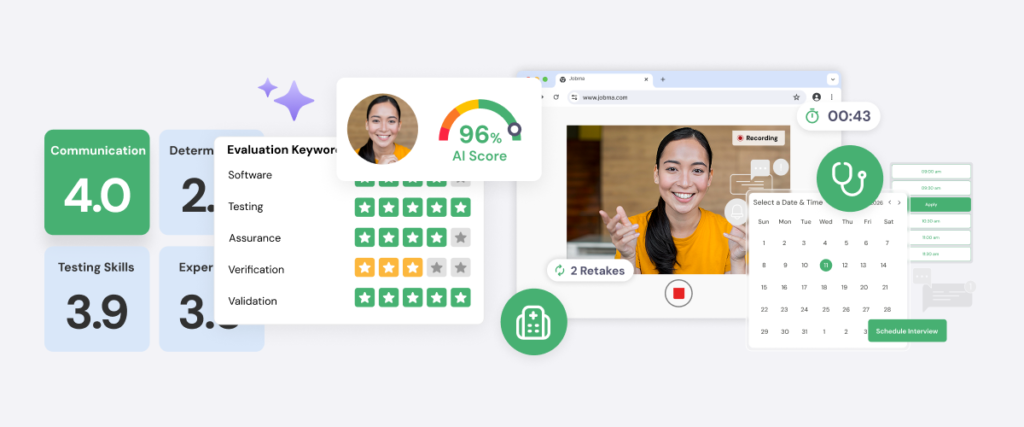
- Leverage Recruitment Tech: Adopt tools like video interviewing platforms and ATS to automate candidate screening, improve candidate outreach, and accelerate hiring decisions for high-demand environments.
Challenge 2: Staff Burnout & Turnover
The burnout syndrome in healthcare jobs is a serious problem that has grown into an epidemic among healthcare workers and associates.
The candidate pool is stretched incredibly thin across demanding shifts, leading to chronic burnout and skyrocketing turnover rates. Losing staff creates a vicious cycle: remaining employees face heavier workloads, leading to more burnout and further resignations.
According to data from the NSI National Health Care Retention Report, the national RN turnover rate sits at 17.6%, with a staggering 22.7% of newly hired Registered Nurses (RNs) quitting within their first year. Furthermore, nurses with under one year of tenure account for 29% of all RN separations.
Many enter the workforce feeling unprepared for the realities of clinical environments, struggling with psychological stress, workplace pressure, and the gap between academic expectations and day-to-day responsibilities.
For recruiters, high turnover creates a constant cycle of replacement hiring rather than long-term workforce growth.
What Recruiters Can Do:
- Align Compensation with Market Reality: Pay levels are paramount for workforce retention. Ensure baseline wages match the current cost of living to prevent staff from jumping to agency or travel roles.
- Focus on First-Year Onboarding: Work with clinical leaders to establish robust, structured mentorship or residency programs for newly qualified hires. This will save massive recruitment costs later.
- Support Wellbeing: Look into wellness programs to help teams manage stress, improve energy, and build healthier workplace habits.
Challenge 3: Skilled Workforce Shortage
A distinct skill gap exists in healthcare, driven by rapid technological advancement, senior workforce retirement, and widespread burnout. One of the biggest challenges healthcare providers face is the lack of skilled staff and the talent pool for potential candidates.
Data from the NSI National Health Care Retention Report highlights that department-level mobility is incredibly volatile; the five-year cumulative turnover rate has reached 117.8% in telemetry, 115.4% in step-down units, and 113.6% in emergency services. Essentially, these high-acuity departments completely replace their entire nursing staff in less than four and a half years, creating a chronic deficit of senior clinical expertise.
The shortage becomes even more difficult in high-acuity environments where healthcare providers cannot compromise on qualifications or clinical competency. Extended vacancies in specialized roles can delay patient care, increase workloads on existing teams, and force healthcare organizations to rely heavily on overtime or temporary staffing solutions.
What Recruiters Can Do:
- Market In-House Clinical Ladders: Top candidates look for a career trajectory. Leverage structured Clinical Ladder programs or Professional Excellence Programs (PEPs) as recruitment incentives; industry studies prove that clear internal advancement paths significantly reduce nurse turnover, boosting retention metrics over non-participating departments.
- Hire for Trajectory, Train for Skill: Shift the recruitment focus from finding the “perfectly certified” candidate to hiring high-potential generalist RNs. Offer fully funded specialty certification tracks or “transition-to-practice” residencies as a primary hiring benefit.


Challenge 4: Rural Area Recruitment
Healthcare organizations in rural areas struggle significantly more to attract potential resources compared to big cities. They struggle to attract qualified professionals due to geographic isolation, limited housing availability, infrastructure deficiencies, and fewer opportunities for medical education and training in rural settings.
Urban centers naturally attract the medical workforce due to larger operational budgets, metropolitan lifestyles, higher baseline salaries, and state-of-the-art medical technology. This geographic disparity leaves rural clinics heavily reliant on expensive temporary agency staff.
What Recruiters Can Do:
- Target Compact States & Cross-Border Talent: Actively source candidates from states participating in the Interstate Medical Licensure Compact (IMLC) or the Nurse Licensure Compact (NLC). Because these compacts streamline and expedite the cross-state licensing process, recruiters can rapidly onboard out-of-state clinicians who are ready to practice immediately, either in person or via local hybrid roles.
- Source via Visa Waiver Programs: Tap into international talent pools by specifically marketing to foreign medical graduates through the J-1 visa waiver and H-1B programs. Because international graduates can remain in the country post-residency if they commit to practicing in a medically underserved area for at least three years, they represent a highly qualified, highly stable talent pipeline for rural facilities.
Challenge 5: Credential Verification
Validating medical licenses, background checks, clinical certifications, and professional malpractice histories remains a slow, bureaucratic bottleneck. This rigorous process is essential for patient safety, legal compliance, and preventing negligent hiring, but primary source verification delays the hiring loop by weeks.
The rapid growth of microcredentials, specialized certifications, continuing education programs, and digital badges has made verification processes increasingly complex for healthcare recruiters.
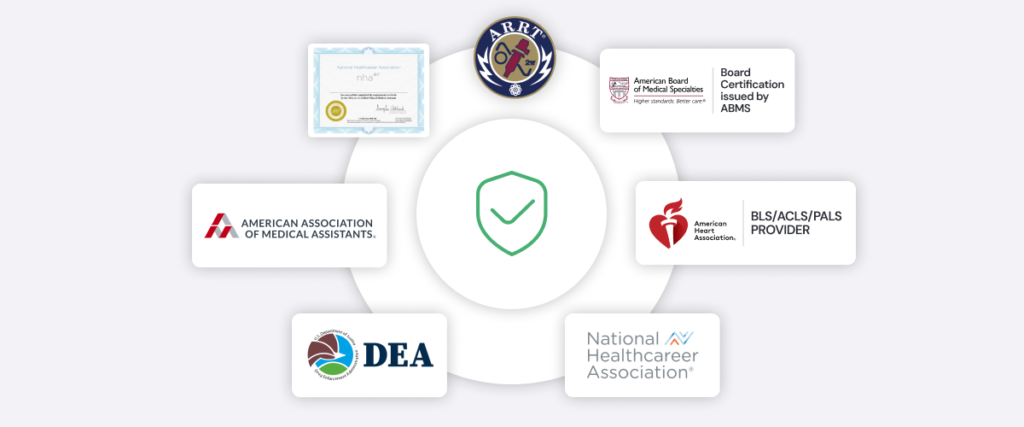
Recent fraudulent nursing diploma schemes have further intensified scrutiny around credential verification, while facing a massive spike in sophisticated, look-alike fraudulent credentials from new applicants.
Failed credential verification can have devastating consequences: patient safety risks, legal liability for healthcare organizations, revoked licenses, damaged reputations, and millions in litigation costs.
What Recruiters Can Do:
- Automate Primary Source Verification (PSV): Implement automated credentialing software that plugs directly and securely into primary licensing boards and state registries for instantaneous, tamper-proof validation.
- Audit Educational and Institutional History: Don’t just check the active license number; verify the legitimacy of the issuing institution. Cross-reference applicant graduation data with up-to-date lists of unaccredited, blacklisted, or closed institutions provided by federal law enforcement and state boards.
- Run Concurrent Screening Compliance: Do not wait for a final job offer to initiate the credentialing process. Introduce automated background checks and primary source verification simultaneously during the secondary interview stage to compress the compliance window and catch red flags before a candidate advances.
Challenge 6: Lack of Recruiting Resources
Healthcare organizations globally are struggling with a pronounced healthcare human resource crisis. Internal healthcare HR and talent acquisition teams are notoriously understaffed, overworked, and underfunded.
Recruitment teams are responsible for sourcing candidates, coordinating interviews, managing credential verification, supporting onboarding, and handling compliance requirements simultaneously across multiple departments.
Many teams are relying on outdated tech stacks, forcing talent acquisition specialists to spend their days managing manual spreadsheets rather than proactively sourcing passive candidates or building meaningful talent communities.
What Recruiters Can Do:
- Deploy AI-Powered Sourcing Platforms: Utilize AI-driven recruitment tools, such as ATS and video interviewing platforms, to automate initial resume matching, screen basic clinical prerequisites, and handle interview scheduling logistics autonomously.
- Outsource High-Volume Administrative Hiring: Partner with specialized healthcare RPO (Recruitment Process Outsourcing) firms for high-volume or seasonal roles, allowing your internal recruiters to focus entirely on high-touch, critical specialty hires.
- Build Internal Talent Pools: Create a database of past applicants and referral candidates to reduce reliance on external hiring and save time on repetitive sourcing.
Challenge 7: Poor Candidate Experience
Candidate experience has become a critical factor in healthcare recruitment, particularly in competitive hiring markets where qualified professionals often receive multiple job opportunities simultaneously.
A slow, erratic, and opaque recruitment process drives top-tier healthcare candidates straight into the arms of faster competitors.
The RN Recruitment Difficulty Index stands at 78 days, meaning it takes an average of over 2.5 months to fill an experienced clinical role. And because clinical professionals are constantly working demanding schedules, odd hours, and extended hours, traditional email-and-phone interview processes fail to engage them. When hiring workflows lack flexibility or responsiveness, candidates may accept competing offers before recruitment teams can complete evaluations.
What Recruiters Can Do:
- Adopt a Strict “72-Hour Response” Rule: Up to 31% of healthcare candidates ghost employers due to slow follow-up. Ensure your recruitment team reviews applications and initiates contact within 72 hours of submission.
- Deploy Asynchronous Video Interviews: Introduce on-demand video interviewing platforms for initial screening rounds. Allowing clinicians to record their responses to standard questionnaire prompts after a night shift, rather than forcing them to take a phone call during sleep hours. Provide automated, mobile-friendly text links that allow candidates to book their video interviews without the back-and-forth emails.
Challenge 8: E-Healthcare Recruitment and Competition for Digital Talent
The rapid growth of digital healthcare services has introduced a new set of recruitment challenges for healthcare human resources. E-healthcare providers require professionals who possess both clinical expertise and digital literacy, creating demand for hybrid skill sets that remain limited across the talent market.
E-healthcare providers require software developers, healthcare data analysts, cybersecurity specialists, cloud infrastructure professionals, and AI talent who understand the regulatory, operational, and patient-centered complexities of healthcare systems.
At the same time, they compete with major tech companies for the same digital talent pool. The talent pool with this hybrid skill set is extremely limited, and tech giants often offer higher salaries and more flexible work arrangements, making recruitment even more challenging.
What Recruiters Can Do:
- Lead with Patient Impact and Mission: Tech giants can outbid healthcare systems on salary, but they cannot compete on purpose. Recruiters must appeal to a candidate’s desire for real-world impact by explicitly emphasizing how their code, data models, or virtual care workflows will directly save patient lives and improve community health outcomes.
- Incorporate Digital Simulations into Selection: Replace long, text-heavy technical interviews with brief, user-friendly digital simulations or asynchronous tech screens during the initial interviewing phase. This allows recruiters to evaluate a candidate’s digital empathy and troubleshooting in real-time, while drastically compressing the time-to-hire.
Overcoming Obstacles in Healthcare Hiring
Healthcare recruitment challenges are multifaceted and interconnected, requiring a strategic, technology-driven approach. The integration of AI-powered recruitment tools, automated primary source credentialing platforms, on-demand video interviewing, and text-based automation can help healthcare organizations overcome these obstacles more effectively.
By building supportive environments and optimizing hiring loops, healthcare facilities can turn talent acquisition into a pillar of long-term organizational sustainability.