

What are the Key Benefits of Switching from Phone Screens to One-Way Video Interviews?
One-way video interview software transform early-stage screening into a measurable, scalable, and standardized process. Instead of scheduling dozens of phone calls, you invite multiple candidates to respond to pre-set questions in a video. Candidates respond on their own time, and you review answers when it works for you. The shift is not just operational – it changes the quality, consistency, and speed of early-stage hiring.
Faster Screening Cycles
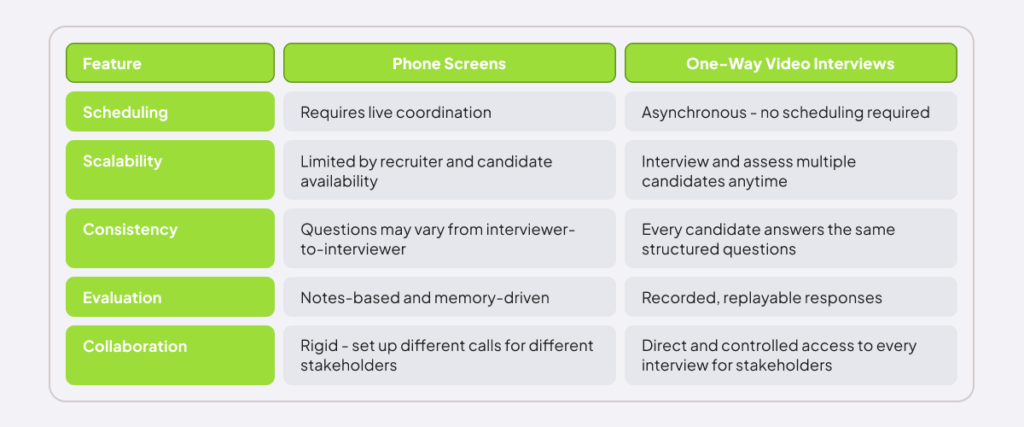
With one-way video interviews, you’re no longer stuck conducting calls one-by-one. Instead of scheduling and completing each phone screen separately, candidates submit their responses within a set deadline, and you can review them all at once.
Multiple candidates can be evaluated at the same time, which keeps the process moving. Strong applicants move to the next round faster, reducing the chances of losing them to another company with a quicker hiring process.
Better Quality Evaluations
You can rewatch candidate video responses, analyze clarity, and validate initial impressions. This reduces snap judgments and strengthens hiring accuracy.
Instead of relying on handwritten notes or memory, decisions are based on objective insights and information. The result is a stronger shortlist built on observable communication skills, structured thinking, and job-relevant competencies.
Deeper Insights Beyond Voice
Phone screens provide only verbal responses. You miss non-verbal cues like confidence, clarity of expression, and communication style.
Video responses add visual context. You assess presence, articulation, and engagement – critical indicators for customer-facing, leadership, or collaborative roles. At the same time, recordings can be replayed, paused, or shared with stakeholders, enabling more accurate decision-making.
Scalable Collaboration Across Teams
Phone screens rely on one recruiter’s observations from the conversation. This could mean important details can get filtered out unintentionally. One-way video interviews, on the other hand, allow all stakeholders to directly review candidate responses within one platform. Teams align faster because everyone sees the same content. This reduces internal delays and speeds up shortlist decisions.
Improved Candidate Flexibility
Candidates often juggle work, multiple job applications, and family. Phone screens restrict them to fixed time slots, sometimes during working hours.
With one-way video interviews, candidates can respond at their convenience within the deadline. This flexibility improves participation rates and reduces no-shows, especially for remote or global talent pools.
Phone Screens vs One-Way Video Interviews
Jobma – Your One-way Video Interview Platform
Switching to self paced video interview is not just about saving time – it is about upgrading how early-stage hiring works. Jobma makes this shift seamless by combining smart interview workflows, AI-powered insights, and structured evaluation tools to help teams screen faster and smarter.
The platform features like automated scheduling, intelligent AI scoring, built-in reference checks, collaborative reviews, and ATS integrations help organizations reduce hiring costs, shorten time-to-hire, increase candidate engagement, and improve candidate-role matching. For teams looking to modernize screening, Jobma delivers a serious competitive advantage.