

 United Kingdom (English)
 Log In



What is the Full Recruitment Cycle?
The full recruitment cycle (also called full-cycle recruiting or end-to-end recruitment) means one recruiter or team owns the entire hiring journey, from the moment a role opens to the day a new hire walks through the door and beyond.
In traditional recruiting, different specialists handle different stages – one person sources candidates, another screens them, and another closes deals. This creates handoffs that can delay hiring and confuse candidates. Full-cycle recruiting consolidates these responsibilities under a single owner for seamless workflow and clear accountability.
Getting this right matters. Withcost-per-hire now $5,475 for non-executive roles ($35,879 for executives) and screening alone averaging 8-9 days, HR leaders need efficient processes that deliver quality hires, without sacrificing speed or candidate experience.
In this guide, I’ll walk you through the seven stages of full-cycle recruiting, along with practical strategies and tools for each stage.
Key Takeaways
- Full-cycle recruiting has one clear owner for the whole hiring process.
- Each vacancy is costly, so every stage must count.
- Candidates expect honest ads and fast, clear updates.
- Keep interviews lean and structured, usually 2–3 rounds.
- Track what’s working, then keep tweaking the process.
What is a Full Cycle Recruiter?
A full-cycle recruiter manages every hiring stage rather than specializing in one area. Required skills include communication, business acumen, interviewing expertise, negotiation, Applicant Tracing System (ATS) proficiency, and employment law knowledge.
Experienced full-cycle recruiters typically manage 3-5 open roles simultaneously. More than this risks quality decline and burnout.
What are the 7 Stages of the Full Recruitment Cycle?
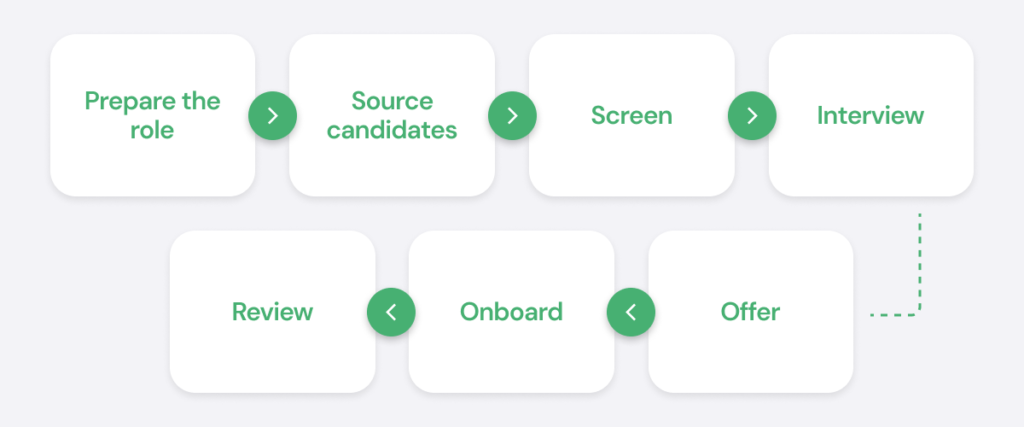
1: Preparing the Role and Hiring Strategy
The key question to start with isn’t “What will this person do?” but “What business problem will they solve in six months?”
Define Your Requirements First
Document these essentials before you start:
- Must-have versus nice-to-have qualifications
- Compensation range
- Work pattern (on-site, hybrid, remote)
- Who has final decision-making authority
Tips to Attract Candidates
Keep Job Titles Searchable and Clear
Avoid “Coding Ninja”, use “Software Engineer”. Creative titles tank your visibility and conversion in job boards and searches.
Treat Job Descriptions as Marketing Assets
Open with a compelling “What’s In It For Me” hook before listing requirements. Start with what the role achieves, not just tasks.
Be Honest About the Realities of the Role
Overselling leads to early turnover, so build trust at the start by being realistic with potential candidates about what they can expect coming in.
Be Specific, Not Vague
State “3+ years”, not “several years of experience.” Research shows vague phrases discourage applicants.
Salary Transparency Matters
47% of candidates are more likely to apply when a salary is clearly listed. It sets expectations early and builds trust from the start.
Name your Benefits. Be Specific, Don’t Just List Categories
List specific benefits like “4 weeks PTO, $5K learning budget”, instead of generic terms like “competitive benefits”.
Helpful Tools
- Collaboration Platforms (Google Docs, Notion): Co-create role profiles with hiring managers, resolve disagreements in real-time.
- Workforce Planning Software (Workday, BambooHR): Model headcount costs to secure approval faster.
- Job Description Templates: Maintain pre-approved descriptions for consistent language.
2: Sourcing Candidates and Building a Talent Pipeline
Effective sourcing goes well beyond just posting on job boards. Build diverse pipelines through employee referrals, social media recruiting, professional associations, and talent pools of “silver medalists” from previous searches.
Tips for Building Your Sourcing Strategy
Post Strategically
Use your ATS to distribute to multiple job boards simultaneously. Test general platforms like Indeed and niche industry boards to see which delivers higher-quality candidates.
Harness Employee Referrals
Create a simple one-page referral form and send your team monthly reminders with specific open roles. Structure bonus payouts at 30/60/90 days to encourage retention.
Mine your Talent Database
Tag candidates from previous searches by skill set and speciality. When someone impresses you but the timing isn’t right, mark them for future openings.
Engage on Social Media
Share behind-the-scenes content showing what life is actually like for your team. Candidates research your culture before applying.
Tips for Reaching Passive Candidates
The real competitive advantage comes from reaching passive candidates who aren’t actively job hunting.
Here’s what you need to do to reach passive candidates:
- Personalize outreach by referencing specific projects or achievements – generic templates get ignored.
- Lead with conversation rather than immediately jumping into a job offer, but remember to keep it brief.
- Nurture over time. If someone isn’t ready now, tag them in your ATS and follow up every 3-6 months with relevant content and opportunities.
Helpful Tools
- Applicant Tracking Systems (Lever, Greenhouse, Workable): Post once and syndicate to 20+ job boards. Tag “silver medalists” for future roles.
- Employee Referral Platforms (Boon, Erin, Teamable): Automate referral tracking. Look for tiered structures that reward 90-day retention.
- Talent CRM Tools (Beamery, SmashFly): Nurture passive candidates with automated campaigns triggered by milestones.

3: Screening and Shortlisting Candidates
Structure your screening for efficiency and fairness, because this stage often creates the biggest bottleneck.
Tips for Screening Resumes
Use Knockout Criteria Early
Flag deal-breakers first – visa status, location requirements, essential certifications.
Screen with Checklists, Not Gut Feel
Standardized criteria reduce bias and ensure every candidate is assessed against the same must-have requirements you established at the start of the process.
Keep Applications Simple
The majority of candidates abandon overly complex forms. If your application takes more than 5 minutes to complete or requires re-entering work history manually after uploading their CV, it can impact the completion rate.
How to Manage AI in Screening
AI adoption in recruitment doubled in one year, and many candidates now use AI to create resumes. Focus on what AI can’t fake: specific achievements with metrics, verifiable outcomes, and concrete examples.
Use AI as a filter, not the decision-maker – maintain human oversight. Be transparent about how and where AI is used, as 56% are concerned that it can make the process feel less personal.
How to Avoid Being Branded an “ATS Black Hole”
88% of UK candidates expect responses within two weeks, yet only 9% receive replies. Stand out by:
- Sending automated confirmations immediately.
- Using status labels, candidates can see.
- Responding to everyone who completes an interview.
- Sending personal rejections with actionable feedback.
Conduct efficient screens. Keep phone or video screens to 15-20 minutes. Use async video for scheduling flexibility. Limit skills assessments to under 2 hours.
Helpful Tools
- ATS with Automated Communications (Greenhouse, Lever, SmartRecruiters): Automatic confirmations and status updates. Configure knockout questions.
- One-Way Video Screening (Jobma): Candidates record on their schedule. Share with hiring managers.
- Skills Assessment Tools (Codility, TestGorilla): Evaluate abilities objectively before interviews.
4: Interviewing and Candidate Assessment
Design consistent interviews that evaluate the competencies you’ve determined are must-haves when you started preparing the role in Stage 1.
Tips for Keeping Interviews Lean and Respectful
Coordinate your Panel Effectively
Assign clear roles to avoid redundant questions: one can cover technical skills, another cultural fit, and another problem-solving. Share scorecards so everyone evaluates the same competencies. Brief your panel beforehand on what to assess and what to avoid.
Structure your Questions
Use behavioral questions (“Tell me about a time when…”) to reveal past performance and situational questions (“How would you handle…”) to show their problem-solving approach. Avoid hypotheticals that invite rehearsed answers.
Address Bias Proactively
Train interviewers on legal boundaries and fair assessment. Avoid questions around age, marital status, religion, or family plans; instead, focus exclusively on job-relevant competencies. Use structured scorecards to reduce gut-feel decisions.
Respect Candidates’ Time
Keep the interview process focused and efficient, lengthy process can be exhausting. Most roles can be covered in 2-3 rounds. Eliminate unnecessary rounds that don’t add assessment value.
Typical lean interview structure:
- Phone or video screen (15-20 minutes)
- In-depth skills and behavioral interview
- Final panel if needed
Helpful Tools
- Scheduling Automation (Calendly, GoodTime): Eliminate back-and-forth emails by letting candidates book directly from available slots. Advanced platforms coordinate panel interviews across multiple interviewers automatically.
- Video Interviewing Platform (Jobma): Enable remote interviews without travel costs. Jobma allows both live and asynchronous recorded responses, useful across time zones or when multiple stakeholders need to review the same candidate.
- Shared Interview Scorecards (Built into most ATS): Standardized evaluation criteria ensure every interviewer assesses the same competencies and reduces bias.
5: Job Offer, Negotiation, and Hiring Decision
Move quickly once you’ve made your decision. Top candidates are often exploring multiple opportunities, so delays risk losing the best candidates.
Tips for Making Compelling Offers
Practice the “Pre-Close”
Discuss salary ranges, notice periods, and concerns throughout the interview process. By offer time, you should be 90% confident they’ll accept.
Structure your Offer Delivery
Call personally to make the offer and walk through the complete package. Follow with written confirmation within 24 hours. Never lower the advertised salary without transparent reasons or change job responsibilities between the interview and offer.
Manage Negotiation Constructively
Listen and find creative solutions. For instance, if you can’t move on salary, explore signing bonuses, earlier review dates, additional PTO, or development budgets. Stay in touch during the notice period.
Close the Loop with Other Candidates
Notify other candidates promptly and with respect. Again, remember to keep those relationships warm for future opportunities – today’s second choice might be next quarter’s perfect fit.
Helpful Tools
- Offer management workflows (ATS, Greenhouse): Generate letters from templates, track approvals, and monitor acceptance.
- E-signature platforms (DocuSign, HelloSign): Get offers signed in minutes from any device.
- Compensation benchmarking (Payscale, Salary.com, Pave): Access market data for competitive offers.
6: Onboarding and the First Weeks
Onboarding determines whether your hiring investment pays off. A strong start sets the tone for retention and performance.
Tips for Effective Onboarding
Start Before Day One (“Pre-boarding”)
Send these materials a week before they start:
- Welcome materials and tech setup instructions
- First-week schedule and team introductions
- Buddy or mentor assignment
Make the First Days Count
Complete paperwork efficiently without letting admin tasks dominate. Provide clear role expectations aligned with the must-have requirements you established at the start. Outline a 30-60-90 day plan with specific milestones, and introduce key team members and stakeholders early.
Check in Proactively
Schedule check-ins at week 1, month 1, and 90 days. Use pulse surveys to catch issues that won’t surface face-to-face.
Helpful Tools
- Onboarding Platforms (BambooHR, Workday, Rippling): automated checklists and reminders for all stakeholders.
- Task Management (Asana, Trello, Monday): Repeatable workflows with clear ownership and due dates.
- Learning Management Systems (TalentLMS, Lessonly): Consistent training delivery with completion tracking.
- Pulse Surveys (CultureMonkey): Anonymous feedback at 7, 30, and 90 days.
7: Review, Measure, and Improve the Recruitment Life Cycle
Don’t stop at the hire – close the loop through continuous improvement.
Tips for Closing the Recruitment Cycle Loop
Gather Feedback Systematically
Collect input from hiring managers within two weeks and new hires at 30 days, so it’s still fresh. Ask rejected finalists for their perspective, as this feedback reveals friction points.
Track Metrics that Matter
Focus on metrics that reveal how healthy your process is, like:
- Time-to-hire by stage
- Source effectiveness
- Offer acceptance rates
- New hire performance and retention at 90 days and one year

Read on for more details on the metrics you need to track.
Act on Insights, Not Assumptions
Document learnings after each hire. Hold quarterly retrospectives to identify patterns. If metrics show candidates drop after phone screens, investigate whether screeners ask the right questions or if salary expectations are misaligned.
Helpful Tools
- ATS Reporting Dashboards (Greenhouse, Lever, Workable): Track time-to-hire by stage, source effectiveness, conversion rates.
- Survey Tools (Typeform, SurveyMonkey): Structured feedback from candidates and hiring managers.
- Analytics Platforms (Tableau, Power BI): Unified dashboards comparing metrics across teams and time periods.
Pros and Cons of Full-Cycle Recruiting
Advantages
- Better Candidate Experience: A single point of contact is reassuring as candidates know who’s guiding them through each stage.
- Reduced Time-to-Hire: Eliminating handoffs speeds up the process with no delays waiting for the next specialist.
- Clear Accountability: One owner ensures clear responsibility at every stage.
- Lower Costs: Streamlined processes reduce overhead and decrease reliance on agencies.
Disadvantages
- Can Overwhelm a Single Recruiter: Managing every stage requires time, focus, and bandwidth.
- Requires a Board Skill Set: Full-cycle recruiters require expertise across sourcing, relationship building, business acumen, interviewing, negotiation, ATS proficiency, and employment law.
- Not Scalable for High-Volume Hiring: You’ll need multiple recruiters or a team-based approach.
- Risk of Inconsistency: When the recruiters are overworked, screening quality or candidate communication may be affected.
How to Implement Full-Cycle Recruiting in Your Organization
Adapt to your Company Size
Small companies and startups typically assign the entire process to one full-cycle recruiter or HR generalist. Medium-sized companies often have an HR team where one person oversees the full cycle while others assist with specific stages. Large enterprises usually have dedicated talent acquisition teams with specialists for each phase, though one lead recruiter maintains overall accountability.
Start with One Role
Test the full-cycle model on a single hire before rolling out across your organization. Document your process and refine based on what you learn.
Define Clear Handoff Protocols, if Needed
If you can’t implement a full-cycle approach immediately, clearly define when and how handoffs occur between recruiters, coordinators, and hiring managers. The goal is seamless transitions, not siloed steps.
Invest in Skill Development
Provide training on:
- Interviewing techniques and structured assessment
- Employment law basics and compliance requirements
- ATS and CRM system proficiency
- Negotiation strategies for closing candidates
- Relationship building and stakeholder management
Set Realistic Workload Expectations
One full-cycle recruiter typically manages 3-5 open roles simultaneously, depending on seniority and complexity. Keep workload balanced to maintain quality across each stage.
Measure Continuously
Track time-to-hire, cost-per-hire, offer acceptance rate, and quality-of-hire. Use these metrics to identify bottlenecks and refine your process quarterly.
Which are the Best Metrics for Tracking Full-Cycle Recruiting Outcomes?
You can’t improve what you don’t measure.
| Metric | What to Measure | Why Track It? |
|---|---|---|
| Quality-of-Hire | New hire performance ratings and retention | The ultimate measure of hiring effectiveness |
| Time-to-Hire | Days from requisition to accepted offer | Identifies bottlenecks; faster hiring wins top talent |
| Cost-per-Hire | Total recruiting costs divided by the number of hires | Helps optimize your source mix and budget allocation |
| Offer Acceptance Rate | Percentage of offers accepted | Shows whether your process creates enthusiasm or doubt |
| Source Effectiveness | Which channels deliver the best candidates | Guides on where to invest your sourcing efforts |
Your Hiring Process is a System – Treat it Like One
The full recruitment cycle isn’t seven isolated tasks; rather, it’s a connected system where each stage either reinforces or undermines the next. You don’t need a huge budget; just a more intentional approach.
Audit your current process against these seven stages. Find your biggest bottleneck, that is, where candidates tend to drop off or momentum stalls. Fix that first, measure the impact, then move to the next weak point.
Get it right, and you’ll stop competing on salary alone. You’ll build a reputation that brings talent to you.
Frequently Asked Questions About the Full Recruitment Cycle
What is the full recruitment cycle?
The full recruitment cycle is when one recruiter or team manages every hiring stage from requisition through onboarding, maintaining consistency and accountability throughout the process.
How long does the full recruitment cycle take?
Time-to-hire varies by industry and role complexity, but expect 40-45 days on average. Full-cycle recruiting can reduce this by eliminating handoff delays between specialists.
What’s the difference between full-cycle and traditional recruiting?
Traditional recruiting often splits responsibilities across specialists (sourcers, coordinators, closers). Full-cycle recruiting assigns one recruiter or team to own the entire process, improving continuity and accountability.

About the Author

Auria Heanley is co-founder of Oriel Partners, a London-based temp agency. She is extremely passionate about providing the highest quality of service to both clients looking to find temp staff and candidates looking for a temporary role. Oriel Partners’ clients range from global multinationals to small boutique firms, all requiring the same personal service and high-calibre support.
Disclaimer: This article was authored by a guest contributor or third party. The views expressed are their own and do not necessarily reflect those of Jobma. Jobma does not endorse any products, services, or claims mentioned. This content is for informational purposes only.