


Traditional Interviews vs On-Demand Interviews: What Works Best in 2026?
The debate between traditional and on-demand interviews continues to gain momentum. While traditional in-person and live interviews have long been the norm, one-way and agentic AI interviews are shaping the new era of hiring practices. Let’s delve into the dynamics of each approach and explore how they stack up against each other in today’s digital age.
Over 87% of companies use video interviews. With the rising adoption of AI tools in recruitment, ongoing research suggests that this number is expected to rise in the coming years. But how are on-demand interviews different from traditional ones?
What are Traditional Interviews?
Traditional interviews typically include in-person, panel, and video interviews conducted virtually in real time with an interviewer. For a long time, this format has been the foundation of hiring across industries – from corporate offices to campus recruiting. While these methods still play a role, today’s digital hiring landscape demands a closer look at how they function and where they fit.
Below is a deeper look at the defining characteristics of traditional interviews:
Localized Candidate Access
Traditional interviews are often conducted on-site or within a specific geographic region. This structure naturally emphasizes local or regional talent pools.
- Organizations frequently prioritize candidates who can commute easily or relocate quickly.
- Campus and walk-in drives typically target talent within specific locations.
- Hiring timelines may depend on physical availability.

This model works well for roles requiring immediate on-site presence. However, as companies across the US and globally prioritize skill validation, job-role fit, accurate and bias-aware screening at scale, and more comprehensive candidate evaluation, many are rethinking their talent strategy.
Real-Time Scheduling Coordination
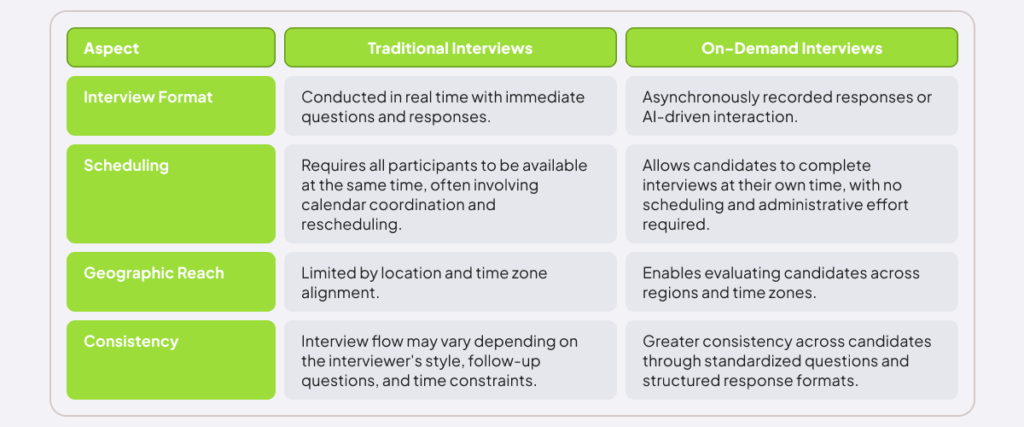
This format ensures live interaction and spontaneous dialogue, which many hiring managers value. At the same time, it demands structured planning and administrative coordination. Traditional interviews require all stakeholders – recruiters, hiring managers, and candidates – to be available simultaneously. So, scheduling often involves calendar alignment across all participants. If any of them is unavailable or reschedules late, it impacts hiring timelines. Coordination efforts further compound high-volume hiring processes.
Live Screening and Immediate Evaluation
Initial screening using traditional models often includes phone and video calls or first-round face-to-face meetings. Recruiters assess communication style, confidence, and presence in real time, and follow-up discussions depend on immediate impressions. Notes are typically taken manually during or after the conversation, and are later shared manually with stakeholders and collaborators.
This approach emphasizes interpersonal chemistry and quick judgment. However, it also relies heavily on the interviewer’s ability to capture accurate insights during a single live exchange.
In-Person Interaction and Candidate Experience
Traditional interviews are built around direct, face-to-face engagement. The entire experience is immersive and shapes both perception and performance. Candidates communicate through posture, eye contact, facial expressions, and tone modulation. Interviewers, on the other hand, observe how candidates navigate real workplace environments, interacting with potential team members and adapting to unfamiliar settings. Such on-site visits expose candidates to the organization’s pace, workspace design, leadership accessibility, and overall atmosphere.
For many roles – especially client-facing or leadership positions – this format provides valuable behavioral cues. It mirrors real workplace interactions and helps simulate day-to-day communication dynamics. The format places strong emphasis on presence, confidence, and social fluency – attributes that matter in many roles but may not fully represent a candidate’s technical or strategic capability.

Limited Review Capabilities
Traditional interviews are typically ephemeral – they happen once and rely heavily on manual documentation created during or after the conversation. Recruiters and interviewers take handwritten or typed notes while simultaneously engaging in conversation. Feedback sessions depend on how thoroughly those notes capture context and nuance. When multiple stakeholders are involved, summaries are shared verbally rather than through direct playback of responses.
This structure reinforces active listening and real-time judgment. However, in organizations with distributed hiring teams – especially those operating across time zones – collaborative review becomes more complex. Two interviewers may interpret the same response differently, and without recordings, there is no standardized reference point for verification. This places greater responsibility on interviewer training, structured scorecards, and clear evaluation criteria to maintain consistency and fairness.
Immediate Response Expectations
Traditional interviews prioritize spontaneous communication. Candidates are expected to process questions and respond without extended reflection time. Conversations evolve dynamically depending on candidate performance. Interviewers frequently probe deeper with follow-up questions based on initial responses. This structure evaluates cognitive agility, clarity of thought, and verbal articulation. In roles that demand rapid decision-making, such as consulting, customer support, public relations, or leadership, this can closely mirror workplace pressure.
However, complex strategic or technical questions may benefit from thoughtful analysis rather than immediate answers. Real-time expectations may also disadvantage candidates who perform better with deeper reflection, emphasizing conversational fluency and confidence as part of the assessment criteria.
Possibility of Bias and Misconceptions
In-person interviews inevitably center on human judgment, intuition, and interpersonal chemistry. Experienced interviewers focus on identifying soft skills, leadership presence, and emotional intelligence through real-time interaction and follow-up questions. Cultural fit is also often assessed through informal conversation and shared values discussion. Final decisions typically emerge from collaborative deliberation rather than automated scoring systems.
Traditional interviews reflect a human-first hiring philosophy – one that prioritizes relational assessment and experiential judgment. But because evaluations rely heavily on perception, outcomes can vary between interviewers. So, competency-based scoring and interviewer training become essential safeguards. Without them, personal preferences and unconscious bias may influence decisions.
On-Demand Interviews: Tools for Modern, Scalable Hiring
On-demand or asynchronous interviews – including self paced video interview and agentic AI interviews – represent a structural shift in how organizations discover, evaluate, and hire talent. Companies that use one-way video interviews report saving 20% recruitment time.
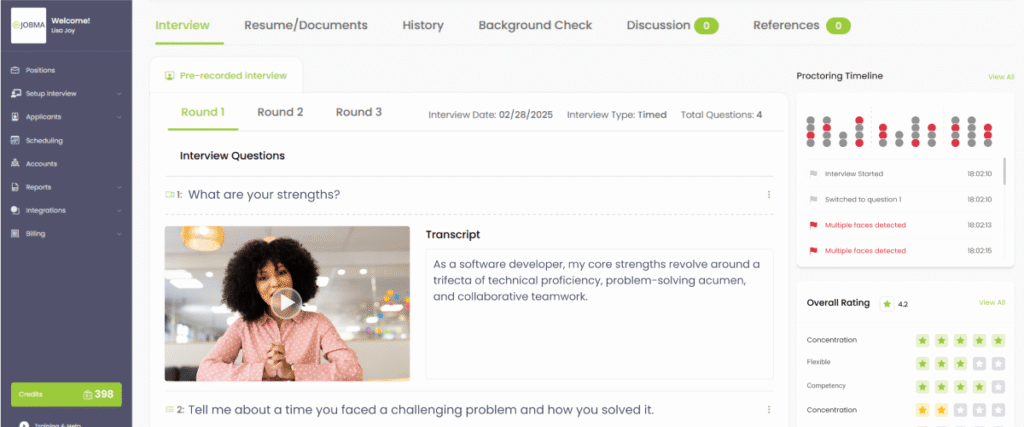
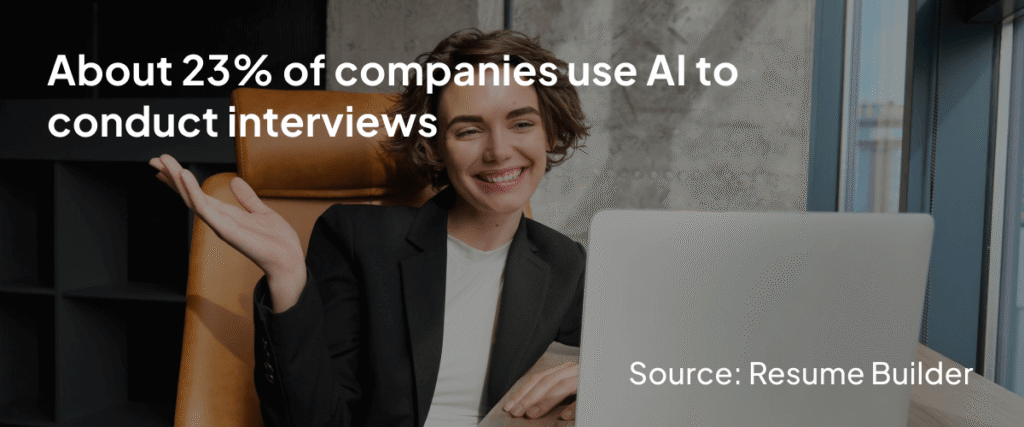
Unlike traditional formats that depend on shared physical space and synchronized schedules, asynchronous models are built for distributed teams, global talent markets, and data-backed decision-making. Recent studies show that about 23% of companies use AI to conduct interviews. Here’s a breakdown of some of the key features of on-demand interviews:
Access to Distributed and Global Talent
On-demand interviews remove geographical limitations in the screening process. Because candidates can complete interviews from anywhere with a stable internet connection, employers are no longer constrained by proximity to physical offices. This format supports remote-first organizations, multi-state hiring initiatives, and global talent acquisition strategies without requiring travel coordination or relocation to appear for interviews. Instead of limiting early screening to candidates who can attend live sessions, organizations can evaluate applicants across time zones and regions in parallel, significantly expanding the available talent pipeline.
Asynchronous Interview Infrastructure
With smart asynchronous interviews in the hiring workflows, candidates respond to standardized questions within a defined time frame, and hiring teams review those responses later. This flexibility fundamentally changes how early-stage screening operates, transforming it from a calendar-dependent task into a scalable workflow.
Because every candidate receives the same prompts and response conditions, evaluation becomes more consistent. Recruiters can pause, replay, compare responses, and access smart performance insights within the interviewing platform rather than relying on memory or handwritten notes. In high-volume hiring environments such as retail, customer support, and campus recruiting, this structure enables simultaneous screening of hundreds of applicants without requiring live interviewer bandwidth, bringing down review time from days to minutes.
Autonomous Interviews with Agentic AI
Agentic AI interviews simulate structured dialogue through adaptive questioning. Unlike static questionnaires, smart interview agents respond dynamically to candidate input, asking follow-up questions based on previous answers, candidate profile, and role requirements. This creates a conversational experience while maintaining standardized evaluation logic behind the scenes.
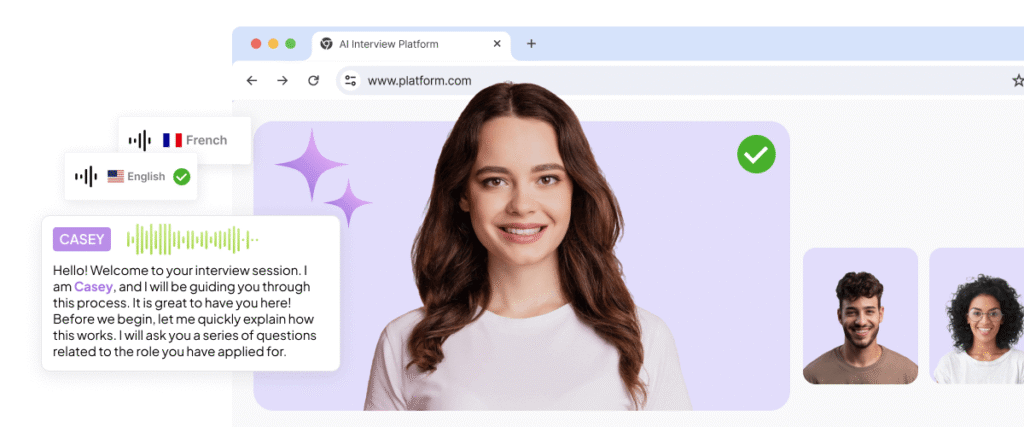
From an operational standpoint, agentic AI interviews allow organizations to conduct assessments at scale while ensuring that each candidate is evaluated against the same performance criteria.
Measurable Insights and Data-Backed Evaluation
One-way interviews generate structured digital records that support measurable evaluation. Every response is stored, time-stamped, and evaluated against defined competencies or job requirements. This transforms interviews from isolated conversations into analyzable information that can be reviewed, compared, and calibrated across hiring teams.
For HR leaders and talent acquisition teams, having access to this data leads to clearer and more confident hiring decisions. They can track interview completion rates, compare the quality of responses, and review scores across different candidates. Over time, teams can also connect interview performance with actual hiring results, such as who gets hired and succeeds in the role. This helps make evaluations and hiring decisions more accurate and consistent.
Bias Mitigation Through Standardization
Because pre-recorded and agentic AI interviews use consistent question sets and defined scoring frameworks, they create structural guardrails around evaluation. Each candidate is assessed against the same criteria and performance indicators, reducing vulnerability to individual judgements from informal or subjective live questioning. Recorded responses allow for secondary review and calibration, creating accountability in evaluation decisions.
Better Flexibility and Candidate Experience
Pre-recorded and agentic AI interviews improve the overall candidate experience by giving individuals greater control over how they present themselves. They can complete their interviews any time within a set time frame instead of logging in at a fixed, scheduled hour. This flexibility gives candidates control over when they participate, whether that is after work, on a weekend, or during a quiet moment in their day.
More importantly, flexibility can improve performance. By reducing time pressure and logistical stress, on-demand interviews create conditions where candidates can present their skills and experience more clearly and thoughtfully. Structured questions and defined response times give them space to think before speaking and give more complete, relevant, and well-rounded answers.
Why Does the Shift to Asynchronous Interviews Matter?
As hiring becomes more competitive and data-driven, the interview process itself must evolve to support business outcomes. The move toward asynchronous interviews reflects a deeper shift in how organizations think about speed, scale, fairness, and candidate expectations.
Hiring Speed as a Competitive Advantage
A hiring process that depends on back-and-forth coordination or limited interviewer availability can create bottlenecks that cost organizations strong talent. One-way interviews accelerate screening and reduce the time between application, evaluation, and decision.

When screening moves faster, recruiters can identify qualified candidates sooner, advance them quickly, and reduce overall time-to-hire. This speed does not just improve efficiency – it increases offer acceptance.
Talent Acquisition Becomes More Strategic
One-way interviews free recruiters from spending hours on repetitive conversations and shift their focus to stakeholder alignment, employer branding, workforce planning, and candidate relationship building.
This elevates talent acquisition from an administrative function to a strategic resource partner. When interactions are structured and scalable, recruiting teams concentrate on quality, long-term fit, and workforce forecasting.
More Reliable Hiring Decisions
Asynchronous interviews create digital records of responses, scoring, and evaluation criteria, strengthening documentation and audit readiness. This level of traceability supports internal accountability and protects organizations in regulated industries. When decisions are backed by structured evaluation data rather than informal impressions alone, hiring becomes more transparent and reliable.
The Future of Hiring Workflows
On-demand and autonomous interviews represent more than just a technological advancement; they signify a paradigm shift in the way organizations approach hiring. Embracing the flexibility and efficiency of on-demand interviews, it helps transcend geographical boundaries, streamline recruitment processes, and make more informed hiring decisions. With 99% of Fortune 500 companies already using some form of automated tool as part of their hiring process, one-way interviewing presents a valuable opportunity in shaping the future of recruitment.