


Jobma 2025 Year in Review
2025 was a defining year for hiring. As organizations transitioned towards skills-based evaluation and teams scaled their digital hiring ecosystem, Jobma continued to evolve – focusing on automation, accessibility, security, and a positive hiring experience.
Across industries and markets, hiring teams relied on Jobma to streamline screening and deliver fairer evaluations at scale. Throughout the year, we introduced powerful product updates, expanded integrations, reinforced security, and built a more intuitive experience for both candidates and recruiters. Our approach to AI remained grounded in ethical principles – reinforcing trust, reducing bias, and ensuring transparent, respectful candidate journeys.
But beyond features and automation, 2025 was a year shaped by people. Jobma supported thousands of candidates navigating an increasingly complex job market, offering flexibility, clarity, and a consistent sense of fairness – helping remove the delays and friction traditionally associated with early-stage hiring.
As we reflect on the past year, here’s how Jobma grew, adapted, and continued to strengthen its role alongside the broader HR tech landscape.
Customer Success & Platform Impact
2025 was a year defined by scale and meaningful outcomes for hiring teams. Across industries, Jobma helped teams reduce time-to-hire, cut operational effort, and improve evaluation quality. One of our enterprise customers achieved $1.8 million* in annual cost savings.
The estimated annual cost savings from automating one interview round with Jobma, which previously required the involvement of three interviewers, are factored in, along with reduced hiring time and an average hourly pay rate of $45 across the hiring team, including recruiters and hiring managers. Savings figures are estimates and may vary based on hiring volume, role type, and interview duration.Three features stood out as customer favorites. Pre-recorded interviews gave both candidates and recruiters the flexibility to engage on their own time. Seamless ATS integrations kept data flowing across hiring tools without manual effort. And for organizations hiring at scale for customer-facing and support roles, language proficiency assessments became a critical way to evaluate communication skills.
Candidate sentiment remained a clear strength. With a 90.20% candidate satisfaction score (cNPS) and an 80.7% interview completion rate, candidates consistently recognized Jobma for bringing clarity, convenience, and fairness to the application experience.
Jobma supported hiring at volume – it continued delivering outcomes rooted in efficiency, accuracy, and trust.
To put the year into perspective, we’ve visualized key 2025 metrics that reflect how Jobma was used.
| Interview completion rate** **Observed by Think Together |
Candidate satisfaction score | New Integrations added |
New coding languages |
| 80.7% | 90.20% | 14 | 11 |
| Most loved features Pre-recorded video interviewing ATS integrations Language proficiency assessments |
|||
Integrations
Switching between disconnected HR systems slows teams down, which can be frustrating, especially when they’ve been part of your workflow for years. That’s why Jobma continued investing to become a seamless part of the HR tech ecosystem. Throughout the year, we focused on building integrations to reduce manual work, eliminate data silos, and keep hiring teams inside the tools they already rely on.
Our goal wasn’t to change how recruiters work, but to remove the friction that slowed them down. This also meant expanding beyond core ATS connectivity. We integrated with ID verification, background screening, and other workflow tools.
These integrations shaped how Jobma fit into hiring teams’ daily workflow. For hiring teams, this meant simpler processes, fewer manual steps, and a consistent experience across platforms they already rely on. For enterprises, it meant scaling hiring confidently without compromising on compliance, data accuracy, or candidate experience.
New Integration Partnerships We Added in 2025:
Awards & Achievements
With millions of buyers depending on trusted review platforms to evaluate software, recognition from G2 and SourceForge reflects strong authority. Jobma earned multiple awards across both platforms – reflecting strong performance, consistent customer trust, and standout value in recruitment technology.
- G2 Spring 2025 – Momentum Leader
- G2 Spring 2025 – Grid Leader
- SourceForge Spring 2025 – Top Performer
- SourceForge Summer 2025 – Top Performer
These achievements underscore the impact Jobma delivered for customers throughout the year.
Where We Connected with the HR Community
It was also a year of meaningful conversations – with customers, partners, and peers across the industry. Our conference presence was guided by a few defining themes – AI governance, skills-based hiring, enterprise readiness, and the human impact of rapid change. These events shaped our roadmap and reinforced Jobma’s role in modern hiring workflows.
- SHRM, San Diego
- HR Tech Conference, Las Vegas
- Workday Rising, San Francisco
- SIA CollaborationX, Dallas
- Snowflake World Tour, Dallas
- NMSDC 2025, Miami
- Magnit Global Supplier Summit
From SHRM to HR Tech Conference, Workday Rising, and SIA CollaborationX, conversations consistently centered on moving AI from experimentation to execution, while maintaining transparency, compliance, and trust.
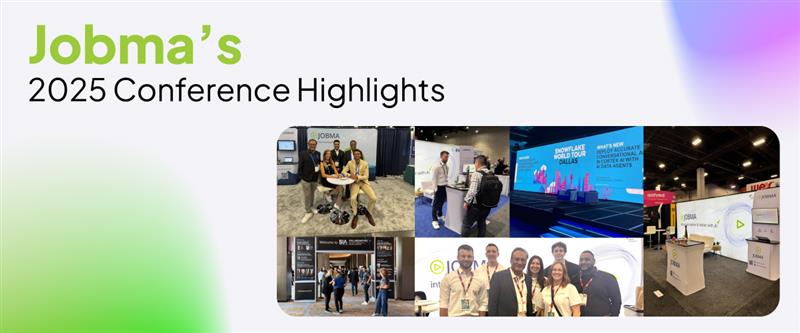
At the Snowflake World Tour, discussions reinforced the importance of secure, scalable data foundations as AI and analytics become core to hiring infrastructure. We spent time at NMSDC 2025 in Miami, where inclusive growth and supplier diversity highlighted the broader role hiring technology plays in expanding access to opportunity.
We also participated in the Magnit Global Supplier Summit, where staffing leaders and top suppliers shared insights on the future of the staffing industry, supplier excellence, and the growing role of artificial intelligence in workforce solutions.
Jobma’s Major Rollouts
2025 turned out to be one of Jobma’s strongest years yet. We shipped major platform upgrades, strengthened security, and stayed focused on one thing throughout – making hiring simpler for recruiters and fairer for candidates. Here’s a look back at the major rollouts.
Powerful Technical Assessments
As technical roles continued to evolve, hiring teams needed more accurate ways to evaluate real-world skills. In response, we enhanced Jobma’s coding assessments across both pre-recorded and live interviews, giving employers greater control over how technical ability is assessed before decisions are made.
To support role-specific evaluation, we strengthened Jobma’s coding assessments with a broader library of languages – including C, R, Ruby, .NET, Swift, TypeScript, Kotlin, Scala, Rust, Bash, and Dart.
Hiring teams gained more control with configurable test cases, customizable stubs at the interview-kit level, and enhanced real-time coding within live interviews. Recruiters could now observe how candidates think, debug, and problem-solve.
Autonomous AI Video Interviewing
We rolled out AI-assisted live interviews – a shift toward a more flexible, adaptive hiring workflow. Powered by Agentic AI, interviews can run autonomously, dynamically adjusting questions and follow-ups based on candidate responses. While recruiters retained full control with the ability to jump in at any time and seamlessly transition the session into a live conversation. This approach allows teams to manage high-volume hiring efficiently, maintain consistency, and capture deeper insights into candidate skills and problem-solving ability.
Employers can generate interview questions based on job titles, descriptions, and experience levels, then refine them to match specific requirements. Assessments are grounded in employer-defined keywords, keeping evaluations aligned with the role.
To support technical roles, we also introduced a dedicated feedback section for coding questions, giving recruiters deeper visibility into problem-solving ability beyond pass-or-fail outcomes.

Intelligent AI Assistant
Our AI assistant evolved into a true productivity co-pilot for recruiters, supporting interview scheduling, tracking, and report generation through natural language prompts and quick-action workflows. With fewer clicks and reduced navigation friction, teams were able to manage high-volume hiring with greater speed and clarity.
Fairness, Integrity, & Transparency
Protecting the integrity of the hiring process remained a core priority. Offline proctoring was extended to live interviews, ensuring that candidate activity and proctoring events are logged even during connectivity interruptions. Once sessions are reconnected, all data is automatically synced to the evaluation report, improving reliability and transparency.
ID Verification was also introduced, requiring candidates to complete government ID and selfie verification before interviews when enabled. This helps address growing concerns around impersonation and interview fraud, especially for teams hiring at scale.
To support transparency, Jobma’s AI assistant now explains the rationale behind skill ratings, highlighting behavioral and communication indicators so employers understand not just the score, but why it exists.
Game-based & Interactive Assessments
To make assessments more engaging, Jobma introduced game-based evaluations such as Memory Check, Sliding Puzzles, and Speed Sort, designed to test cognitive and behavioral skills in a science-backed, interactive format.
We also introduced flowchart-style questions, enabling visual and scenario-based assessments offer greater flexibility and interactivity, for functional and process-driven roles.
Raised the Bar on Security & Compliance
Jobma achieved ISO/IEC 27001 certification, reinforcing our commitment to global standards of privacy, security, and data protection. This certification is recognized globally as the gold standard for information security. Earning this represents a rigorous, independent validation of Jobma’s systems, controls, and risk-management practices – marking one of the most important milestones of the year.
Now, let’s dive into where the HR industry has been!
Highlights in the HR Industry
In 2025, HR teams were pulled into some of the fastest workplace shifts in decades – driven largely by AI acceleration, workforce fatigue, and rising expectations around fairness, transparency, and wellbeing.
AI Moved From Experiment to Infrastructure
AI adoption accelerated across hiring, onboarding, performance management, and analytics – shifting from a single rollout to layers of tools solving operational challenges. As adoption increased, HR teams took on larger roles: guiding responsible use, ensuring alignment with company values, and addressing questions around bias, transparency, and job design as part of everyday decision-making.
The Hiring Market Stayed Busy, But Cautious
Hiring volumes remained high in 2025, driven largely by replacement needs, skills shortages, and global expansion. But with economic uncertainty, organizations became more selective. This pushed skills-based hiring to the forefront, with employers prioritizing practical assessments, structured interviews, and real-world problem-solving over traditional credentials.
Candidate experience also emerged as a differentiator. With trends like job hugging reflecting workforce caution and burnout, candidates expect flexibility, transparency, and respect for their time.
Wellbeing Became a Business Metric
Employee mental health and well-being were redefined in 2025. No longer viewed as perks, but a core measure of organizational health. Burnout, disengagement, and anxiety showed up in engagement surveys, productivity, retention, and performance. Trends like quiet cracking highlighted deeper cultural strain, with younger generations pushing workplaces toward more human-centered environments where leadership behavior, communication norms, and daily experiences mattered as much as policies.
Trust, Fairness, and Accountability Took Center Stage
As hiring became more automated, trust became more fragile. Rising interview fraud, impersonation risks, and opaque AI decisions pushed employers to demand stronger safeguards. Identity verification, proctoring, explainable AI, and compliance-ready systems gained importance, especially for organizations hiring at scale or across borders.
By the end of 2025, it was clear that progress in hiring would be measured not just by speed or scale, but by how transparently and responsibly those gains were achieved.
Looking Ahead to 2026: Predictions
If 2025 was about rapid adoption, 2026 will be about control, coordination, and confidence.
Agentic AI Becomes a Core HR Capability
Agentic AI is expected to move from emerging technology to foundational infrastructure in HR and HCM platforms. These systems will increasingly manage multi-step workflows – screening candidates, coordinating interviews, generating insights, and adapting processes in real time.
But adoption will come with caution. Many organizations still lack the data foundations, governance models, and security guardrails required to deploy agentic AI responsibly. In 2026, success will hinge on human oversight, measurable performance benchmarks for AI systems, and clear accountability for outcomes.
Skills Intelligence Shapes Workforce Design
Skills-based hiring will evolve into skills-based workforce planning. Employers will focus less on credentials alone and more on the skills that matter for each role, understanding talent inventories, redeploying teams, and redesigning work. AI will increasingly handle routine tasks, allowing humans to focus on judgment, creativity, and complex problem-solving.
Job descriptions will become more fluid, assessments more contextual, and hiring decisions more tightly linked to real business outcomes.
HR and IT Become Operationally Interdependent
The line between HR and IT will continue to blur. As AI agents become embedded across the employee lifecycle, HR leaders will rely more heavily on IT for architecture, security, and integration. At the same time, IT will depend on HR to understand adoption, behavior, and human impact.
Rather than operating in silos, organizations will need shared governance models, aligned priorities, and platforms that bridge technical capability with people strategy.
Regulation and Compliance Set New Guardrails
The regulatory environment will grow more complex in 2026. Governments worldwide are introducing laws governing AI use in employment decisions, mandating transparency, risk mitigation, and human involvement. Compliance will no longer be a regional concern; it will be a global operational requirement. Notable examples include:
- Illinois: AI in Employment Decisions (HB 3773) – Effective Jan 1, 2026
- Texas: Responsible Artificial Intelligence Governance Act (TRAIGA) – Effective Jan 1, 2026
- California: FEHA Amendments for Automated Decision Systems – Fully applicable 2026
- Colorado: Colorado Artificial Intelligence Act (CAIA) – Enforcement begins Jun 30, 2026
- Ontario (Canada): AI Disclosure in Job Postings – Effective Jan 1, 2026
- New York City: Automated Employment Decision Tool (AEDT) Law – Active, under enforcement scrutiny
Organizations will need hiring platforms that support explainability, audit trails, secure data handling, and compliance by design, ensuring AI-assisted decisions remain accountable and defensible globally.
Conclusion
If there’s one takeaway for hiring leaders, it’s this – periods of rapid change create the greatest opportunity to build stronger, more resilient teams. AI moved faster than most teams expected, skills mattered more than titles, and trust between employers, candidates, and technology became non-negotiable.
As we look ahead into 2026, Jobma is looking forward to a new year focused on helping hiring teams navigate what’s next with confidence – embracing innovation, leveraging automation, upholding transparency, and balancing speed with fairness. We’re closing out the year grateful for our customers, partners, and the hiring teams who continue to push the industry forward, and we’re excited for the new year with renewed energy to help shape the future of hiring.