

Gen Z at Work: Trends, Expectations, and Challenges
A Generation Entering at a Turning Point in the Workforce
With Gen Z entering the workforce, we’re seeing a structural shift driven by technology. This transformation is reshaping how work is organized, what skills matter, and how careers unfold.
Economists and labor statisticians show that youth unemployment rates are elevated relative to the broader labor market but not unprecedented. In the United States, for example, youth unemployment was 10.8 percent in Jul 2025, compared with 4.3 percent for all workers, highlighting a persistent gap that reflects both demand and structural adjustment.
However, confidence among Gen Zs remains strong. In Randstad’s global survey, 79 percent of Gen Z workers say that they’re confident in their ability to acquire new skills rapidly, and 85 percent evaluate opportunities through the lens of long-term goals rather than compensation alone. Even Deloitte’s 2025 Gen Z and Millennial Survey confirms that younger professionals are deeply intentional about career growth, stability, and meaningful impact, priorities that counter the narrative of drift or entitlement.

Most companies still rely on traditional career ladders – slow promotions, long tenure, and rigid hierarchies. But Gen Z values speed, flexibility, digital skills, and meaningful work. For leaders, the solution is not to “manage” Gen Z differently; it’s to redesign talent systems so they match today’s workforce – one that rewards fast learning, adaptability, and strong digital capability.
The Early Career Redesign – A Shift to Skill-Based Roles
Randstad’s data shows that entry-level roles have declined by 29 percentage points globally, with junior technology roles down 35 percentage points and finance down 24 percentage points, while healthcare entry-level roles have increased by 13 percentage points. This variation tells us something important. The market is not shrinking – it is rebalancing toward roles that require either technical specialization or human-centric care delivery. Healthcare and human-centric sectors, where human judgment and interpersonal interaction are still difficult to fully automate, have shown resilience or even growth in early-career hiring.
Automation is absorbing repeatable junior tasks: documentation, reconciliation, basic analysis, and reporting. As Fortune recently highlighted, Gen Z faces one of the most competitive early-career landscapes in years, with AI accelerating the removal of routine work. But that does not eliminate opportunity. It eliminates low-leverage work.
What This Means Strategically
Early careers are moving from “earn your stripes through repetition” to “contribute through interpretation.” That requires:
- AI fluency
- Contextual judgment
- Cross-functional exposure
- Rapid skill acquisition
Organizations that redesign entry roles around interpretation rather than execution will extract more value from Gen Z faster. Those who cling to task-based ladders will struggle with both attraction and retention.
A Closer Look at the Competency Shift
Where once entry-level roles were defined by their low specialization and apprenticeship through repetition, new demands emphasize analytical judgment, digital literacy, and collaborative problem-solving. Today’s organizations seek candidates who can interpret AI outputs, synthesize insights across platforms, and communicate effectively in cross-functional teams, skills that machines augment rather than replace.
This shift mirrors the broader trends in global AI adoption. McKinsey’s latest report on AI in the workplace shows that 94 percent of employees and 99 percent of C-suite leaders are familiar with AI tools, indicating that digital fluency is the baseline expectation across the modern workforce.
Redesigning Career Pathways
Effective early career design now includes:
- Skill Acceleration: Roles structured around analytical problem solving and AI-augmented workflows rather than repetitive task execution.
- Adoption of AI: Training systems that teach employees how to use, validate, and complement AI tools to enhance productivity and quality.
- Cross-Functional Rotation: Programs that expose early career professionals to multiple business functions, accelerating strategic understanding and collaboration skills.
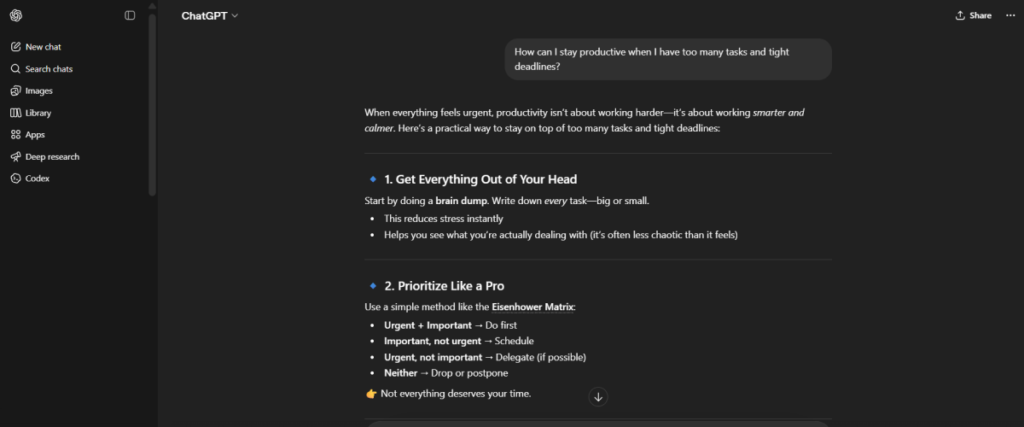
Prompt: How can I stay productive when I have too many tasks and tight deadlines?
Response: Start by prioritizing your tasks based on impact and urgency. Break larger tasks into smaller, manageable steps, and focus on one thing at a time. Use time-blocking or short work sprints to stay focused and eliminate distractions during those periods.]
Organizations that integrate these elements can turn what looks like compression of opportunities into compression of learning cycles, enabling young talent to contribute at higher value much earlier in their careers.
Ambitious, But Aware of the Job Market Challenges
Gen Zs show confidence in their capacity to learn and grow, with roughly 80 percent expressing rapid learning confidence, while simultaneously reporting stress and concern about job security. Applicants today navigate algorithmic screening tools, competency-based interviews, and real-time labor market comparisons. The margin for error is narrower, and feedback loops are more immediate.
SHRM’s analysis emphasizes that Gen Z expects employers to acknowledge structural pressures, particularly around mental health and job security. Deloitte’s survey further shows that financial anxiety remains prominent, with many Gen Zs expressing concern about cost of living and long-term economic stability. Another report by EY supports this proposition – it observes that about 51% of young people view physical and mental health as an important factor for future success. Yet these same individuals continue to prioritize career growth and learning. This coexistence of stress and ambition defines the modern early-career mindset.
Leadership Practices That Counter Anxiety
- Share Expectations About Skills: Clearly define what skills and competencies are needed for success in each role. When employees know exactly what is expected, it removes confusion and helps them feel more confident about their progress.
- Clear Career Progression: Show clear career paths with specific milestones for growth and promotion. This helps employees understand what they need to do next, reducing uncertainty and improving long-term retention.
- Ensure Access to AI Tools: Make sure employees have access to relevant AI tools, training, and resources. This ensures everyone can build relevant skills and keeps opportunities fair across the workforce.
Why Gen Z is Redefining Job Loyalty
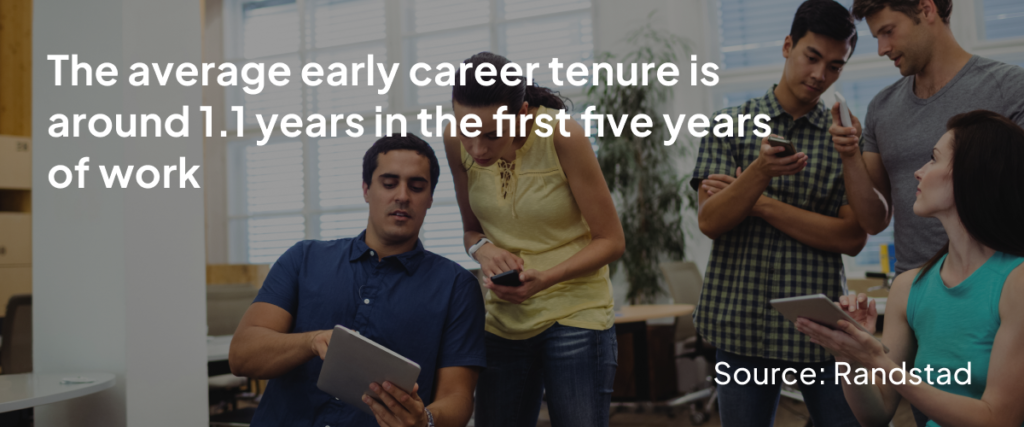
Conventional HR may equate tenure with loyalty. Gen Z is rewriting that equation. According to Randstad’s survey, average early career tenure is around 1.1 years in the first five years of work, alongside high job-hunting activity.
CNBC reports that Gen Z is reshaping return-to-office expectations, prioritizing flexibility, transparency, and alignment with organizational values. Deloitte’s findings show that younger workers are more willing to leave roles that do not align with long-term goals or well-being priorities. Mobility for Gen Z is not instability; it’s proactive career management.
Factors Driving Strategic Mobility
- Visible Progression: Access to clear progression paths reduces speculative job hopping.
- Pay Transparency: Clarity on compensation frameworks fosters trust and aligns expectations.
- Continued Development Opportunities: Investments in professional growth signal long-term organizational commitment.
These preferences are reinforced by broader workplace trends. A large proportion of Gen Z workers express a preference for hybrid or flexible work arrangements, which can be both a retention lever and a signal of organizational adaptability.

The Employer Perspective
Employers often view early mobility as a retention challenge, fearing that less tenure means less institutional knowledge and higher recruitment costs. To tackle employee attrition, retention strategies must shift from tenure incentives to trajectory incentives, rewarding learning, contribution, and cross-functional impact. Provide opportunities for lateral movements within the company. When people move between roles, they gain a wider understanding of the business, build stronger internal networks, and become more flexible across teams – all of which strengthen the organization overall. Compensation frameworks should be transparent and tied to measurable outcomes rather than implicit negotiation.
Technology as a Native Advantage
Gen Z is the generation that has had access to technology since their birth. The native fluency that comes from easily accessible technology, like the internet, cellular connectivity, social networking websites, online learning resources, etc., is becoming an enterprise asset as digital transformation accelerates across industries.
The data shows that a majority of young people already use generative AI in their work to some degree, which exceeds adoption rates among older cohorts. According to Deloitte’s global survey, about 57 percent of Gen Z respondents and a similar share of millennials reported using generative AI tools in their day-to-day roles. At the same time, a solid majority anticipate additional training in the near future. Another analysis finds that 55 percent of Gen Z use AI to problem-solve at work, while 75 percent use AI to learn new skills, both well ahead of older cohorts.
These usage patterns underscore two intersecting realities: Gen Z is early in the AI adoption curve, and access to AI tools is reshaping how they approach work.
Competitive Advantage Through AI Fluency
Many younger workers see AI as a productivity enhancer, enabling them to streamline repetitive tasks and focus on higher-value work. However, a substantial share also worries that GenAI could displace jobs or exacerbate skill mismatches. This duality reflects a sophisticated understanding rather than naive enthusiasm.
When companies make AI resources available to everyone – not just tech teams or data specialists – Gen Z’s comfort with technology turns into a real business advantage. Instead of seeing AI as something that replaces jobs, organizations can use it to help employees work smarter, faster, and more creatively.
Making AI skills common across the company does three important things:
- Task Optimization: Employees use AI to handle repetitive or time-consuming work, freeing them up to focus on higher-value thinking, decision-making, and collaboration.
- Skill Elevation: Workers learn how to question, verify, and interpret AI-generated outputs. This builds stronger critical thinking skills and reduces the risk of blindly trusting automated results.
- Innovation Acceleration: When more employees feel confident using AI tools, they are more likely to experiment, test ideas, and improve processes. This shortens innovation cycles and helps teams solve problems faster.
How Gen Z is Changing the Workplace
Gen Z is changing workplace norms in meaningful ways – and those changes are influencing the entire organization, not just their own generation.
Mental Health as Performance Infrastructure
Gen Z has normalized conversations about mental health in professional settings, not as optional “well-being extras” but as part of performance infrastructure. Supportive work environments, access to mental health resources, and empathetic leadership significantly enhance engagement and retention for young employees.
When organizations treat mental health as part of performance, not just an optional benefit, results improve. For example, adding well-being check-ins to regular performance reviews or including mental health goals in leadership KPIs sends a clear message that it matters. Companies that do this often see higher engagement, less burnout, and more stable teams.
Open Adoption of Digital Tools and Upskilling
Recent studies report that Gen Z adapts quickly to new platforms and collaborative technologies. Combined with Randstad’s AI usage findings, this creates faster experimentation cycles. Peer-to-peer upskilling becomes organic, reducing formal training costs and increasing agility.
Inclination to Purpose and Transparency
Gen Z workers place purpose and transparency at the center of employment decisions. They evaluate roles through long-term goals, ethical alignment, and workplace clarity. Firms that can articulate strategy, clarify career growth pathways, and demonstrate impact not only retain talent but also foster deeper engagement and discretionary effort.
Turning Purpose into Clear Action
High expectations around purpose and transparency can create frustration if a company’s strategy feels unclear or inconsistent. When employees hear strong purpose statements but don’t see them reflected in daily decisions, trust can weaken.
Leaders can prevent this by connecting big-picture purposes to clear, measurable actions. It’s not enough to talk about mission and values – organizations need to show how those ideas guide goals, performance metrics, and decision-making. When purpose is backed by visible systems and consistent behavior, it builds credibility. Gen Z is revitalizing workplace culture, but only organizations that systemically support these shifts will reap the benefits.
Faster Feedback Cultures
Gen Z expects regular feedback, not just annual performance reviews. Having grown up in a real-time digital environment – instant ratings, comments, and updates – they’re more comfortable with continuous input and course correction. This pushes organizations to move away from outdated annual review cycles toward ongoing performance conversations. Managers who adopt shorter feedback loops often see stronger alignment, fewer surprises, and quicker skill development. Continuous feedback also reduces disengagement because employees know where they stand and how to improve.
The broader impact is cultural. When feedback becomes normalized and frequent, teams become more adaptive and transparent. Problems surface earlier. Wins are recognized faster. Performance management shifts from evaluation to development.
Flexibility and Output-Based Performance
Gen Z has accelerated the shift from time-based work to outcome-based work. Rather than equating productivity with hours spent in an office, they focus on results, efficiency, and measurable impact.
This mindset forces organizations to clarify deliverables, define success metrics, and rethink rigid presenteeism norms. The result is more structured hybrid policies, clearer role expectations, and performance systems tied to outputs instead of visibility. When performance is measured by outcomes rather than presence, organizations often uncover inefficiencies and redundant processes, making flexibility a productivity strategy.
Higher Standards for Ethical and Responsible Leadership
Gen Z tends to evaluate employers based on values alignment, corporate responsibility, and transparency. They are more likely to research company practices, leadership behavior, and social impact before committing long-term. This scrutiny pushes organizations toward clearer governance, more responsible AI adoption, and transparent communication. Leadership teams are increasingly expected to explain not just what decisions are made, but why. Companies that respond with consistent action, not just messaging, strengthen employer brand, internal trust, and long-term resilience.
The Most Prepared Generation for a Tech-Driven Future
With most Gen Z workers expressing confidence in their learning capabilities, long-term career orientation, and engagement with technology, young employees are reshaping the future of work. AI usage is widespread, and digital fluency is becoming a competitive advantage. These are readiness indicators, not signals of failure.
Leaders who align organizational systems with Gen Z preferences, transparency, expectations, equitable access to training, and visible career progression will not struggle with this generation. They will scale with them.